- Eras
- Irish eraModern era
- Concepts
- agriculturesoilsvegetationeconomyenvironmentheritageModern eraIrish era
- Within
- Beaver Island archipelago
Summary
Farming on Beaver Island is best understood as an island food system rather than a single export industry. Families cleared and drained land, kept cattle and other stock, grew hay and oats, maintained orchards, preserved food for winter, and moved animals and supplies by boat. The work crossed into fishing, transportation, land tenure, and ecology: the same ferries that carried people also carried cattle, while former fields and orchards are now visible as old fields, homesteads, and habitat-management concerns.
The evidence does not support a continuous production series or a complete map of farms. It does support a sequence of documented fragments: a 1932 soil and fertilizer program, 1930s dairy-improvement associations, cooperative threshing in the early 1950s, later cattle ventures, and preservation attention to farm buildings and fields. Modern growers describe a renewed effort to reduce the island’s dependence on imported food. That is a current aspiration and practical project, not a claim that an earlier economy has returned unchanged.
Soil and land-use planning context
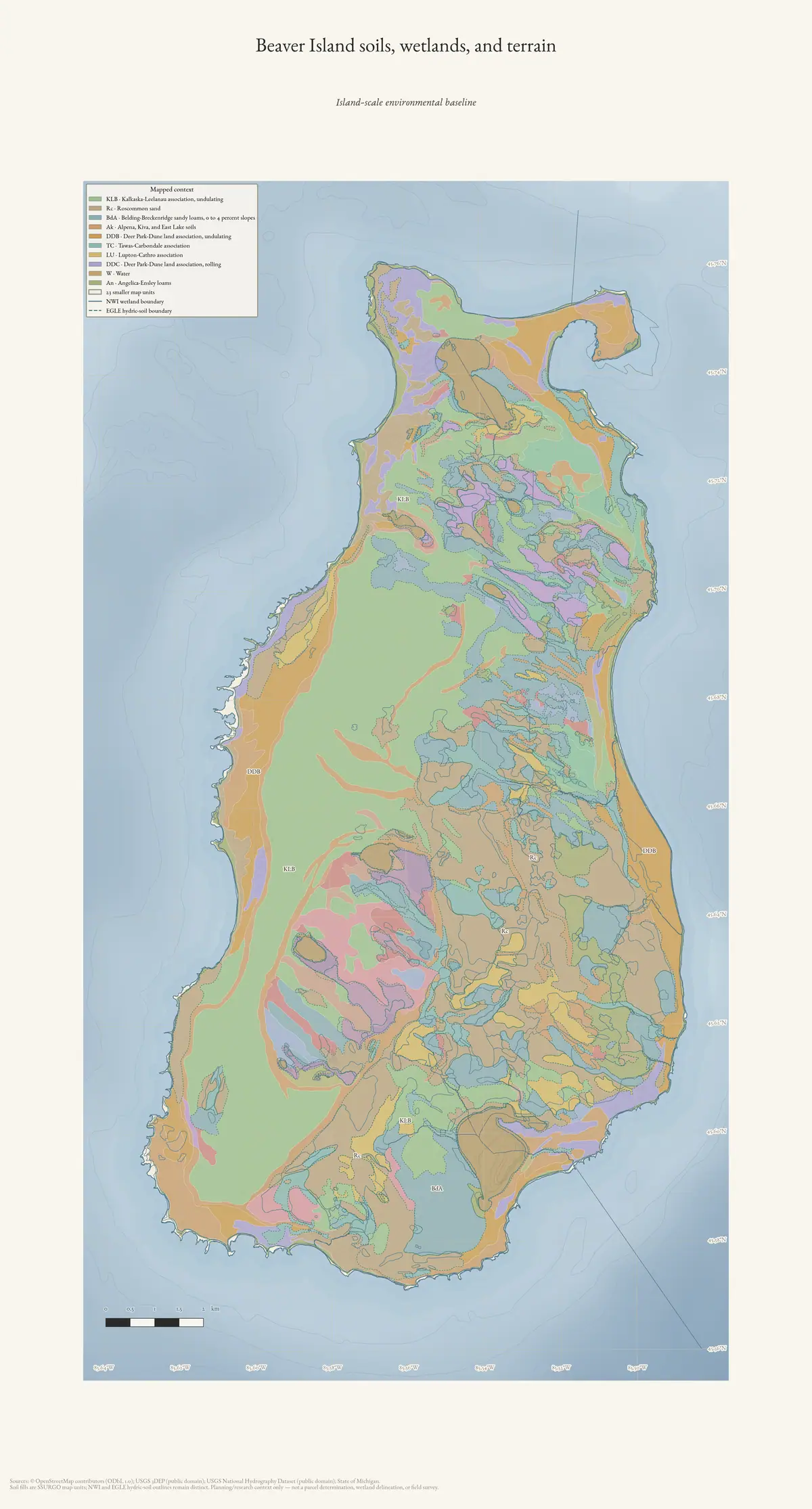
The Beaver Island planning natural-resource evidence crosswalk, 2017–2024 provides a modern planning counterpart to the 1932 soil experiments and the county soil survey. Its four generalized soil associations connect drainage, dunes, lake plains, moraines, wetlands, forest cover, slope, farming, and development. That vocabulary helps explain why farming was concentrated in particular landscapes, but the plans do not establish parcel-scale farm suitability or identify every historical field.
The associated Beaver Island Master Plan ecology map-plate evidence, 2017–2024 preserves the visual soil-association, slope, elevation, wetland, and dune plates. They should be read as the planners’ map frame and compared with the USDA and SSURGO layers, not substituted for those surveys or for field work.
The Seven-island ecology connectivity matrix, 2026 extends that comparison to all seven island frames, keeping soil and land-cover summaries next to tree, forest, vegetation, and physical-geology context. It helps identify landscape questions for farming history without turning mapped soil classes into parcel-level suitability findings.
The Hall–Varlet Part 91 soil-erosion application for Donegal Bay Subdivision lot 30, S-1972, 2025 is a useful counterpoint because it is not a farm record. Its Donegal Bay residential septic-field application names a forested steep dune, an open dune, and two on-site soil associations, while also recording proposed topsoil, seed, mulch, and silt-fence measures. It shows how modern land-use and erosion records can connect to the farming and altered-landscape themes without being misread as evidence of agricultural use or property ownership.
From household work to cooperative equipment
The local-history account of Beaver Island describes Joe Schmidt cutting oats with a three-horse team and a binder in mid-July, the cut oats left in shocks in the field to dry, then fed to a threshing machine operated by Lawrence Vesty and Bill Ricksgers, with straw blown into the barn loft and grain gathered from a lower pipe into buckets or burlap bags. The machine had been bought by Beaver Island farmers as a cooperative project and moved from farm to farm. Its authors place this in the early 1950s and say it was “only used for a few years” before farming lost its viability as a way of life. The record is detailed about technique and cooperation but gives no farm census, wage record, or precise end date.1
Earlier county reporting provides firmer dated snapshots. The 1932 soil work records sampling and planned alfalfa fertilizer trials on five farms. In 1937, four Shorthorn bulls placed in 1935 were reportedly serving island associations, with a planned rotation intended to avoid inbreeding. These notices establish extension and dairy-improvement activity; they do not show the trials’ outcome or quantify the island’s livestock. Contemporary newspapers now anchor Peiffer’s Orchard as a Beaver Island “fruit farm” by 1914, under the variant forms Peffer and Peiffer. A later BeaverIsland.Net account places it a mile east of East Side Drive near Kilty Point and says the owner followed Michigan Agricultural College advice that killed many trees and reduced the rest’s yield. That account gives no date, spray formula, correspondence, or experimental report. It also recalls apples going out by boat from the dock at Nomad.2 The 1978 Historical Map’s claim that this was a $55,000 farm producing only from 1919 is not adopted: the valuation is unverified and the 1919 beginning conflicts with the 1914 newspaper notice.
A May 2023 forum discussion adds a modern observation, not a correction to that history. A prospective horticultural worker described an old apple tree near Beaver Head Lighthouse and proposed future fruit and vegetable production for the farmers market. A former lighthouse caretaker recalled small reddish fruit from the tree, suitable for pies and sauce, but no one identified its variety. The exchange preserves local knowledge and a possible agricultural initiative; it does not establish a cultivar, orchard ownership, or a farm that was actually created.3
The earliest held regional agricultural attestation is not an island farm record. In 1816, Michillimackinac Indian agent William Henry Puthuff grouped Odawa communities at Cheboygan, L’Arbre Croche, the Beaver Islands, and Grand Traverse in an aggregate report of corn, potato, and vegetable production sold at Mackinac and to the fur trade. His 12,000-bushel figures apply to that whole named regional grouping; they do not establish a Beaver-Island farm count, acreage, or production total. Wisconsin Historical Collections, volume XIX, 1910
Farms, ferries, and changed landscapes
A Beaver Island Net local-history account locates the remains of Mike Burke’s farm west of the trails to the CMU cabins, on a 20-foot bluff on the island’s east side, and says the Irish settlers who first occupied that “flat and wet plateau” moved into a farmhouse the Mormons had abandoned at the time of their exodus. It supported Pat Burke’s family dairy operation until the beginning of the Second World War. Early in the 1900s, according to the same account, the Greene family (of the “White Dan” Greene farm) dug a drainage trench across the Burke farm to relieve standing spring rainwater in fields to the west; the Burkes believed the trench ruined their own fields and “bore a grudge for the rest of their lives.” The trench has since been filled in, and standing water still appears along the King’s Highway in spring. This is local memory, not a title record, and it describes one family’s farm rather than island farming generally.4
A separate passage on the same page describes island-wide practice, not the Burke farm specifically: until the Second World War, several island farms kept livestock, milked cows, and shipped cattle off once a year on a ferry reserved for that purpose, sometimes over two days. Sheep also went out in specially installed pens, though cattle were the main business. Animals were marked by ear cut rather than branded; sawdust went down on the ramp and in the boat to reduce slipping; and steers that broke free sometimes swam ashore and were not recaptured for weeks or months.4
The Don Burke Farm, a separate property in Section 14 of Peaine Township, was bought in September 1970 by Major Daniel J. Egbert, an annual visitor to his parents’ Sand Bay cottage, who intended to preserve its original barn “as an example of early pioneer farming.” The report gives the farm’s first recorded real-estate transaction as 1874 but says its actual beginnings were believed earlier, possibly connected to Strangite-era work in the early 1850s — a belief the source does not substantiate further. The same June–July 1970 preservation effort also named the older Bonner farm across the road from Dr. Protar’s home as a second site under consideration, without identifying which Bonner family member had owned or built it. Both notices are clues for future property-chain and agricultural-schedule work, not grounds to assign an unverified history to every old barn or field.
The related farming research dossier records the nine-source collection, evidence matrix, and timeline behind this survey. It makes the distinctions among extension reporting, local memory, state/ecological context, and current producer statements explicit.
The surviving landscape also needs careful reading. The state’s 2017 plan lists old homesteads and “Mormon fields” on Beaver Island, an old apple orchard at the former Indian Village on Garden Island, and an historical apple orchard and old fields on High Island. It identifies management concerns, not public archaeological locations; this archive does not publish public archaeological locations. MNFI’s 2024 guide similarly classifies crop lands, pastures, orchards, and old fields as human-altered uplands that can support or spread invasive species.
Cattle ventures and conservation programs at mid-century
Beaver Island also saw newer commercial livestock ventures alongside the older family dairy farms. In May 1960, a Beacon notice reported that Don Wielke and Perry Crawford, together with Bud and Lawrence McDonough, were “beginning to raise beef cattle” on the island; it gives no herd size, property, or later outcome.5 By December 1961, a venture the paper called the “Ponderosa of Beaver Island” had received 68 white-faced Hereford cows and one bull, shipped after almost two weeks of weather that had made boat transport impossible; the report does not name all the owners, identify the receiving farm, or record the herd’s later survival or growth.6
A different kind of record survives from 1974: an April notice describing Agricultural Conservation Service cost-share programs available to Beaver Island landowners and the Beaver Island Sportsman Club, covering tree planting, forest-stand improvement, and permanent wildlife habitat at 75 percent of cost, plus restored 1973 cost-share practices for woodland treatment and wildlife food plots at 50 percent. The notice names Pete LoDico, in Boyne City, as the program contact; it documents that the program was available, not that any island landowner applied, was approved, or completed the work.7 Read together with the 1932 and 1937 extension visits, it shows a federal and state advisory presence in island land use that outlasted household farming itself, shifting from crop and dairy improvement toward forest and wildlife-habitat cost-sharing.
Food resilience now
Lake Michigan Farms describes a contemporary local-growing initiative driven by limited fresh-food options and imported supplies, and reports microgreens sold at McDonough’s Market. The catalogued 2026 Apple Blossom Farm listing describes a proposed regenerative farm on a former agricultural property. These pages make the current conversation visible, but their figures and future plans remain the publishers’ statements. They should not be read back into the historical record.
Evidence and limits
This survey rests on three kinds of source that should not be blended: dated county-extension and Beacon notices (1932, 1937, 1960, 1961, 1970, 1974), which are contemporary but episodic and rarely record outcomes; Beaver Island Net local-history pages recalling the Burke and Pfeiffer farms and cooperative threshing, which preserve named detail but carry no publication date and are one family’s or author’s memory rather than a farm census; and current state, ecological, and producer sources (the 2017 MDNR plan, the 2024 MNFI guide, and Lake Michigan Farms), which describe today’s landscape and today’s stated intentions, not a historical production record. No source held here supports a continuous farm count, acreage total, or livestock census for any period, and no source here should be read as identifying a specific archaeological location.
Open questions
- Can agricultural schedules establish farm counts, crops, livestock, and value by township and decade?
- Which farms took part in the 1932 experiments and the 1935 dairy associations, and what did county-extension files report afterward?
- What ferry, market, or inspection records can test the cattle-shipping memory?
- Which former orchard and farmstead records can be published without exposing sensitive cultural-resource locations?
- Did the 1960 beef-cattle project or the 1961 Ponderosa of Beaver Island venture continue past their reported start, and what became of either herd?
- Was the Bonner farm’s original barn, or the Don Burke Farm’s, ever preserved, and does either survive today?
- Did any island landowner apply for the 1973–74 Agricultural Conservation Service cost-share practices, and what, if anything, was completed?
See also
- Commercial fishing
- Pre-settlement landscape and environmental history
- Don Burke Farm
- Bonner farm
- Lake Michigan Farms
- Beaver Island Game Club
- Beaver Island Net, “Burke’s Farm”
- Beaver Island Net, “Pfeiffer’s Orchard”
- Beaver Island Net, “The Farm Life”
- MDNR management plan for state-owned Northern Lake Michigan islands, 2017
- MNFI Natural Features of Beaver Island landowner’s guide, 2024
- Island farming and food systems research dossier, 2026
- Beaver Island Soil Survey and Planned Alfalfa Fertilizer Experiments in 1932
- Beaver Island Bull Clubs and Dairy Improvement Visit in 1937
- Beaver Island beef-cattle raising begins, 1960
- Ponderosa of Beaver Island receives 68 Hereford cows and a bull, 1961
- Purchase and preservation plans for the Don Burke Farm, 1970
- Beaver Island agricultural conservation cost-share notice, 1974
- Hall–Varlet Part 91 soil-erosion application for Donegal Bay Subdivision lot 30, S-1972, 2025
Footnotes
-
Beaver Island Net, “The Farm Life,” local-history page, circa 1999–2017,
data/websites/www.beaverisland.net/markdown/beaver-island-history/Historic_Sites/the_Farm_Life/the_farm_life.md. ↩ -
Beaver Island Net, “Pfeiffer’s Orchard,” local-history page, circa 1999–2017,
data/websites/www.beaverisland.net/markdown/Places/Pfeiffers_Orchard/pfeiffers_orchard.md. ↩ -
Beaver Island Forum discussion, “Fruit Explorer looking for employment with lodging,” May 21–29, 2023. ↩
-
Beaver Island Net, “Burke’s Farm,” local-history page, circa 1999–2017,
data/websites/www.beaverisland.net/markdown/Places/Burkes_Farm/burkes_farm.md. ↩ ↩2 -
Beaver Beacon, May 1960, “Steaks and Hamburgers,”
/data1/beaver-island-archive/ocr/beaver_beacon/markdown/1960-05_Beaver-Beacon.md. ↩ -
Beaver Beacon, December 1961, “Jordan River Farms,”
/data1/beaver-island-archive/ocr/beaver_beacon/markdown/1961-12_Beaver-Beacon.md. ↩ -
Beaver Beacon, April 1974, “Stabilization,”
/data1/beaver-island-archive/ocr/beaver_beacon/markdown/1974-04_Beaver-Beacon.md. ↩
Sources
- A participant discussed sandy soil, manure, heirloom seeds, and shared garden space; it documents local gardening knowledge and mutual aid, not a controlled agricultural study.forum · www.beaverislandforum.com · 05 · t005692
- A resident offered or sought house plants, including aloe, geranium, peace lily, and other ornamentals, with a warning that sea onion was not edible. This is a household plant exchange, not a horticultural inventory or botanical record.forum · www.beaverislandforum.com · 12 · t012799
- A resident sought garden soil; a reply recommended composted mulch from the transfer station, bagged topsoil, fertilizer, and a possible delivery. This is peer gardening advice and an informal material lead, not a soil test, transfer-station policy, or agricultural production record.forum · www.beaverislandforum.com · 13 · t013574
- A resident offered honey-crisp apples from a personal crop as they ripened. This is a small first-party local-food availability notice, not an orchard inventory, yield record, or market survey.forum · www.beaverislandforum.com · 13 · t013550
- A Saanen goat named Rosie was offered for rehoming with fence panels, hay, and a small shelter; a follow-up said she was still waiting for a home. This documents a small-livestock placement offer, not a completed transfer, herd, breeding outcome, or agricultural census.forum · www.beaverislandforum.com · 14 · t014733
- A resident seeking winter shelter for farm animals and feed considered buying a shipping container but said the seasonal shipping window had passed. This documents a farm-infrastructure need and logistics constraint, not a completed purchase, livestock operation, or zoning record.forum · www.beaverislandforum.com · 14 · t014893
- A never-connected plastic rain barrel was offered for sale. This indicates household interest in rainwater-management equipment, not an installed collection system, potable-water use, or agricultural production.forum · www.beaverislandforum.com · 18 · t018597
- A user sought three-point implements for brush cutting, grading, back-blading, or plowing. This is an equipment-demand signal potentially related to land maintenance or small-scale agriculture, not evidence of farm production or a completed acquisition.forum · www.beaverislandforum.com · 18 · t018519
- A gardener reported rabbit damage to several bean types and sought surplus seedlings from other gardens. This is household-scale garden evidence and an informal exchange request, not a production or wildlife-abundance statistic.forum · www.beaverislandforum.com · 18 · t018478
- A resident planned to raise three chicks and seek homes for them before leaving the island in October. This is a household-scale animal-care plan, not evidence of a farm, flock size, breed, or completed placement.forum · www.beaverislandforum.com · 18 · t018221
- A resident sought fencing to use as a trellis, reported obtaining one, and received additional offers of fence sections and cattle panels. This is evidence of household-scale growing/support-material demand and reuse, not proof of a farm, crop, livestock, or production volume.forum · www.beaverislandforum.com · 17 · t017821
- A resident sought two T-posts and received an offer of T-posts and cattle panels. This documents a small materials need that may support household gardening or fencing, but does not establish agricultural production or a completed transfer.forum · www.beaverislandforum.com · 17 · t017824
- A seller offered a quantity of composted, blended black dirt for landscaping or soil improvement; a participant asked about availability and the seller later supplied a contact number. This is a local soil-material offer, not evidence of crop production, soil testing, or sale volume.forum · www.beaverislandforum.com · 17 · t017770
- A resident sought a bale of hay. This is a single livestock or household-provisioning request, not evidence of a farm, animal population, hay production, or completed purchase.forum · www.beaverislandforum.com · 17 · t017227
- A seller announced a grass-finished steer already at the butcher and offered whole- or half-steer shares at $4.25 per pound of hanging weight, including butcher fees. This is a single local sale notice, not a livestock census, production measure, or independently verified price record.forum · www.beaverislandforum.com · 16 · t016296
- A prospective resident described operating a small commercial farm and cidery and asked about island farming, grazing land, and old apple trees; a participant referred him to agricultural engineer Roy Elsworth. This documents a prospective agricultural connection and community referral, not a farm establishment, land transaction, or complete list of island farms.forum · www.beaverislandforum.com · 00 · t000510
- A resident asked whether anyone on Beaver Island had Buff Orpington hens or a rooster for sale. This is a single poultry-seeking request and possible local-breeding signal, not evidence of a flock, sale, breed presence, or island-wide agricultural production.forum · www.beaverislandforum.com · 16 · t016587
- A resident sought to borrow a cider press for three weeks after the expected press became unavailable. This is a seasonal food-processing request and evidence of local equipment sharing, not proof of cider production volume, orchard output, or a completed pressing.forum · www.beaverislandforum.com · 16 · t016769
- Project-generated Beaver Island Master Plan natural-resource evidence crosswalk, 2017–2024.Described in this archive: Beaver Island planning natural-resource evidence crosswalk, 2017–2024.Adds the plans’ dated soil-association, drainage, slope, wetland, forest, and land-use vocabulary for comparing farming constraints and altered landscapes without making parcel-scale suitability claims. No public copy of this file is known; the archive holds one and can provide it on request.research · island_governance · master_plan_natural_resource_evidence_2017_2024
- Project-generated Beaver Island Master Plan ecology map-plate evidence index, 2017–2024.Described in this archive: Beaver Island Master Plan ecology map-plate evidence, 2017–2024.Preserves plan-page soil-association, slope, elevation, wetland, and dune plates as planning evidence, not parcel-level agricultural suitability or legal constraints. No public copy of this file is known; the archive holds one and can provide it on request.research · island_governance · master_plan_map_plate_evidence_2017_2024
- Project-generated seven-island ecology connectivity matrix (2026).Described in this archive: Seven-island ecology connectivity matrix, 2026.Provides island-level soil, land-cover, forest, vegetation, and physical-geology context for comparing farming landscapes across the archipelago; it is not parcel suitability analysis. No public copy of this file is known; the archive holds one and can provide it on request.research · island_farming · crosswalks · archipelago_ecology_connectivity_matrix_2026
- Described in this archive: Hall–Varlet Part 91 soil-erosion application for Donegal Bay Subdivision lot 30, S-1972, 2025.Residential septic-field application at Donegal Bay Subdivision lot 30. It contributes site-specific soil, dune, vegetation, and erosion-control evidence, not agricultural use, ownership, or completed-work evidence.governance · township_meetings · documents · st-james-planning · s-1972-hall-varlet-number-2-soil-erosion-pdf-933b263de8
- Described in this archive: Beaver Island Net, “Burke’s Farm”.Retrospective account of a dairy operation, cattle shipping, and altered drainage; not a parcel or herd ledger.
- Described in this archive: Beaver Island Net, “Pfeiffer’s Orchard”.Retrospective orchard account; claims about agricultural advice are retained as local memory.
- Visitors and participants described finding old apple trees near Protar’s Cabin and along Hannigan’s Road, and named “Snows” as a possible apple variety. These are informal observations without ownership permission, cultivar confirmation, orchard boundary, or agricultural-management evidence.forum · www.beaverislandforum.com · 00 · t000468
- Described in this archive: Beaver Island Net, “The Farm Life”.Describes cooperative threshing and farming’s early-1950s loss of viability.
- Described in this archive: MDNR management plan for state-owned Northern Lake Michigan islands, 2017.Institutional record of old homesteads, fields, and former orchards as management concerns.research · island_farming · mdnr_northern_lake_michigan_islands_plan_2017
- Described in this archive: MNFI Natural Features of Beaver Island landowner’s guide, 2024.Ecological treatment of crop lands, pastures, orchards, and old fields.research · island_farming · mnfi_landowners_guide_2024
- Project research record for the Beaver Island soil and alfalfa experiment cluster (1932).Preserves the 21 soil samples, five planned fertilizer trials, 0.1-acre plot design, named analyses, cooperating farmers, and explicit limits on results and locations. No public copy of this file is known; the archive holds one and can provide it on request.kb_research · beaver_island_soil_alfalfa_1932
- Current producer statement; its imported-food framing and planned initiatives are not historical measurements.research · island_farming · lake_michigan_farms_2026
- Reports Don Wielke and Perry Crawford, with Bud and Lawrence McDonough, beginning a beef-cattle operation; no herd size, property, or later outcome given. See event/beaver-island-beef-cattle-raising-begins-1960.data1 · beaver-island-archive · beaver_beacon · 1960-05_Beaver-Beacon
- Reports 68 white-faced Hereford cows and one bull arriving for the "Ponderosa of Beaver Island" venture after a weather delay; owners and receiving farm not fully identified. See event/beaver-island-ponderosa-cattle-arrival-1961.data1 · beaver-island-archive · beaver_beacon · 1961-12_Beaver-Beacon
- Reports Agricultural Conservation Service cost-share practices for tree planting, forest-stand improvement, and wildlife habitat available to Beaver Island landowners and the Sportsman Club; availability only, not applications or completed work. See event/beaver-island-agricultural-conservation-cost-share-1974.data1 · beaver-island-archive · beaver_beacon · 1974-04_Beaver-Beacon
- Reports Major Daniel J. Egbert's purchase of the 120-acre Don Burke Farm in Section 14, Peaine Township, its 1874 first recorded transaction, a belief in earlier Strangite-era origins, and Egbert's intent to preserve the original barn. See event/purchase-and-preservation-of-don-burke-farm-1970.data1 · beaver-island-archive · beaver_beacon · 1970-09_Beaver-Beacon
- Names an older Bonner farm across the road from Dr. Protar's home as a second site under consideration for preservation, without identifying the owner or builder. See structure/bonner-farm-1970-preservation.data1 · beaver-island-archive · beaver_beacon · 1970-06_Beaver-Beacon
- A prospective horticultural worker described an old apple tree near Beaver Head Lighthouse and proposed fruit and vegetable production for the farmers market. A former lighthouse caretaker described the tree’s fruit from memory as small, reddish, and useful for pies and sauce, while identifying the variety as unknown. The discussion is an anecdotal observation and proposal, not a cultivar identification, orchard survey, or evidence that the proposed farm was established.forum · www.beaverislandforum.com · 17 · t017714
- Beaver Island Archive, *Beaver Island soils, wetlands, and terrain* — plate drawn by this project. CC BY 4.0 for the drawing; underlying data under its own terms (see credit)Soils, wetlands and terrain at island scale - SSURGO map units with NWI and EGLE hydric-soil context and 3DEP terrain - which is the ground any farming here had to work with. It is a modern survey, not a record of what was cultivated or when. Credit: Drawn from the archive's own data in EPSG:3078. Map data © OpenStreetMap contributors (ODbL 1.0); SSURGO soils, USFWS National Wetlands Inventory, Michigan EGLE hydric soils, USGS 3DEP, and National Hydrography Dataset (public domain). No public copy of this file is known; the archive holds one and can provide it on request.output · maps · environment · beaver-island-environment
- A participant connected urban food-forest discussion to island farmers-market and local-food efforts, naming several community participants. It documents an exploratory economic-development conversation, not a confirmed food-forest project or job count.forum · www.beaverislandforum.com · 04 · t004638
- A participant announced the start of spring sap collection and encouraged islanders to set spiles and a fire pit. It documents seasonal community knowledge, not production quantities or a commercial operation.forum · www.beaverislandforum.com · 04 · t004612
- A participant shared an external farm video/article as inspiration. It is comparative agricultural discussion, not evidence of Beaver Island farming practice.forum · www.beaverislandforum.com · 03 · t003268
- A participant discussed spring maple sap collection. It documents seasonal knowledge, not production quantities or a commercial operation.forum · www.beaverislandforum.com · 03 · t003237
- A farm-market notice listed locally available vegetables, berries, herbs, flowers, and other produce. It is first-party seasonal promotion, not an audited harvest or sales record.forum · www.beaverislandforum.com · 02 · t002574
- A forum notice promoted the Beaver Island Gardens and farmers market. It documents a seasonal food-system outlet, not verified producer participation or market volume.forum · www.beaverislandforum.com · 02 · t002591
- A Beaver Island Gardens notice offered fresh asparagus, homemade grape juice, and reservations for orders. This is first-party seasonal promotion, not an audited harvest or sales record.forum · www.beaverislandforum.com · 02 · t002409
- A first-party notice listed perennial plants, shrubs, berries, and planters for sale at Beaver Island Gardens. It documents a seasonal horticultural business offering, not inventory or transaction totals.forum · www.beaverislandforum.com · 02 · t002381
Added 1 August 2026 · revised 7 August 2026. Recent changes
Cite this article
Beaver Island Archive, “Island farming and food systems”, https://beaverislandarchive.org/themes/island-farming-and-food-systems/, accessed [date], citing Beaver Island Forum, "Garden plot 2013", November 2012, topic 5692. (and 44 further sources listed on the page).
Last revised 2026-08-07. Fill in [date] with the date you read it — this page is static and cannot know that.
BibTeX for “Island farming and food systems”RIS for “Island farming and food systems”