- Eras
- Irish eraModern era
- Concepts
- irish-arranmoreheritagecommunitymigrationhistoriography
- Within
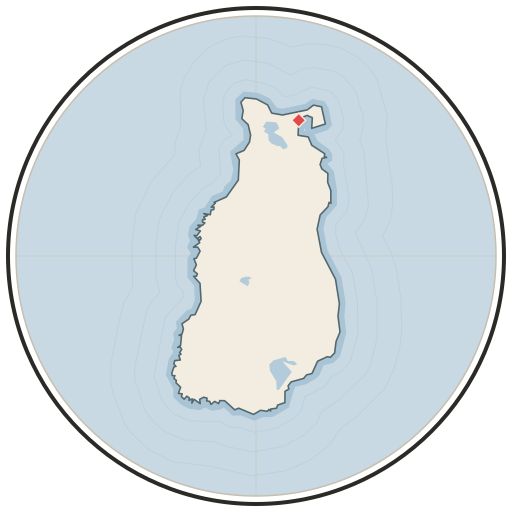
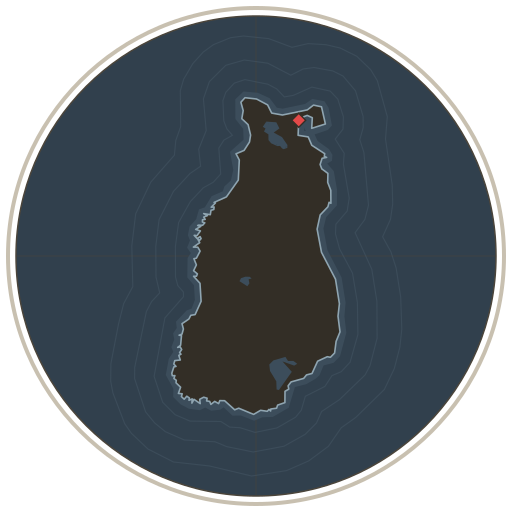
- Beaver Island
Summary
The sources held here describe an Irish community on Beaver Island shaped by migration from Arranmore (Árainn Mhór, County Donegal), fishing and farming, Catholic institutions, Irish language, and sustained contact with Anishinaabe, Mormon, German, and other neighbors. Ancestry and a later heritage label do not account for it. The Notre Dame archaeological project approaches that history as ethnogenesis: identities were “defined and solidified through contact with other peoples”, made and remade through material life and social interaction rather than carried unchanged from Ireland.1
Language evidence
The strongest local evidence currently held is a combination of a public historical marker, a Notre Dame research poster based partly on oral histories, and later community accounts. The Holy Cross marker states that after the 1856 expulsion of the Mormons “many Irish families settled on the island. To serve this community, liturgies were given in the Gaelic language until the 1890s.”2 Keating’s poster says “The Irish language was utilized in daily conversations, mass and confessions, and for conducting the business of the island”, and reports that “Father Peter Gallagher, pastor on Beaver Island for many years, said the Mass in Gaelic” — both attributed on the poster to Paul Connors’s 1999 Loyola dissertation, which is not held here.3 These sources support the claim that Irish language survived materially and institutionally on the island; they do not provide a complete speaker census or a continuous audio record.
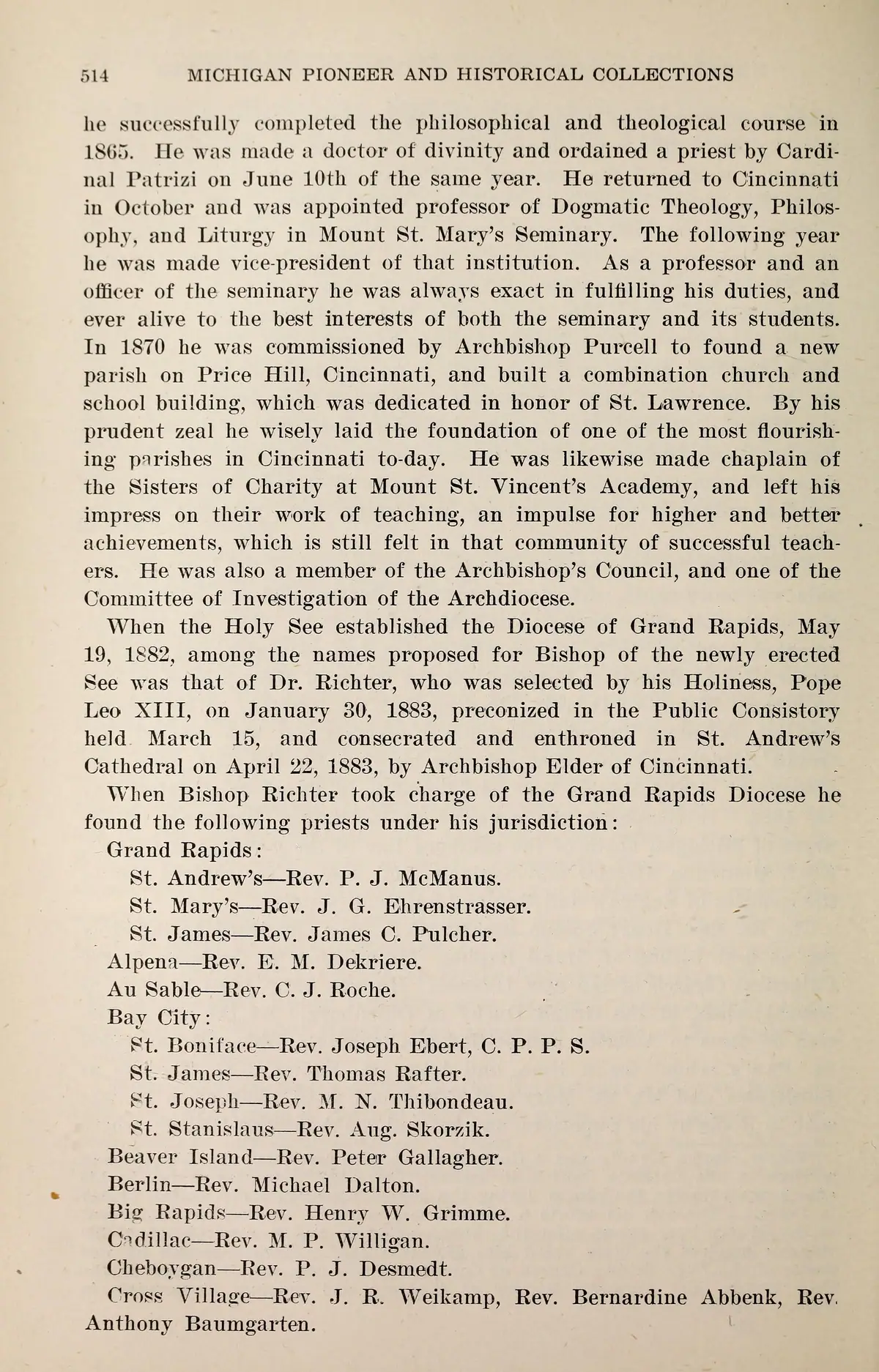
A priest of that name is independently attested for the island in a diocesan roster: Rev. Robert W. Brown’s list of the clergy Bishop Richter found under his jurisdiction on taking charge of the new Diocese of Grand Rapids in 1883 gives “Beaver Island—Rev. Peter Gallagher.”4 The roster names him and nothing more — it states no parish, no dates of service and no language — so it corroborates that a Fr. Peter Gallagher served the island, not the Gaelic-Mass account, and it is not by itself grounds for identifying the two men.
The poster also links language change to the arrival of the Beaver Island Lumber Company in 1903 — Irish “continued to be the dominant language on the island until” that year — and reports that “The last native Irish speaker is believed to have died in 1979”, crediting both to Rotman.3 Rotman’s own research design says only that the company “altered the cultural landscape by bringing an influx of foreign laborers in 1903”, citing Gladish 1976.1 Both dates are retained as attributed research findings. No interview transcript is held here, and no source found so far establishes either date independently, so neither is treated as a hard endpoint.
Archaeology and identity
Rotman’s research design describes excavations and archival/oral-history work at Irish immigrant homesteads, naming the Gallagher Homestead (20CX201), dug in 2010–2011, and the Daniel and Catherine Boyle Farm site (20CX204) on Barney’s Lake Road, dug in 2012.1 Its research question is not whether Beaver Island reproduced Arranmore unchanged; it is how people selected, adapted, and transformed traditions in a remote fishing community. That framing connects the Irish settlement event to the material record without turning a research proposal into a completed excavation result.
The held 2010–2011 technical report adds evidence that the fieldwork took place, at the publicly named Peter Doney Gallagher Homestead. Its authors report two July field seasons and an interdisciplinary program of archaeological, archival, and oral-history research. It does not provide a public coordinate or settle the cultural meaning of individual artifacts. See Notre Dame Gallagher homestead archaeological field seasons, 2010–2011.
The 2012 report documents the project’s separate Boyle Farm field season at 20CX204. It adds a second completed archaeological investigation to the held record, but its preliminary artifact discussion and site name do not establish family descent, land title, or a complete account of Irish identity. See Notre Dame Boyle Farm archaeological excavation, 2012.
Continuity and revival
The historical language record sits alongside later forms of cultural continuity: the 2000 Beaver Island-Arranmore twinning celebration, Holy Cross traditions, the modern community newspaper, and the music and folklore collections. These are related but not interchangeable kinds of evidence. A Gaelic speech at a twinning ceremony demonstrates public heritage practice; it does not prove the language remained the ordinary household language in the nineteenth century.
Open questions
- Which surviving oral-history recordings, parish records, and family papers document Irish-language use on the island, and who controls access to them?
- Can the 1903 language-transition claim be tested against dated school, church, workplace, and census records?
- Which archaeological features and artifacts from the Gallagher and Boyle sites are publicly documented, and how should they be connected to named families without overclaiming identity from material culture alone?
- How should Irish-language evidence be interpreted alongside Anishinaabe and mixed-community histories rather than as a replacement narrative?
See also
- Irish settlement of Beaver Island
- Beaver Island–Arranmore twinning celebration
- Holy Cross Catholic Church
- Holy Cross Cemetery
- Beaver Island Lumber Company
- Notre Dame Irish Stories technical report, 2010–2011 field seasons
- Notre Dame Irish Stories Boyle Farm technical report, 2012 excavation
- Notre Dame Boyle Farm archaeological excavation, 2012
- Music and folklore
- Anishinaabe presence in the archipelago
Footnotes
-
Deborah L. Rotman, Ethnogenesis and Irish-American Identity on Beaver Island, Michigan: Revised Research Design, University of Notre Dame Archaeological Research Publication 12-01, dated 5 December 2013, “Statement of significance and impact”, “Previous excavations” and “Artifacts and architecture”. ↩ ↩2 ↩3
-
Michigan Historical Marker L2251, Holy Cross Catholic Church, St. James, Beaver Island — reverse text. Registered 2013, erected 2014. ↩
-
Maureen Keating, America’s Emerald Isle: Irish Language and Identity on Beaver Island, Michigan, University of Notre Dame research poster, “Introduction” and “Findings”. ↩ ↩2
-
Rev. Robert W. Brown, “Historical Sketch of the Diocese of Grand Rapids,” Michigan Historical Collections, vol. 38 (1912), p. 514. ↩
In the sources
Helen Collar (1911–1995) spent four decades transcribing Beaver Island census returns, parish registers, deeds and death records onto index cards, and recording what islanders told her. Clarke Historical Library publishes that work. It is a researcher's working file — what a record says, what she suspected, and what an informant remembered, often in the same paragraph — so what follows is what the archive holds, not what this archive claims.
Collar wrote a general account of this subject: Ireland — the townlands the island came from. A secondary account in her own words, cited as hers; where she names a source, cite that instead.
Four alphabetical pages (A–G, H–M, N–S, T–Z) on Irish origins, chiefly Arranmore and Co. Donegal.
Collar wrote a general account of this subject: Emigration and immigrant life. A secondary account in her own words, cited as hers; where she names a source, cite that instead.
Three alphabetical pages (A–C, D–M, O–Z) on the passage and on settling.
These are Collar's twentieth-century working notes. They preserve the language of her informants and of her period, including racial descriptions of Anishinaabe residents, and they are quoted verbatim because altering a transcription silently would be worse. See the register of dated records for what the parish registers record, and the editorial standards for what this archive will and will not turn a transcription into.
Sources
- A forum participant shared a Reuters link about vaccine delivery to Arranmore. Reuters is the stronger source for the underlying Irish event; the forum preserves Beaver Island-connected interest in Arranmore and cross-island media circulation, not evidence about Beaver Island vaccination.forum · www.beaverislandforum.com · 16 · t016070
- A participant shared a humorous image described as coming from an Arranmore Facebook page. The attachment is evidence of Arranmore-related media circulation among forum users, not a verified Arranmore institution, event, or Beaver Island cultural program.forum · www.beaverislandforum.com · 15 · t015089
- A forum participant circulated a BBC Northern Ireland interview link concerning Arranmore’s Barney Gallagher. The BBC item must be consulted directly for its claims; the forum is evidence of Irish/Arranmore media circulation among Beaver Island-connected users.forum · www.beaverislandforum.com · 00 · t000281
- Forum participants shared and followed an Ireland newsletter link. This documents Irish-interest information exchange within the community, but does not establish the newsletter’s editorial claims or represent a formal island cultural program.forum · www.beaverislandforum.com · 00 · t000109
- Participants circulated contemporary news about the IRA and Northern Ireland peace process. The linked news reports are stronger for the underlying events; this thread documents local Irish-affairs media circulation, not an independent history.forum · www.beaverislandforum.com · 00 · t000399
- Participants discussed peace and the Irish Troubles, with personal political opinions and a deployed participant's comment about returning home. This is community discourse, not a verified diplomatic or military history.forum · www.beaverislandforum.com · 00 · t000388
- A participant circulated a media reference to Irish road bowling and connected the sport imaginatively to King's Highway. It documents Irish-cultural recreation interest, not an island event or a complete history of the sport.forum · www.beaverislandforum.com · 00 · t000475
- A participant shared an external page that mentioned Beaver Island in an Irish-travel context and invited St. Patrick's Day links. This records holiday and heritage-media circulation, not an official island celebration or verified history of the linked page.forum · www.beaverislandforum.com · 00 · t000547
- Participants circulated and discussed a National Geographic article about Celtic culture and Ireland's economy. The magazine article is the stronger source for its claims; the forum preserves local Irish-cultural media circulation and reaction.forum · www.beaverislandforum.com · 00 · t000538
- A participant circulated a long popular-history account of St. Patrick, Irish symbols, and St. Patrick's Day. It combines historical claims, legend, and cultural interpretation; scholarly, ecclesiastical, or primary sources are stronger for dates and biography.forum · www.beaverislandforum.com · 00 · t000837
- A participant linked a Wikipedia history of the Irish flag as a seasonal educational reference. The linked source is stronger for the flag's history than the forum, which records local circulation.forum · www.beaverislandforum.com · 00 · t000835
- A campaign notice used island community identity in political messaging; it documents campaign framing, not a neutral cultural account.forum · www.beaverislandforum.com · 05 · t005611
- The discussion advocated supporting island merchants and services; it documents participant sentiment, not an economic-impact study.forum · www.beaverislandforum.com · 05 · t005777
- A forum participant linked a Free Press article about Father Tony and added personal remembrance; the newspaper article is stronger evidence for its reported claims, while the forum preserves local reaction.forum · www.beaverislandforum.com · 05 · t005901
- The notice explicitly connected the diaspora gathering with preserving island music and identity; it documents organizers’ stated purpose, not an independently measured cultural effect.forum · www.beaverislandforum.com · 05 · t005888
- A playful participant discussion proposed “Boodle” language and referenced local speech traditions; it documents folklore and community wordplay, not a formal language or verified etymology.forum · www.beaverislandforum.com · 05 · t005941
- A playful thread about the Beaver Island Pirate’s philanthropic persona is folklore/community performance, not verified identity or philanthropy.forum · www.beaverislandforum.com · 05 · t005968
- A first-party notice previewed Irish-themed St. Patrick’s programming; it documents commercial cultural promotion, not a general measure of island identity.forum · www.beaverislandforum.com · 06 · t006025
- A forum relay linked an Irish Examiner article about island life; the linked publication is stronger evidence for its claims, while the forum records local circulation.forum · www.beaverislandforum.com · 06 · t006062
- A first-party St. Patrick’s notice advertised Irish food, music, and beer; it documents commercial cultural programming, not a general measure of island identity.forum · www.beaverislandforum.com · 06 · t006048
- A forum link relayed an MLive opinion piece about “Boodle”; the linked publication is stronger evidence for its claims, while the forum preserves local circulation and reaction.forum · www.beaverislandforum.com · 06 · t006759
- A participant asked whether anyone celebrated Passover and linked a song; the thread documents an individual community inquiry, not evidence of an organized congregation.forum · www.beaverislandforum.com · 07 · t007317
- A participant shared a future-looking account or link concerning Arranmore Island. The archived forum post is a community lead, not an official Arranmore planning, demographic, or twinning record.forum · www.beaverislandforum.com · 14 · t014223
- Research-design document for historical archaeology at 19th-century Irish immigrant homesteads. It frames identity as negotiation among Irish, Native American, Mormon, German, and other communities, and identifies material culture, foodways, built environments, archives, and oral histories as evidence. Its population percentages and period narrative are the authors' synthesis of cited sources, not raw census data held here.documents · rotman_2012_ethnogenesis_nd
- Poster based on archival material and oral-history interviews. It reports Irish use in daily conversation, Mass, confession, and island business, records Father Peter Gallagher's reported Gaelic Masses, and treats the 1903 lumber-company arrival and an alleged last native speaker in 1979 as research findings requiring attribution.documents · keating_americas_emerald_isle_poster
- Described in this archive: Notre Dame Irish Stories technical report, 2010–2011 field seasons.Held technical-report components document a completed 2010–2011 field investigation at the publicly named Gallagher homestead. They support the project’s methods and fieldwork context, not a complete identity history or artifact interpretation.documents · nd_irishstories · 2011
- Described in this archive: Notre Dame Irish Stories Boyle Farm technical report, 2012 excavation.Held report documents the 2012 Boyle Farm field investigation, preliminary artifact analysis, and project outreach. It is evidence of the research program, not a complete interpretation of Irish identity or site materials.documents · nd_irishstories · 2012 · 2012-Front-pages
- Marker text says many Irish families settled after the 1856 expulsion and that parish liturgies were given in Gaelic until the 1890s; it is a public marker, not a complete language census.state · michigan · historical_markers
- Documents Gaelic speech and the living civic connection to Arranmore at the 2000 twinning celebration; it is modern community evidence, not proof that historical language claims are complete.web · twinning_2000_beaverisland_net
- Described in this archive: Michigan Historical Collections, volume 38, 1912.The 1912 diocesan roster lists “Beaver Island—Rev. Peter Gallagher” in the context of Bishop Richter’s 1883 assumption of the new diocese. It supplies Catholic institutional context for the separately reported Irish-language Mass tradition, but does not identify this priest with that later account or itself mention Gaelic.
- A participant relayed a Boyne City Gazette article about Irish heritage and St. Patrick’s Day activity involving Beaver Island and Boyne City. The quoted forum text is secondary and copied without permission; the newspaper remains the source to verify.forum · www.beaverislandforum.com · 04 · t004687
- A Shamrock notice used an Irish Christmas greeting and advertised Irish holiday food alongside a Community Center performance. It documents public Irish-cultural presentation in 2011, not broader language use across the island.forum · www.beaverislandforum.com · 04 · t004411
- A first-party restaurant notice advertised Irish-themed food and drinks. It documents commercial presentation of Irish identity in late 2011, not broader cultural participation.forum · www.beaverislandforum.com · 04 · t004342
- A Community Center notice promoted an Irish music performance and a discounted Beaver Island Community School student rate. It documents advertised access to Irish cultural programming, not attendance.forum · www.beaverislandforum.com · 04 · t004077
- A restaurant notice linked a ticketed Makem and Spain Brothers performance to a dinner promotion. It documents commercial tie-in to cultural programming, not event outcome.forum · www.beaverislandforum.com · 04 · t004076
- A Homecoming-week notice listed Irish traditional band Goitse alongside island cultural programming. It documents advertised Irish-linked performance, not attendance or broader cultural impact.forum · www.beaverislandforum.com · 03 · t003871
- A Shamrock notice promoted Michael Beans Gardner and Rigormortis during Homecoming. It documents advertised music programming, not event outcome.forum · www.beaverislandforum.com · 03 · t003890
- A notice advertised Irish music at Danny’s Pub. It documents commercial cultural programming, not attendance or broader language use.forum · www.beaverislandforum.com · 03 · t003726
- A first-party notice listed summer music programming including Irish-themed entertainment. It documents advertised cultural programming, not attendance.forum · www.beaverislandforum.com · 03 · t003519
- A notice invited an English-themed tea event. It documents social-cultural programming, not broader identity history.forum · www.beaverislandforum.com · 03 · t003381
- A notice advertised St. Patrick’s weekend games and activities. It documents planned cultural celebration, not attendance or results.forum · www.beaverislandforum.com · 03 · t003273
- A restaurant notice advertised ethnic-themed food. It documents commercial cultural presentation, not broader identity history.forum · www.beaverislandforum.com · 03 · t003161
- A participant circulated the National Archives of Ireland's newly online 1911 census and connected it to Donegal genealogy research and the island's Aran-linked settlers. The official census archive is stronger for census data; the forum documents a local genealogy research lead and contemporary access to it.forum · www.beaverislandforum.com · 01 · t001684
- A participant circulated a buy-a-brick appeal for the Aranmore community center. This is evidence of an active Beaver Island–Aranmore civic and cultural connection, while the linked Aranmore site is stronger for the center's project details and any contribution outcome.forum · www.beaverislandforum.com · 01 · t001358
- A participant announced Thomas Burke's planned visit and linked him to a documentary about Beaver Island and Arranmore/Aranmore struggles with landlords. The forum establishes local circulation and intended hospitality; the documentary and contemporary reporting are stronger for Burke's identity and the film's claims.forum · www.beaverislandforum.com · 01 · t001388
Added 31 July 2026 · revised 3 August 2026. Recent changes
Cite this article
Beaver Island Archive, “Irish language and identity on Beaver Island”, https://beaverislandarchive.org/themes/irish-language-and-identity/, accessed [date], citing BMcCaw, "Arranmore Vaccine Drop," Beaver Island Forum, March 11, 2021, topic 16070. (and 44 further sources listed on the page).
Last revised 2026-08-03. Fill in [date] with the date you read it — this page is static and cannot know that.
BibTeX for “Irish language and identity on Beaver Island”RIS for “Irish language and identity on Beaver Island”