- Founded
- 1902
- Dissolved
- 1915
- Coordinates
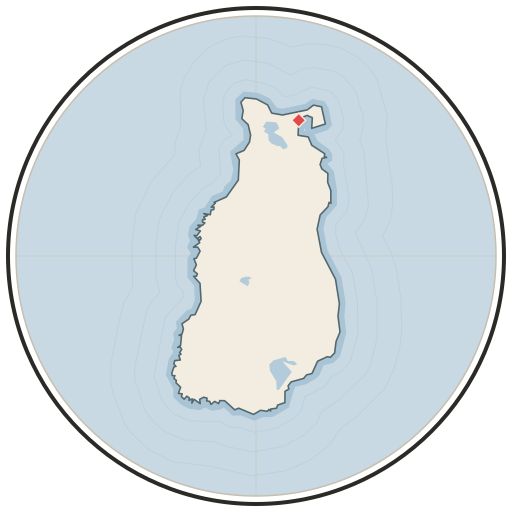
- 45.7501° N, 85.5095° WGoogle Maps: Beaver Island Lumber CompanyDownload KML
- Eras
- Lumbering eraIrish eraModern era
- Concepts
- lumberingeconomyforestslumber-workforce
- Within
- Beaver Island · Saint James
- Media
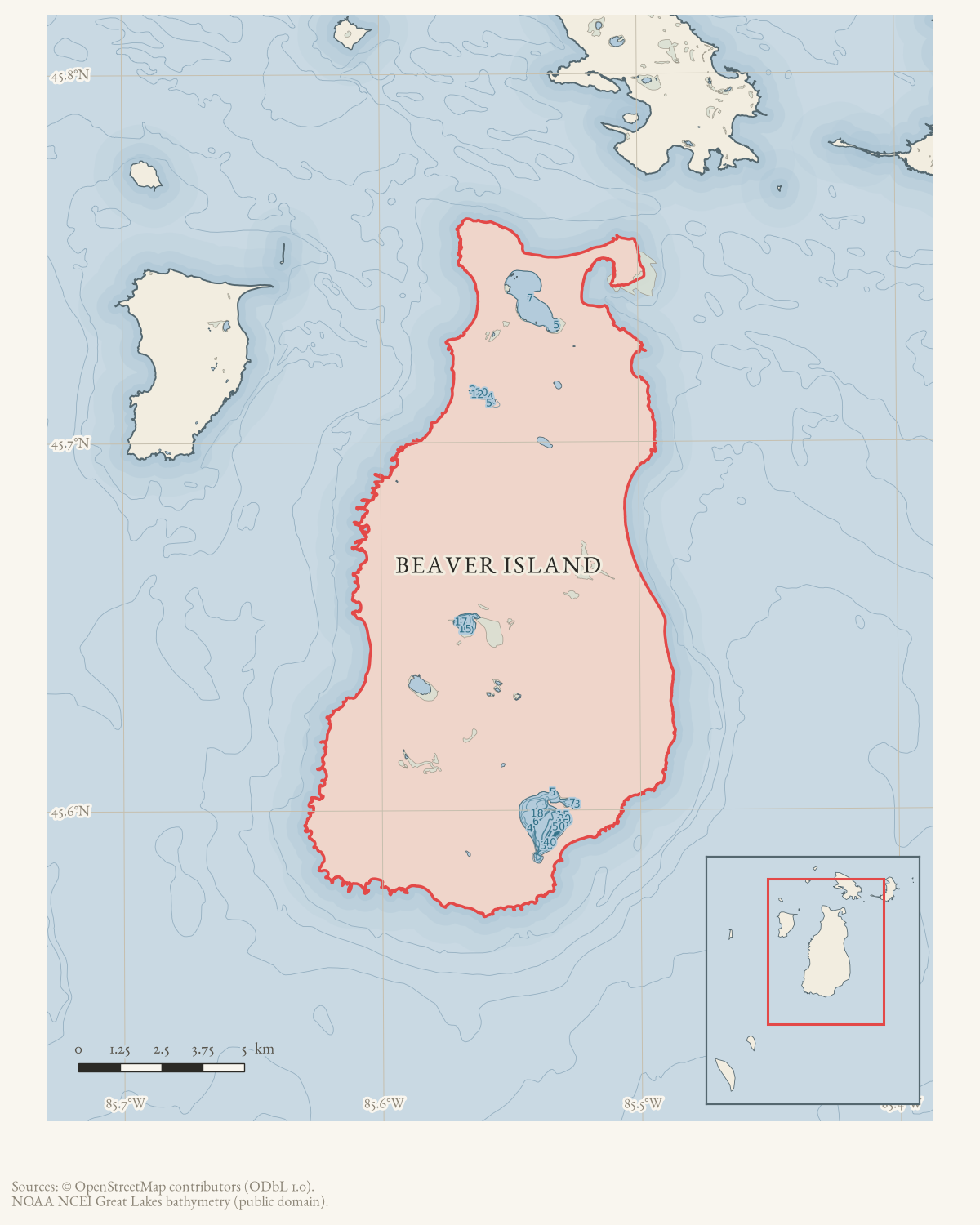
- Beaver Island History Map, 1978 revision
Summary
The Beaver Island Lumber Company was the archipelago’s large industrial timber operator of the early twentieth century, cutting timber at the head of Beaver Island and moving it by narrow-gauge railway to a sawmill and lath mill at Saint James. A project research ledger records an archival chronology of organization on 27 December 1902 and operations beginning 19 June 1903; contemporary county newspapers document the company by name from 1907, and its company store, sawmill, and rail-fed mill system are independently attested through 1913. A contemporary 15 October 1914 report says the company had closed all lumbering operations and was selling its movable property; a 1973 local retrospective places the company-store sale on 15 May 1915. The production shutdown is therefore well dated, while the date of legal dissolution or final departure remains unresolved, so that distinction is recorded here as contested. Named individuals recur in the held record as employees rather than owners: the Stephens family ran the company store, William Belfy piled lumber and loaded vessels from 1912, Herman Fischner and Fr. Scheid’s father worked for the company in other capacities, and an unnamed engineer was killed in a train derailment during the company’s operating years.
History
A project research ledger citing a Clarke Historical Library chronology records the company organized on 27 December 1902 and beginning operations on 19 June 1903; a 1973 Beaver Beacon retrospective independently places the company’s purchase of the future McDonough’s Market property at 16 May 1903, close to that operating date, and states it built a bunkhouse, stables, warehouse, homes and company store there. A December 1932 Charlevoix Sentinel retrospective, reprinting an earlier report, describes the company as incorporated with $75,000 capital and planning extensive island timber operations including a six-mile railroad.
On 15 October 1914 the Charlevoix Sentinel reported that timber scarcity had caused the company to close “all lumbering operations” and begin selling its movable property. The report inventories approximately fifteen miles of narrow-gauge railway, two locomotives, a fine dock, and extensive real estate. This is direct contemporary support for the 1978 History Map’s 1914 endpoint for the mill-and-railroad operation. The company’s sale of its store on 15 May 1915 and later remembered 1916 or 1917 “departure” dates can describe property disposal and winding down without extending lumber production beyond 1914.
Contemporary county newspapers document the company operating by name from 1907: the Charlevoix County Herald reported that August that contractors Irwin McGowan and John Burney were going to the Beaver Islands to conduct the company’s lath mill, and a March 1909 county poor-board report records that James Rosenberger broke his leg at one of the company’s camps and became a public charge. A May 1908 county poor-board bill separately lists Beaver Island Lumber Co. merchandise supplied to a county charge, evidence the company appears in Charlevoix County’s own administrative paper trail. A 1912 Rock Island Argus description of one island sawmill – without naming the company – matches this operation: timber cut at the head of the island and moved to the mill by a narrow-gauge railway running along the island’s west side to the camps.
Beaver Beacon retrospectives and obituaries name several individuals who worked for the company, none of them identified as owners or incorporators. In 1912 Bernard Stephens operated the company store “for his uncles, William and John Stephens,” the only held source connecting named individuals to the store’s management. That same year, William Belfy married Alice Johnston of Beaver Island and went to work for the company piling lumber on the dock and loading vessels; his 1964 account, reprinted in the Beacon in 1966, recalls 200,000-250,000 board feet shipped weekly from Saint James, a rail line making two to four trips a day between the head of the island and the mill, and tugs towing log booms to feed the mill through the summer. A 1909-arrived islander, John Grill Sr., is separately remembered working “as a lumber scaler for the Stephens Lumber Co., on Beaver” before becoming a grocer – a name this article treats as a probable colloquial reference to the same Stephens family’s operation of the company store, not as an established second company. Herman Fischner, who moved to the island in 1903, was employed by the company before later working for the Federal Department of Fisheries, and Fr. Scheid’s father is separately remembered as the company’s bookkeeper. A visitor’s 1962 recollection places an otherwise undocumented industrial accident in this period: an uncle of Edward Chase, an engineer, was killed when his train derailed “during the lumbering days on Beaver Island,” with no date or further detail given. A 2026 community history additionally reports that many residents of the Anishinaabe village of Peshawbestown worked for the company, while a 1972 local memoir instead emphasizes Manistee and Free Soil investors and the arrival of Protestant workers – complementary accounts of the workforce rather than a complete roster. No employee or ownership record beyond the individuals named above is established by the sources read here.
By 1976 a Bicentennial-era historic-sites list compiled for the Beacon recorded “Beaver Island Lumber Co.,” a “Mill site,” and a “Lumber Company Store” as three separate items of local heritage interest, evidence the company’s physical footprint was still locally legible six decades after its documented 1903-1912 operations.
The railway now has a separate source-critical record at Beaver Island Lumber Company narrow-gauge railroad. It combines the 1912 mill-to-camps description with a 1913 report of a special passenger car to the island’s head and keeps the map’s drawn alignment out of the geometry layer until an engineering map or field survey is found.
Significance
The company was an integrated mill-and-camp system with its own rail transport route, distinguishing it from the island’s earlier fuel-wood, cordwood, and hemlock-tanbark trades and marking the archipelago’s shift toward industrial-scale timber extraction in the early twentieth century. Its documented reach into county-level administrative records – a poor-board bill, a workers’-compensation-era injury report – shows it operating at a scale that drew Charlevoix County’s own bureaucracy onto the island, not only the island’s internal economy.
Evidence and limits
No incorporation record, shareholder list, or company ledger is held here; every operating detail comes from contemporary or retrospective newspaper reporting, a secondary student research project, and a project research ledger citing an unread archival chronology. The 1907-1914 newspaper record is strong for the company’s physical operation – lath mill, camps, rail line, company store – but weak for its corporate structure: no source read here names an owner, incorporator, or officer. The Stephens family is documented running the company store, not owning the company itself, and the “Stephens Lumber Co.” name in a single 1961 obituary is not reconciled with “Beaver Island Lumber Co.” beyond the probable connection this article notes. The October 1914 production shutdown is now directly documented. The 1915 store-sale date, the 1916 and 1917 departure dates, and the 1902/1903 organization dates remain evidence of different events and rest on sources of uneven strength, from directly read newspaper retrospectives to unread secondary works (Gladish, Case, and the underlying Clarke Historical Library chronology). None yet supplies a legal dissolution date.
Open questions
- The company’s incorporators, shareholders, and any legal successor remain unidentified; only employees (a store operator, a lumber piler, a bookkeeper, a lumber scaler) are named in the held record.
- The October 1914 end of lumbering operations is established, but the legal dissolution and final disposition of property still require company and county records. The cited Gladish, Case, Clarke chronology, and George Anthony source may explain why later accounts use 1915, 1916, or 1917.
- Is “Stephens Lumber Co.” (1961 obituary) the same operation as “Beaver Island Lumber Co.,” reflecting the Stephens family’s store management, or a distinct company or division? No source read here resolves it.
- No date, casualty count, or further detail is held for the train derailment that reportedly killed an engineer during the company’s operating years.
- No route geometry, camp inventory, production series, or mill-site article is yet supported strongly enough for separate entities.
See also
Sources
- Contemporary description of one sawmill owned by a lumber company, cutting timber at the head of the island and moving it to the mill by a narrow-gauge railway running along the west side to the camps. The article does not itself print the company name.federal · chronicling_america · sn92053934_1912-04-12_ed1_p12
- “Camp Fires Were Attractive,” Charlevoix Courier, July 30, 1913.Contemporary report says John Stevens arranged for a YMCA boys’ camp to ride a special car to the head of Beaver Island on the narrow-gauge logging road. It independently establishes the operating railway in 1913, although it does not print the company name. No public copy of this file is known; the archive holds one and can provide it on request.
- “Beaver Island Lumber Company Quits,” *Charlevoix Sentinel*, 15 October 1914.Contemporary report says timber scarcity caused the company to close all lumbering operations and sell movable property. It inventories about fifteen miles of narrow-gauge railway, two locomotives, a dock, and extensive real estate. This firmly dates the operating shutdown to 1914; it does not establish legal dissolution or the end of every property sale. No public copy of this file is known; the archive holds one and can provide it on request.
- "Local News," *Charlevoix County Herald*, 24 August 1907.Contemporary county newspaper names Irwin McGowan and John Burney as contractors going to the Beaver Islands to conduct the Beaver Island Lumber Company's lath mill. It supplies direct evidence of a named company operation in 1907, though not the contract terms or mill location. No public copy of this file is known; the archive holds one and can provide it on request.
- "Booze and the County Poor," *Charlevoix County Herald*, 27 March 1909.County poor-superintendent report says James Rosenberger broke his leg at a camp of the Beaver Island Lumber Company and became a public charge. This is evidence for a staffed remote camp and its labor risks, but the report is framed as an anti-liquor argument and is not a workforce register. No public copy of this file is known; the archive holds one and can provide it on request.
- County poor board bills, *Charlevoix County Herald*, 2 May 1908.Printed county-farm bill lists Beaver Island Lumber Co. merchandise supplied for Bridget G. Miller and child. It confirms the company in county administrative records, but does not establish the nature of the goods or employment relationship. No public copy of this file is known; the archive holds one and can provide it on request.
- Secondary research project that gives 1915 as the cessation year while citing Gladish (1976) and Case (1938). Those underlying works are not held here; the date is therefore recorded as contested rather than established.
- Described in this archive: Beaver Island History Map, 1978 revision.Gives 1903–1914 for the mill and railroad. The 1903 property/operating evidence and contemporary October 1914 shutdown report strongly support that as the lumber-production span; the map's route remains unsurveyed.
- Community source names the Beaver Island Lumber Company, reports its role as an employer of Peshawbestown residents, and gives 1917 for its departure. This conflicts with the 1915 and 1916 dates below.
- Secondary local timeline gives 1916 and cites George Anthony, *The Elders Speak*. It also gives 1901 rather than 1902 for the beginning; neither date is independently verified here.
- Local retrospective says the company purchased the future store property on 16 May 1903, built a bunkhouse, stables, warehouse, homes and company store, and sold the store on 15 May 1915. It is strong evidence for the 1903 operational and 1915 divestment dates, but does not by itself prove the company ceased every operation in 1915.data1 · beaver-island-archive · beaver_beacon · 1973-05_Beaver-Beacon
- The held nine-page issue scan is paired with the OCR source and confirms the published notice or report; it does not expand the source-specific identity, event, or outcome claims.data1 · beaver-island-archive · scans · beaver_beacon · issues · 1973-05_Beaver-Beacon
- "Thirty Years Ago," *Charlevoix Sentinel*, December 29, 1932.A retrospective column says the Beaver Island Lumber Company had been incorporated with $75,000 capital and was planning extensive island timber operations, including a six-mile railroad. It is a 1932 reprint of an earlier report, not an incorporation record or proof that the planned railroad was built. No public copy of this file is known; the archive holds one and can provide it on request.
- Retrospective first-person account, later identified (May 1966 reprint, below) as William Belfy's story as told to Phil Gregg on 8 October 1964: he married Alice Johnston of Beaver Island in 1912 and went to work for the company piling lumber on the dock and loading vessels, when 200,000-250,000 board feet per week were shipped from Saint James, with a rail line and tugs feeding the mill. The account is qualitative local memory and the production figure is not an audited company series.data1 · beaver-island-archive · beaver_beacon · 1964-10_Beaver-Beacon
- The held five-page issue scan is paired with the OCR source and confirms the published notice or report; it does not expand the source-specific identity, event, or outcome claims.data1 · beaver-island-archive · scans · beaver_beacon · issues · 1964-10_Beaver-Beacon
- Local memoir dates the company formation to the early 1900s, associates it with Manistee and Free Soil investors, and says it brought many Protestant workers to the island. It does not identify incorporation records or distinguish seasonal from permanent workers.data1 · beaver-island-archive · beaver_beacon · 1972-03_Beaver-Beacon
- The held eleven-page issue scan is paired with the OCR source and confirms the published notice or report; it does not expand the source-specific identity, event, or outcome claims.data1 · beaver-island-archive · scans · beaver_beacon · issues · 1972-03_Beaver-Beacon
- Project research ledger, eras_20260731.json, lumbering findings.Records a Clarke Historical Library chronology lead: organized 27 December 1902, operational 19 June 1903, ceased 1915. This ledger is provenance for the research trail, not a substitute for the underlying archival record. No public copy of this file is known; the archive holds one and can provide it on request.kb_research · eras_20260731
- Verbatim reprint of the October 1964 William Belfy account cited above, introduced as "a tribute to our friend and neighbor, William Belfy," reprinting "his story as told to Phil Gregg on October 8, 1964." Confirms the account's authorship; not independent corroboration of its content.data1 · beaver-island-archive · beaver_beacon · 1966-05_Beaver-Beacon
- The retrospective identifies the former Lumber Company store as the building now occupied by McDonough’s Store, and separately places the mill and Mill Dock at the foot of Free Soil Avenue. The store point is therefore used as a representative company-site location, not as the location of the entire mill, camps, railway, or dock system.data1 · beaver-island-archive · beaver_beacon · 1964-09_Beaver-Beacon
- Current OSM maps McDonough’s Market at approximately -85.509504, 45.7501491. This current successor/store-site point supports the historical company-store identification; it does not establish the historical building footprint or continuity of the broader lumber operation.osm · amenities
- Reports the death of Herman Fischner, who moved to Beaver Island in 1903 and was employed by both the Beaver Island Lumber Co. and the Federal Department of Fisheries; the earliest held record naming an individual company employee. The holding institution's portal restricts automated access; the archive holds a copy of this issue and can provide it on request.data1 · beaver-island-archive · beaver_beacon · 1956-04_Beaver-Beacon
- Reports a visitor who worked in 1912 "for the Company Store of the Beaver Island Lumber Co.," naming Bernard Stephens as operating the store that year "for his uncles, William and John Stephens." The only held source naming individuals connected to the company store.data1 · beaver-island-archive · beaver_beacon · 1960-10_Beaver-Beacon
- Reports Grill came to Beaver Island in 1909 and worked "as a lumber scaler for the Stephens Lumber Co., on Beaver" before becoming a grocer. "Stephens Lumber Co." is not reconciled here with "Beaver Island Lumber Co."; given the same Stephens family's documented role running the company store (see the October 1960 item above), this is treated as a probable colloquial name for the same operation, not established as such.data1 · beaver-island-archive · beaver_beacon · 1961-10_Beaver-Beacon
- Reports a visitor, Edward Chase of Grand Rapids, whose uncle was "the engineer killed when his train was derailed during the lumbering days on Beaver Island." No date, casualty count, or further detail is given; this is the only held record of the incident.data1 · beaver-island-archive · beaver_beacon · 1962-10_Beaver-Beacon
- Lists "Beaver Island Lumber Co.," "Mill site," and "Lumber Company Store" as separate items among the island's historic sites and structures compiled for the Bicentennial. The holding institution's portal restricts automated access; the archive holds a copy of this issue and can provide it on request.data1 · beaver-island-archive · beaver_beacon · 1976-07_Beaver-Beacon
- States that Fr. Scheid, born on Beaver Island, was the grandson of the late W. J. Gallagher, Sr., and that "his father was bookkeeper for the Beaver Island Lumber Company" -- a second named employee, in an office rather than a mill or camp role. The holding institution's portal restricts automated access; the archive holds a copy of this issue and can provide it on request.data1 · beaver-island-archive · beaver_beacon · 1976-05_Beaver-Beacon
Added 31 July 2026 · revised 7 August 2026. Recent changes
Cite this article
Beaver Island Archive, “Beaver Island Lumber Company”, https://beaverislandarchive.org/organizations/beaver-island-lumber-company/, accessed [date], citing "Beaver Island," *Rock Island Argus* (Rock Island, Illinois), 12 April 1912, p. 12. (and 26 further sources listed on the page).
Last revised 2026-08-07. Fill in [date] with the date you read it — this page is static and cannot know that.
BibTeX for “Beaver Island Lumber Company”RIS for “Beaver Island Lumber Company”