- Built
- 1850
- Coordinates
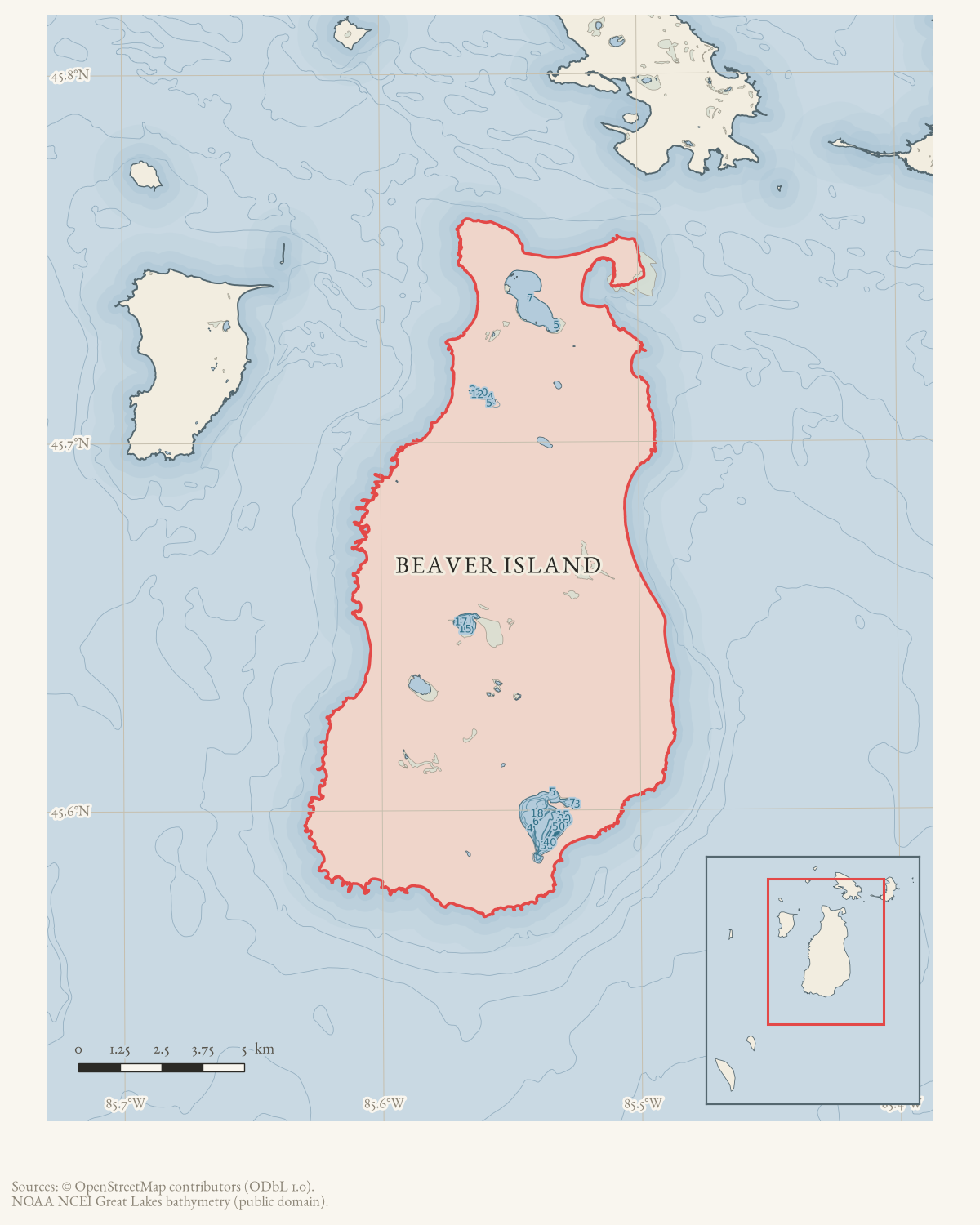
- 45.7462° N, 85.5211° WGoogle Maps: Mormon Print ShopDownload KML
- Eras
- Strang eraModern era
- Concepts
- heritagemormonismStrang eraModern erapublicationhistoriography
- Within
- Beaver Island
- Media
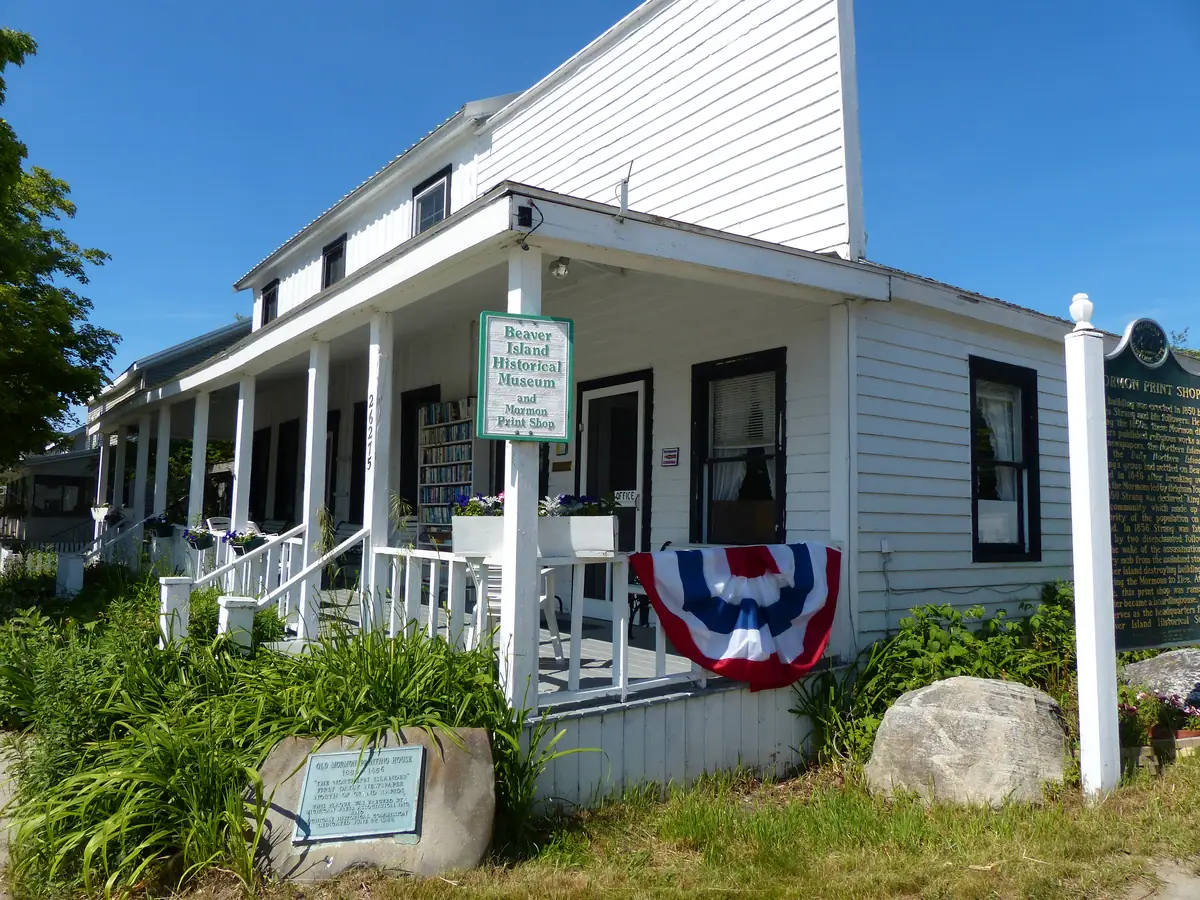
- "The old Mormon Printing Office, now the Gibson House, at Saint James" — plate from A Child of the Sea (1905) · Museum exhibit inside the Mormon Print Shop, St. James (2013) · The Mormon Print Shop, Main and Forest Streets, St. James (2013) · The Mormon Print Shop, side view, St. James (2013)
Summary
The Mormon Print Shop is the surviving Saint James building associated with James Strang’s royal press and the publication of the Northern Islander, 1850–1856, at Main and Forest Streets, Saint James, Beaver Island.1 Built in 1850, it is now the Beaver Island Historical Society’s Print Shop Museum, certified to the National Register of Historic Places (reference 71000386) on 25 January 1971 — the modern museum name should not be read as proof that every surviving feature dates to the press’s 1850-1856 operation.12 The building’s own ground has since produced a second, older history: twenty-first-century archaeology behind the structure has recovered evidence of Late Woodland Ottawa and protohistoric-era occupation predating the press by centuries.3
History
After the Strangite headquarters moved from Voree to Saint James, the Northern Islander began publication there on 12 December 1850, “the newly-constructed printing shop on the harbor road at St. James,” in the nomination’s own words.2 The same press produced books, pamphlets and tracts, including the Book of the Law of the Lord, which was advertised as printed at the “Royal Press, Saint James.” Quaife’s account says that 320 copies were still unbound in the printing office when the anti-Strangite party attacked in 1856; the office and other Strangite property were ransacked during the expulsion. James Strang was shot in June 1856 and died in Wisconsin on 9 July 1856; the nomination’s statement of significance says that “shortly after the shooting, the islands were invaded by an angry mob of non-Mormons from the mainland. Nearly all Mormon settlers were forced to emigrate, while buildings were sacked and the uncompleted tabernacle was burned.”2 These claims describe the press and its contents through partisan or later sources, not a surviving nineteenth-century building inventory.
The 1892 Michigan Pioneer sketch, preserved and discussed in the Northern Islander source article, reports that by the 1880s the former Northern Islander office had become a boardinghouse and was then regarded as the best hotel in Saint James. That is evidence for the building’s post-kingdom reuse, but it does not establish an uninterrupted ownership chain or identify which historic fabric survived conversion.
Elizabeth Whitney Williams, who kept the harbour light, published a photograph of the building in that second life. Her 1905 plate names it — “the old Mormon Printing Office, now the Gibson House” — and shows a two-part clapboard structure with a full-width verandah and a picket fence, which is a boardinghouse elevation rather than a printing office.
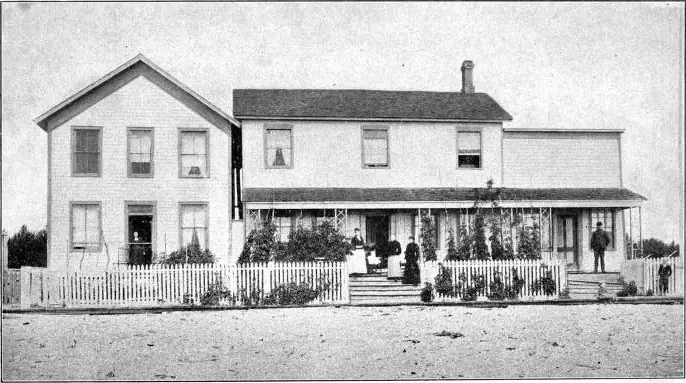
The Beaver Island Historical Society was founded in 1957 and made the building its headquarters and museum, one of several properties it would eventually hold alongside the Marine Museum, Protar’s House, and Heritage Park.4 Local Beaver Beacon reports document the Society’s 1964 effort to receive the deed and retire the property’s mortgage, and its 1963-1966 public museum operation. A planned one-story addition on the site of the former Old Post Office was reported with permits in hand in July 1976, intended as bicentennial-year exhibit space; further reports through September 1976 describe continued planning rather than a confirmed completion date.5 On the night of 12 March 1980, a fire in a rented house across the street burned out of control in high wind; sparks caught in debris under the Print Shop’s own porch and a fire started beneath the building itself. The Beacon reported the Society “was within minutes of losing the old Mormon structure and its treasures” before firemen went in the front door, chopped a hole in the floor, and put out the fire underneath; the Harmon house burned to the ground, but the Print Shop, the Cole house, and the Cull house were all saved after a roughly three-hour effort involving most of the town.6 The Michigan historical marker identifies the building as James Strang’s Print Shop; the National Register reference supplies the federal historic-resource join key.
Archaeology behind the building
In a season reported by the Charlevoix Courier in July 2016, a Northern Michigan University archaeology field school directed by Dr. Scott Demel completed “a third season of digging behind the Mormon Print Shop.” The excavated square pits showed a stratified sequence: Late Woodland Ottawa occupation (roughly AD 900-1,000) at the deepest layer, a protohistoric layer (1600 to the early 1800s, when European trade goods and people arrived), and a historic layer running from the Mormon period through modern times. Students uncovered a linear wall feature with post holes that Demel suggested “might have been a longhouse,” and an elk jaw and teeth along the same wall.3 This predates the print shop building itself by centuries and documents Indigenous and protohistoric occupation of the site the Strangite press was later built on; it is not evidence about the building’s own construction or contents. The same NMU field season also worked at Cable Bay and French Bay; those finds belong to their own articles.3
A 2022 Eastern Michigan University historic-preservation field school, whose primary project was the Beaver Head Lighthouse, sent a Collections Team to the Print Shop’s own archive room, where students spent most of nine days inventorying 139 boxes of the Historical Society’s collections on movable metal shelving and reviewing the Society’s draft collections policy.4 This documents the building’s present function as an archive and artifact-storage site in addition to its museum role, part of the broader institutional history covered in Museums, preservation, and public memory and, for the press itself, Print and publication.
Significance
The preservation-era nomination describes a two-story building approximately 30 feet wide and 20 feet deep, with a one-story, 19-foot rear addition, built of squared logs covered with vertical board and batten, with a gable roof and center entranceway; the original cedar-post foundation had deteriorated and been replaced with cement blocks by the time of nomination.2
The building is a rare fixed point connecting the Strangite newspaper, the kingdom’s publishing program, the violence and material loss of 1856, and the later community’s preservation work — and, beneath its own floor, a much older record of Indigenous occupation that the 2016 excavation was the first to document. Its evidence is layered: the press history comes from textual sources, the building’s construction and alteration sequence from the National Register nomination, and its earliest human use from archaeology that has not yet been published in a full excavation report.
Open questions
- Obtain a current building survey to distinguish the nomination’s preservation- era description from later additions, repairs, and present condition.
- Identify the printer, press, type and other equipment actually used in the building, rather than assuming that the museum’s present exhibits are original.
- Reconstruct the title and occupancy chain from the 1856 expulsion through the reported 1880s boardinghouse period and the Historical Society’s 1964 deed.
- Determine whether the building’s address and coordinates refer to the entire historic parcel or only the mapped National Register point.
- Was the 1976 Old Post Office addition completed, and does it survive as part of the present museum building?
- Has the 2016 NMU excavation’s longhouse-feature hypothesis and elk-jaw find been published in a full site report, and what dates or identifications does it support beyond the 2016 newspaper account?
See also
Footnotes
-
Michigan State Historic Preservation Office / National Park Service, National Register of Historic Places GIS point layer, feature 71000386; CertDate “01/25/71,” Address “Main and Forest Sts.,” St. James, Charlevoix County, Michigan. ↩ ↩2
-
National Park Service, National Register nomination, “Mormon Print Shop,” reference 71000386, description and statement-of-significance sections, https://nara-media.s3.amazonaws.com/electronic-records/rg-079/NPS_MI/71000386.pdf. ↩ ↩2 ↩3 ↩4
-
Charlevoix Courier, July 18, 2016, “Beaver Island dig turns up intriguing discoveries.” ↩ ↩2 ↩3
-
Dan Bonenberger, Nancy Bryk, and Alec Jerome, Beaver Island - Eastern Michigan University Field School Final Report (August 17, 2022). ↩ ↩2
-
Beaver Beacon, July, August, and September 1976, “The Bicentennial Projects,” “Historical Society Notes,” and “Notes from Beaver Island Historical Society.” ↩
-
Beaver Beacon, April 1980, “Fire Threatens Museum and Block in Town” and “Museum Saved!” ↩
The dated record
Sources
- Described in this archive: Beaver Island History Map, 1978 revision.Labels the building “Mormon Print Shop—Now the BIHS Museum.” The present-tense wording is interpreted at the map's 1978 publication date and is independently supported by the July 1976 Beaver Beacon.
- Listing location and reference number.federal · layers · nrhp_points
- Described in this archive: National Register nomination for Mormon Print Shop.Public NARA nomination PDF. It records a preservation-era description of the 1850 building, removal of hotel-era additions, and then-current Historical Society use; it is not a current survey or original construction/title record.research · mormon_print_shop · sources · nps-nrhp-mormon-print-shop-71000386
- *Northern Islander* (Saint James, Beaver Island), 1850-1856, and Milo M. Quaife, *The Kingdom of Saint James* (1930), Appendix I, pp. 184-187. The source article preserves the held newspaper and Quaife discussion.Described in this archive: Northern Islander, 1850–1856.Documents the press's move from Voree to Saint James, the Royal Press's books and pamphlets, and the ransacking of the office during the 1856 expulsion; the *Northern Islander* article also cites the 1892 report that the former office had become a boardinghouse by the 1880s. No public copy of this file is known; the archive holds one and can provide it on request.
- Described in this archive: Beaver Island Historical Society.The marker identifies the building as James Strang's Print Shop and says it now serves as the Historical Society headquarters; the Society article records the 1957 founding and later museum use.state · michigan · historical_markers
- Reports the Society's plan to clear the Print Shop's debt and receive the deed, followed by a public mortgage-burning event. This documents preservation and ownership history in 1964, not the building's nineteenth-century title chain.data1 · beaver-island-archive · beaver_beacon · 1964-08_Beaver-Beacon
- The held six-page issue scan is paired with the OCR source and confirms the published notice or report; it does not expand the source-specific identity, event, or outcome claims.data1 · beaver-island-archive · scans · beaver_beacon · issues · 1964-08_Beaver-Beacon
- Reports the Print Shop Museum open to visitors and later describes the museum as occupying the historic building; the archive preserves the local report as retrospective institutional evidence.data1 · beaver-island-archive · beaver_beacon · 1963-07_Beaver-Beacon
- The held six-page issue scan is paired with the OCR source and confirms the published notice or report; it does not expand the source-specific identity, event, or outcome claims.data1 · beaver-island-archive · scans · beaver_beacon · issues · 1963-07_Beaver-Beacon
- Reports that the planned Old Post Office addition to the Mormon Print Shop had permits and was expected to be built in August as exhibit space. It documents a plan, not construction completion or a permit file. The holding institution's portal restricts automated access; the archive holds a copy of this issue and can provide it on request.data1 · beaver-island-archive · beaver_beacon · 1976-07_Beaver-Beacon
- The held Bicentennial issue confirms the planned addition notice.data1 · beaver-island-archive · scans · beaver_beacon · issues · 1976-07_Beaver-Beacon
- Reports the Mormon Print Shop and Protar home as National Register properties in the Historical Society’s preservation context. It does not supply a new nomination, boundary survey, or title record. The holding institution's portal restricts automated access; the archive holds a copy of this issue and can provide it on request.data1 · beaver-island-archive · beaver_beacon · 1976-08_Beaver-Beacon
- The held issue confirms the preservation notice.data1 · beaver-island-archive · scans · beaver_beacon · issues · 1976-08_Beaver-Beacon
- Reports discussion of plans to construct the post-office formerly attached to the Museum. It documents continued planning, not construction start or completion. The holding institution's portal restricts automated access; the archive holds a copy of this issue and can provide it on request.data1 · beaver-island-archive · beaver_beacon · 1976-09_Beaver-Beacon
- The held issue confirms the planned addition notice.data1 · beaver-island-archive · scans · beaver_beacon · issues · 1976-09_Beaver-Beacon
- Structured record fields (not previously extracted from this layer): CertDate "01/25/71" (certified to the National Register 25 January 1971); Address "Main and Forest Sts."; ResType "building"; NumCBldg 1. Supplies the listing date this article previously lacked.federal · layers · nrhp_points
- Read directly (text extraction). States the building is "approximately 30 feet wide and 20 feet deep" with "a one-story addition 19 feet wide" attached to the rear, built of squared logs covered with vertical board and batten, gable roof, center entranceway; the original cedar-post foundation had deteriorated and been replaced with cement blocks by the time of nomination. The significance narrative states that after Strang was shot in June 1856 and died in Wisconsin on July 9, 1856, "the islands were invaded by an angry mob of non-Mormons from the mainland. Nearly all Mormon settlers were forced to emigrate, while buildings were sacked and the uncompleted tabernacle was burned."research · mormon_print_shop · nps-nrhp-mormon-print-shop-71000386
- Charlevoix Courier, July 18, 2016, "Beaver Island dig turns up intriguing discoveries."Read directly. Reports Northern Michigan University's Dr. Scott Demel and students completing "a third season of digging behind the Mormon Print Shop, erected in 1850 and now headquarters for the Beaver Island Historical Society." Excavated square pits showed a stratified sequence of occupations: Late Woodland Ottawa (AD 900-1,000) at the deepest layer, the protohistoric era (1600-early 1800s, when European goods and people arrived), and the historic period from the Mormons' arrival through modern times. Students found a linear wall feature with post holes that Demel suggested "might have been a longhouse," and an elk jaw and teeth along the same wall. The same field season also worked at Cable Bay and French Bay; those finds are recorded in their own articles. No public copy of this file is known; the archive holds one and can provide it on request.data1 · beaver-island-archive · charlevoix · Charlevoix-Courier-2016
- Read directly. The field school's May 2022 Collections Team, led by Nancy Bryk, spent the bulk of nine days "inventorying the collections in the archive room" of the Print Shop, focused on movable metal shelving, as part of a broader review of the Beaver Island Historical Society's draft collections policy. States BIHS's properties "include the Mormon Print Shop Museum, the Marine Museum, Protar's House, and Heritage Park." The field school's main on-site project was the Beaver Head Lighthouse, not the Print Shop building itself; the Print Shop appears here as the Society's archive and artifact storage site.
- Read directly. On the night of March 12, 1980, a fire in a rented house (owned by Mr. and Mrs. Karl Harmon of Chicago) across the street from the Museum burned out of control; a wind out of the east-northeast blew sparks that caught in debris under the Print Shop's own porch, starting a fire beneath the building. Fire Chief Bud McDonough and volunteers, after both fire trucks and gasoline pumps ran low, went in the front door, chopped a hole in the floor, and put the fire underneath out; the Harmon house burned to the ground but the Museum, the Hugh Cole house, and the Cull home were saved after a roughly three-hour effort. The Historical Society's own "Museum Saved!" note calls the building 130 years old and reports structural repairs and fire-prevention renovations completed by the next opening, plus new fire extinguishers and an emergency door already installed. The holding institution's portal restricts automated access; the archive holds a copy of this issue and can provide it on request.data1 · beaver-island-archive · beaver_beacon · 1980-04_Beaver-Beacon
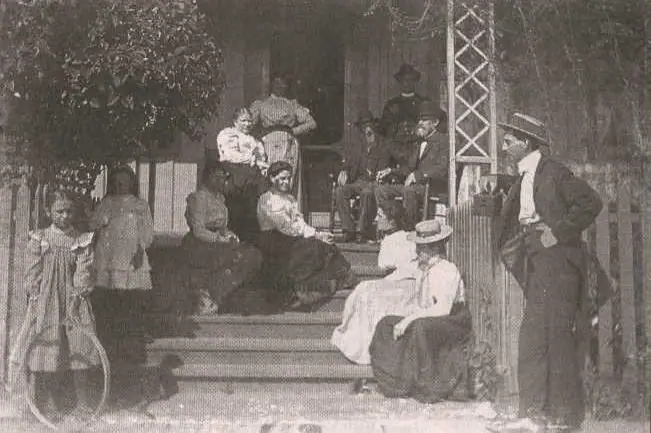
- Opened and checked: a group of about a dozen adults and children posed on the wooden steps and porch of a clapboard building, in period dress consistent with the gallery's 1899 date. The identification of the building as the print shop is the Beaver Beacon gallery's own caption, cited here as theirs rather than asserted from the image, which shows no signage. No third-party collection watermark appears on it.

Added 28 July 2026 · revised 4 August 2026. Recent changes
Cite this article
Beaver Island Archive, “Mormon Print Shop”, https://beaverislandarchive.org/structures/mormon-print-shop/, accessed [date], citing Beaver Island Historical Society, *Beaver Island Historical Map* (1978 revision). (and 20 further sources listed on the page).
Last revised 2026-08-04. Fill in [date] with the date you read it — this page is static and cannot know that.