- Born
- 1837-02-19
- Died
- 1925-03-03
- Work
- Unlicensed healer
- Along road
- Sloptown Road
- Coordinates
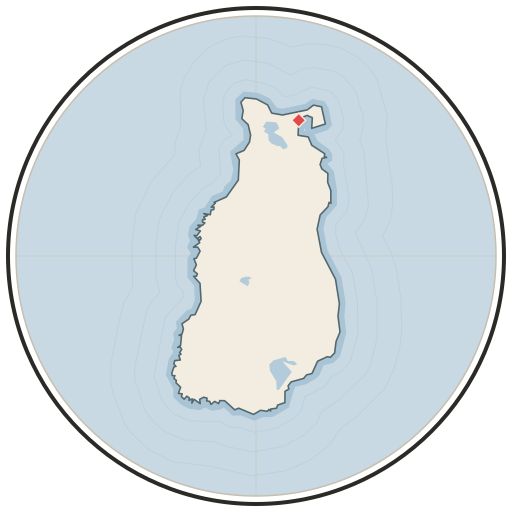
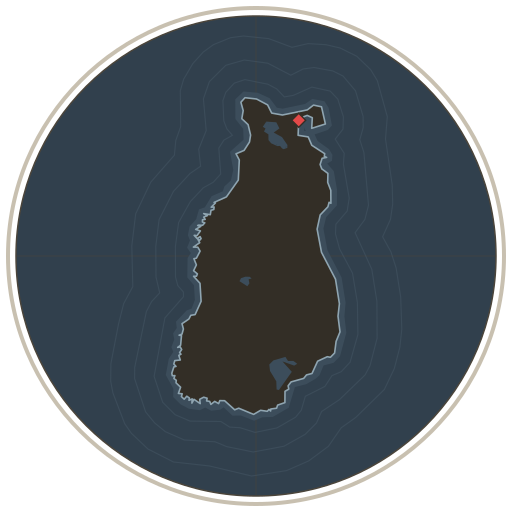
- 45.7036° N, 85.5633° WGoogle Maps: Feodor ProtarDownload KML
- Eras
- Irish era
- Concepts
- heritage
- Within
- Beaver Island
- Media
- Beaver Island History Map, 1978 revision
Summary
Feodor Protar (born Friedrich Parrot, 19 February 1837 - 3 March 1925) was a Russian-born former actor and newspaper editor who settled alone on Beaver Island in 1893 and became, without formal medical license, the island’s principal source of care in the years it had no resident physician. Islanders were by the 1890s overwhelmingly Irish in origin (see Irish settlement of Beaver Island). The epithet “our heaven-sent friend” is attached to him on a plaque at his grave enclosure and is used by the Beaver Island Historical Society, whose presenter is quoted using it in the Beaver Beacon of August 2004; no source held here shows it in use during his lifetime or in the years immediately after his death. His cabin is individually listed on the National Register of Historic Places (reference 72000604) and is maintained, along with his medical ledger and diaries, by the Beaver Island Historical Society.
History
Protar was born Friedrich Parrot on 19 February 1837 in Tartu (then Dorpat, in the Russian Empire; now Estonia).1 In Europe he acted in Dresden, Berlin, Riga and other cities. He emigrated to the United States in 1874, Russified his name from Parrot to Protar, and edited a newspaper in Rock Island, Illinois.12 The held newspaper corpus independently confirms the acting career – he was “a thespian” – and the 19 February 1837 birthdate, but says nothing more about the European years.3
He came to Beaver Island in 1893, reportedly seeking solitude and a fresh start, and lived alone in a cabin on Sloptown Road, practicing subsistence farming.2 That year he bought a house on the farm of his neighbours, the Bonner family – Sophia (Harkins) Bonner and “Black John” Bonner, among the island’s early Irish settling families – and remained close to them until his death.4 His way of living was influenced by Leo Tolstoy’s religious teaching, and he described his own outlook on mortality: “Thus I await the final day with equanimity, which will bring me not obliteration but transformation.”2
Between 1911 and 1923 the island had no full-time physician. Protar – trained or self-taught in pharmacology – practised as an unlicensed healer, treating colds, respiratory infections, arthritis and rashes, and declining childbirth, vaccination and serious cases. He is reported to have dispensed more than 2,000 free treatments and to have kept a medical ledger from 1915 to 1925.2 He died of a stroke in his cabin on the night of 3 March 1925 and was buried near a boulder on his own property; islander William McDonough later built the fieldstone enclosure around the grave, with a plaque reading “our heaven-sent friend.”2
The March 13, 1925 Charlevoix County Herald reported his death as a local obituary, calling him a Russian exile who had lived near Saint James for nearly fifty years and had responded to islanders’ medical needs. That notice gives neither the exact day of death nor any of the later biographical detail; those rest on the separate sources cited above.
The 1978 Historical Map compresses this biography into “Russian actor and editor,” “self-made doctor,” free service, retirement in 1893, and death in 1925. The dates and island medical role agree with independent sources. This article uses unlicensed healer rather than “self-made doctor,” because no held source establishes a medical degree or license; the reported 2,000 free treatments, actor career, and editorship come chiefly from later biographical sources rather than the contemporary death notice.
The Beaver Island Historical Society marked the centenary of his death in 2025 as the “Protar Anniversary,” with a Holy Cross Mass in his honor, a “Protar” theme for the Society’s annual Museum Week, and readings of a two-act play, Beaver Isle, the Musical, dramatizing his friendship with fiddler Patrick Bonner (Sophia and “Black John” Bonner’s son).45
Significance
Protar is one of the few non-Irish, non-Strangite figures to become central to Beaver Island’s post-1856 collective memory, and the only individual besides Strang himself with an individually NRHP-listed residence on the island. His cabin, ledger and library are held and interpreted by the Beaver Island Historical Society as one of its four core historic sites.
Open questions
- The full run of Journal of Beaver Island History, Vol. I, pp. 51-57 (cited by the Historical Society as its main Protar source) is not held here; its content has not been independently verified here.
- Antje Price’s 2006 essay “Protar: A Different Life,” cited by Wikipedia, is likewise not held.
- The exact circumstances and sourcing of the “heaven-sent friend” epithet (who coined it, and when the grave plaque was installed) are known only from the Historical Society’s own web page, not from any primary document held here.
- Nothing in the held corpus establishes when or why Protar chose Beaver Island specifically, beyond the Historical Society’s characterization (“seeking solitude”).
See also
Sources
Full citations, matching the sources: block above.
Footnotes
-
“Feodor Protar,” Wikipedia, retrieved 28 July 2026, https://en.wikipedia.org/wiki/Feodor_Protar. ↩ ↩2
-
Beaver Island Historical Society, “Feodor Protar’s Home on Beaver Island,” retrieved 28 July 2026, https://www.beaverislandhistory.org/protars-home/. ↩ ↩2 ↩3 ↩4 ↩5
-
Northern Islander, February 2024, p. 31. ↩
-
Northern Islander, June 2025, p. 17-18. ↩
In the sources
Helen Collar (1911–1995) spent four decades transcribing Beaver Island census returns, parish registers, deeds and death records onto index cards, and recording what islanders told her. Clarke Historical Library publishes that work. It is a researcher's working file — what a record says, what she suspected, and what an informant remembered, often in the same paragraph — so what follows is what the archive holds, not what this archive claims.
Helen Collar's biographical papers hold an entry headed “Feodar Protar”. Whether it concerns the same person is unverified — names repeat heavily in this community.
The names agree; nothing else in the entry corroborates it.
These are Collar's twentieth-century working notes. They preserve the language of her informants and of her period, including racial descriptions of Anishinaabe residents, and they are quoted verbatim because altering a transcription silently would be worse. See the register of dated records for what the parish registers record, and the editorial standards for what this archive will and will not turn a transcription into.
Sources
- Confirms the cabin's NRHP listing, reference number, and location "SW of St. James, on Beaver Island," Charlevoix County. Does not itself give biographical detail (nomination form text not retrievable via NPGallery).federal · layers · nrhp_points
- Gives his birthday as "February 19, 1837" in a Beaver Island Historical Society announcement of a birthday commemoration at Protar's Tomb.
- States that in 1893 "Feodor Protar bought a house that the family had built on their farm[,] ... an licensed healer and 'island friend,' was close friends with the family and he lived in the house until his death in 1925," in a profile of neighbour Sophia (Harkins) Bonner.
- Charlevoix County Herald, March 13, 1925, “Beaver Island Exile Is Dead.”Contemporary report says Dr. Protar, a Russian exile who had lived near St. James for nearly fifty years, died after serving island residents as a physician; it supplies no exact day, birth name, or formal medical credentials. No public copy of this file is known; the archive holds one and can provide it on request.
- Describes the Protar Home, maintained by the Beaver Island Historical Society, as one of four sites on the island's National Register of Historic Places listing, and Protar as "this cherished philanthropist."
- Web page held by the organization that curates his cabin, ledger, diaries and library; states his prior career as a newspaper editor and actor, his 1893 arrival, his practice as an unlicensed healer from 1911-1923 dispensing over 2,000 free treatments, his death by stroke on 3 March 1925, and the "our heaven-sent friend" plaque on his grave enclosure. Cites *Journal of Beaver Island History*, Vol. I, pp. 51-57, which the archive does not hold directly.
- Gives his birth name (Friedrich Parrot), birthplace (Tartu, then in the Russian Empire, now Estonia), acting career in Dresden, Berlin and Riga, work as a newspaper editor in Rock Island, Illinois, 1874 emigration, and Tolstoyan religious affiliation. Independently corroborates the 19 February 1837 birth date and 1925 death found in the held newspapers. Cites the Beaver Beacon and Antje Price, "Protar: A Different Life" (2006), neither held here.
- Described in this archive: Beaver Island History Map, 1978 revision.Summarizes Protar as a Russian actor and editor, “self-made doctor,” free practitioner, 1893 retiree, and 1925 decedent, and groups his home and tomb. The 1893 and 1925 dates and medical service are independently supported; “self-made doctor” is normalized here to unlicensed healer, and the actor/editor/free-treatment details rely chiefly on later institutional biography.
Added 28 July 2026 · revised 7 August 2026. Recent changes
Cite this article
Beaver Island Archive, “Feodor Protar”, https://beaverislandarchive.org/people/feodor-protar/, accessed [date], citing National Park Service, National Register of Historic Places, "Protar, Feodar, Cabin," reference number 72000604, listed 16 March 1972. (and 7 further sources listed on the page).
Last revised 2026-08-07. Fill in [date] with the date you read it — this page is static and cannot know that.