- Built
- circa 1860
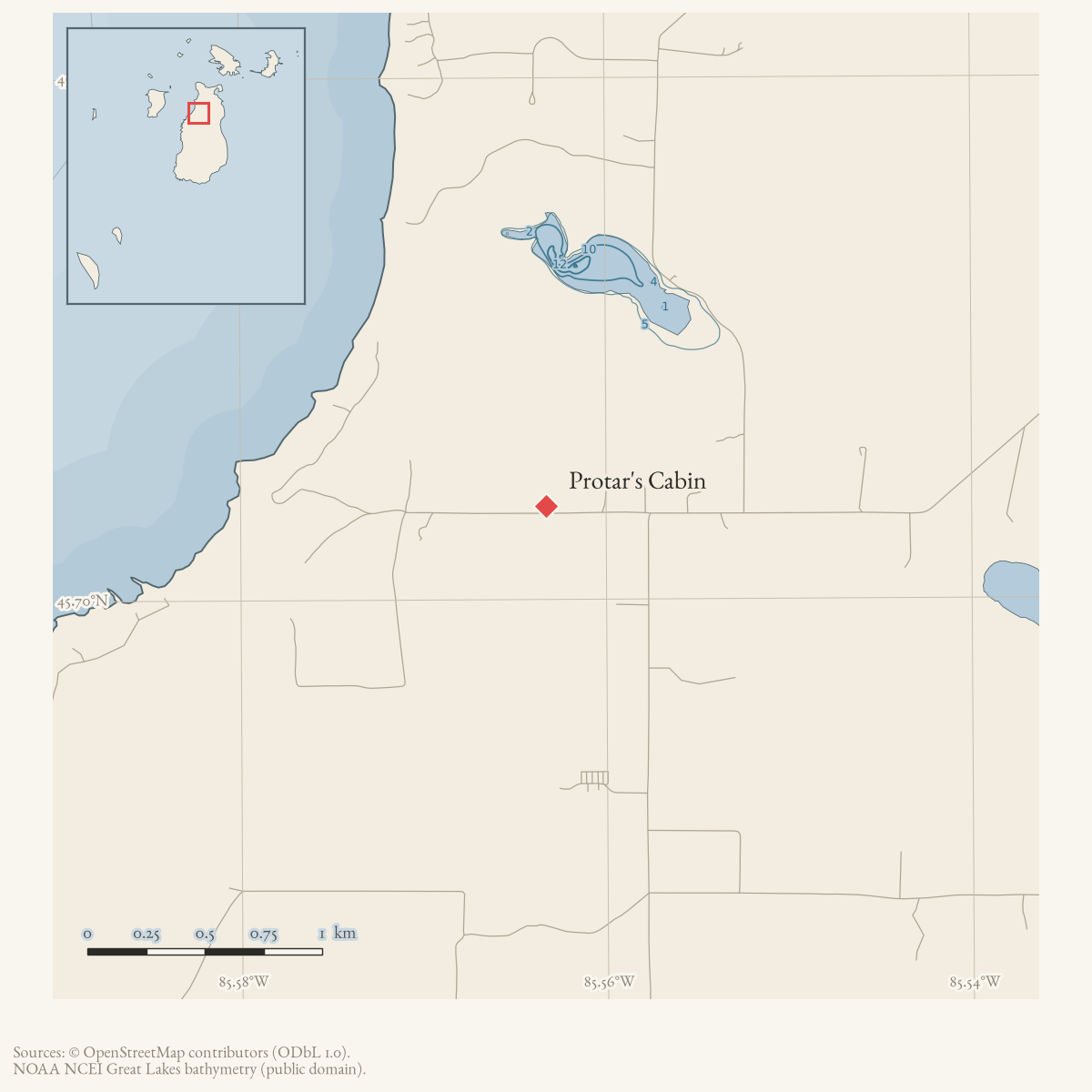
- Along road
- Sloptown Road
- Coordinates
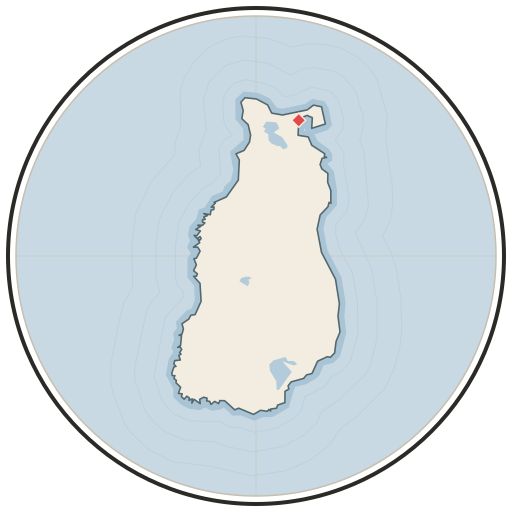
- 45.7036° N, 85.5633° WGoogle Maps: Protar's CabinDownload KML
- Eras
- Irish era
- Concepts
- heritage
- Within
- Beaver Island
- Media
- Beaver Island History Map, 1978 revision
Summary
The cabin standing here predates Feodor Protar and was not built by him. It is a hand-hewn white pine log structure, one and one-half stories, about 32 by 16 feet, built around 1860 — according to the 1971 National Register nomination, by Irish settlers who moved onto the island after the Strangite Mormons were dispossessed in 1856.12 Protar first visited Beaver Island in 1887, driven into St. James harbor by a storm; after summering there for several more years he settled permanently in 1893 and bought the already-standing “old cabin” rather than building it, living in it until his death in 1925.23 Islanders and the Beaver Island Historical Society pursued the home’s preservation from at least 1970, and it was individually listed on the National Register of Historic Places (reference 72000604) on 16 March 1972.
History
The June–July 1970 Beaver Beacon records the start of an organized preservation effort. After a November 1969 visit, Governor Milliken referred the Protar home and the older Bonner farm across the road to the state’s newly formed Historic Preservation Advisory Council. Mr. and Mrs. A. J. Roy carried information about the sites to a Council meeting on 23 January 1970; on 9 July 1970 Eunice Hendrix delivered a letter to state Parks and Recreation officials; and by the article’s writing the sites were “fully documented” for the first Michigan list sent to Washington for the National Register, which would make them eligible for 50-percent matching restoration funds, conditional on a local match and on title held by a body that could guarantee public access. The Civic Association opened a restoration fund with $100 and formed a Historical Committee under Marge Wagner and Eunice Hendrix.4 That campaign is modeled separately at Historic-preservation campaign for Protar Home and Bonner farm, 1970.
By August 1970 the Historical Society reported it had “raised enough money to put a new roof on the Protar House” and asked a contractor to install it that fall, while acknowledging that full restoration would need far more funding.5 A year later, the August–September 1971 Beacon reported the roof and front-porch repair complete, with caulking, summer-kitchen work, and yard cleanup still outstanding.6 The National Register nomination, prepared that November, independently corroborates the date: “a new roof and porch were added in the summer of 1971,” after the building had fallen “into disrepair for a number of years.”1 By August 1976 the Society reported “progress toward final acquisition of the property on which the Protar home, barn and tomb stand,” and noted the home had “been on the National Register of Historic Buildings for several years.”7 An April 1977 report shows work continuing, funded partly by sales of the Society’s newly published Journal of Beaver Island History, Volume One (1976), which included an essay on “F. Protar” among its eleven chapters.8 By November 1980 the Society’s outgoing board president counted stabilizing the Protar Home among the year’s accomplishments; a maintenance report that issue records new siding complete on the house’s east end, with windows, roof, and eaves troughs still needing attention, and a separate item credits Antje Price’s summer work presenting “Dr. Protar to the museum public” in “a well-integrated room” — the earliest held evidence that the home, or part of it, was in active museum use.9
The nomination’s own physical description records the cabin as one and one-half stories, about 32 by 16 feet, walls of square-hewn white pine logs flat-notched at the corners, narrow clapboards once covering the exterior (some still remaining), a wood-shingle roof, and an interior panelled in vertical pine boards, with many furnishings said to be Protar’s own.1 Its account of Protar’s own life differs in particulars from the Wikipedia-sourced biography at Feodor Protar: it describes a university education in Dresden, an escape from Russia “in lieu of serving a Siberian exile,” the death of his wife around 1870, a period touring with actress Fanny Janauschek, and the 1882 purchase (not, as Wikipedia has it, the editorship) of a German-language newspaper in Rock Island, Illinois, before he settled on Beaver Island in 1893. The nomination attributes much of this to an account by Protar’s “adopted son” and to Paul Kersh’s 1939 Michigan History article “Feodar Protar, the Saint of Beaver Island,” neither independently verified here. The discrepancies between the two accounts are not reconciled in this article; both are attributed to their source, and the biographical details are recorded here as contested.
Evidence and limits
The nomination’s biographical section is a secondary, decades-removed account built on family recollection and a 1939 magazine article not held here; its physical description of the building, by contrast, is a contemporary 1971 field record and is treated with more confidence. The scanned nomination’s OCR extraction is degraded in many places; individual words are garbled, not fabricated into invented sentences, so quotations here are drawn only from clearly legible passages. The exact date the cabin passed into Beaver Island Historical Society ownership is still not established in any source read for this article, but a November 1980 report bounds the date the Society was actively presenting it as a museum exhibit to “by 1980” at the latest – narrower than the “several years” of National Register listing the Society claimed in 1976.
Significance
The nomination itself states the significance case the state acted on: “with the exception of the Mormon Print Shop, already on the National Register, the Protar cabin is the best preserved and most historic building on Beaver Island.”1 That is the 1971 Michigan Historical Commission’s own judgment, not an independent finding here. The Beaver Island Historical Society describes Protar as islanders’ “heaven-sent friend,” a phrase traced to the Society’s own website and found nowhere else in the newspapers and books consulted for this article; it is reported here as the Society’s characterization of him, not repeated as an established historical fact. The reverential framing has an older print pedigree than the Society’s website: the nomination’s bibliography cites a 1939 Michigan History article already titled “the Saint of Beaver Island,” a framing not yet verified against that 1939 article directly.
Open questions
- The identity of the circa-1860 Irish settlers who built the cabin is not established from sources consulted.
- Protar’s own birth and death dates, and his birth name, are separately contested; see Feodor Protar for that discrepancy, not repeated here.
- The nomination’s biographical particulars (Dresden university education, a Siberian-exile reprieve, touring with actress Fanny Janauschek, a purchased rather than edited newspaper) diverge from the Wikipedia-sourced account at Feodor Protar; neither Kersh’s 1939 article nor the unnamed “adopted son” account behind the nomination’s version has been independently read.
- The date of the cabin’s transition to Historical Society ownership (as opposed to museum use, bounded here to “by 1980”) is asserted in project research notes but not independently corroborated against a primary source here.
- What did Antje Price’s 1980 Protar room contain, and does it survive in the same form?
See also
Footnotes
-
National Park Service, National Register nomination, “Protar Cabin,” reference 72000604, prepared by the Michigan Historical Commission, November 1971. ↩ ↩2 ↩3 ↩4
-
“Feodar Protar Cabin,” Wikipedia, retrieved 2026-07-31, https://en.wikipedia.org/wiki/Feodar_Protar_Cabin. ↩ ↩2
-
Beaver Island Historical Society, “Feodor Protar’s Home on Beaver Island,” retrieved 2026-07-31, https://www.beaverislandhistory.org/protars-home/. ↩
-
Beaver Beacon, June-July 1970, “Historical Preservation on Beaver Island.” ↩
-
Beaver Beacon, August 1970, “Beaver Island Historical Society.” ↩
-
Beaver Beacon, August-September 1971, “Beaver Island Museum Report.” ↩
-
Beaver Beacon, August 1976, “Historical Society Notes.” ↩
-
Beaver Beacon, April 1977, “Historical Society” report. ↩
-
Beaver Beacon, November 1980, “Historical Society” annual report. ↩
The dated record
Sources
- A student reported choosing Protar for a school essay after consulting Journal of Beaver Island History books, visiting the house, and taking personal photographs. This documents a visitor’s research experience, not an independent biographical or architectural source.forum · www.beaverislandforum.com · 00 · t000147
- The Historical Society announced that Protar’s House would be open from 2:30–4 p.m. on Saturdays during August. This documents a public-access schedule, not attendance or a change in ownership or stewardship.forum · www.beaverislandforum.com · 13 · t013416
- A community notice says Protar interpreter Antje Price would open the Protar Home on July 6 from 1–3 p.m. This documents a public-access opportunity, not attendance or the cabin's ownership history.forum · www.beaverislandforum.com · 06 · t006416
- Listing location and reference number; listed 16 March 1972.federal · layers · nrhp_points
- Described in this archive: National Register nomination for Protar cabin, 1971.Public NARA nomination PDF. Its physical description and 1971 roof/porch repair are read directly from the extracted text; its biographical narrative is attributed to an unnamed "adopted son" account and cites Paul Kersh, "Feodar Protar, the Saint of Beaver Island," Michigan History XXXIII (Winter 1939), which is not held here. The scan is a faded typewritten form and its OCR extraction is degraded in places -- individually garbled words, not fluent invented prose -- so short phrases are quoted only where legible in the extraction.research · protar_feodar_cabin · sources · nps-nrhp-protar-feodar-cabin-72000604
- States the cabin was "constructed by an Irish settler in about 1860" and that Protar "chose for his house" this pre-existing structure; gives dimensions (about 32 by 16 feet) and wall material (square-hewn white pine logs, flat-notched corners).
- States Protar moved to Beaver Island permanently in 1893, used here for the distinction between his residence and the cabin's earlier construction. See [[person/feodor-protar]] for his separately contested birth/death dates and biography; this article does not repeat that biography, only what bears on the cabin itself.
- States Protar "settled on Beaver Island in 1893" and "bought an old cabin on Sloptown Road"; does not name a builder or construction date, consistent with the cabin predating him. The Society is the cabin's steward and the source of the reverential framing discussed in Significance, below; its claims are attributed to it rather than stated as fact.
- Reports that Governor Milliken referred the Protar and Bonner sites to the state's Historic Preservation Advisory Council after a November 1969 visit; that A. J. and Mrs. Roy carried information to a January 23, 1970 Council meeting; that Eunice Hendrix delivered a letter to state Parks and Recreation officials on July 9, 1970; and that the sites were "fully documented" for the first Michigan list submitted to the National Register, making the sites eligible for 50% matching restoration funds conditional on local match and an organization guaranteeing public access. Records a Civic Association restoration fund opened with $100 and a Historical Committee under Marge Wagner and Eunice Hendrix. Does not establish the campaign's outcome.data1 · beaver-island-archive · beaver_beacon · 1970-06_Beaver-Beacon
- Confirms the report.data1 · beaver-island-archive · scans · beaver_beacon · issues · 1970-06_Beaver-Beacon
- Reports the Society had "raised enough money to put a new roof on the Protar House" and asked a contractor to install it that fall, while stating restoration would need much more funding; describes donation canisters placed in island stores. Does not prove the roof work occurred that fall.data1 · beaver-island-archive · beaver_beacon · 1970-08_Beaver-Beacon
- Confirms the report.data1 · beaver-island-archive · scans · beaver_beacon · issues · 1970-08_Beaver-Beacon
- Reports approximately 1,325 museum visitors for the year and states the Society "has just completed putting a roof on the Protar House and repairing the front porch," with caulking, summer-kitchen repair, and yard work still needed. Corroborates the nomination's "summer of 1971" repair date independently.data1 · beaver-island-archive · beaver_beacon · 1971-08_Beaver-Beacon
- Confirms the report.data1 · beaver-island-archive · scans · beaver_beacon · issues · 1971-08_Beaver-Beacon
- Reports "progress made toward final acquisition of the property on which the Protar home, barn and tomb stand," and states the home "has been on the National Register of Historic Buildings for several years," alongside the Mormon Print Shop. Does not provide a deed, parcel description, or closing date. The holding institution's portal restricts automated access; the archive holds a copy of this issue and can provide it on request.data1 · beaver-island-archive · beaver_beacon · 1976-08_Beaver-Beacon
- Confirms the report.data1 · beaver-island-archive · scans · beaver_beacon · issues · 1976-08_Beaver-Beacon
- Reports ongoing Society plans for "further improvements for the Protar home" alongside Print Shop and Marine Museum work, funded partly by sales of the Society's new *Journal of Beaver Island History*, Volume One (1976), whose eleven essays include one on "F. Protar." The holding institution's portal restricts automated access; the archive holds a copy of this issue and can provide it on request.data1 · beaver-island-archive · beaver_beacon · 1977-04_Beaver-Beacon
- The outgoing board president's annual report states the Society "opened the Marine Museum and stabilized the Protar Home" among the past year's accomplishments; a maintenance report lists new siding on the Protar House's east end as complete, with windows, roof, and eaves troughs needing further work. A separate item credits Antje Price's summer work presenting "Dr. Protar to the museum public" in "a well-integrated room" -- the earliest held evidence of a dedicated Protar exhibit space, bearing on the open question of when the home entered museum use. The holding institution's portal restricts automated access; the archive holds a copy of this issue and can provide it on request.data1 · beaver-island-archive · beaver_beacon · 1980-11_Beaver-Beacon
Added 28 July 2026 · revised 4 August 2026. Recent changes
Cite this article
Beaver Island Archive, “Protar's Cabin”, https://beaverislandarchive.org/structures/protar-feodar-cabin/, accessed [date], citing Beaver Island Forum, "Thanks...", April 2004, topic 147. (and 17 further sources listed on the page).
Last revised 2026-08-04. Fill in [date] with the date you read it — this page is static and cannot know that.