- Coordinates
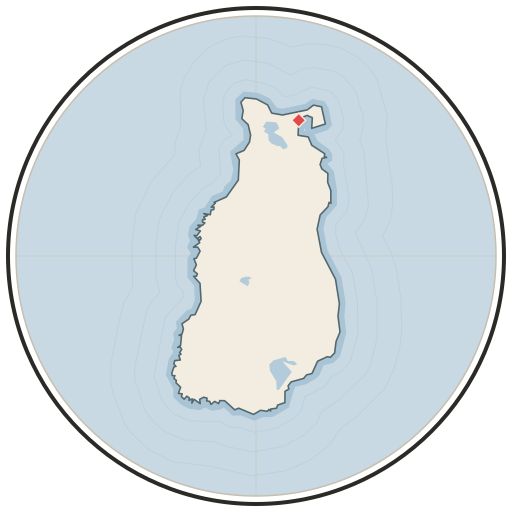
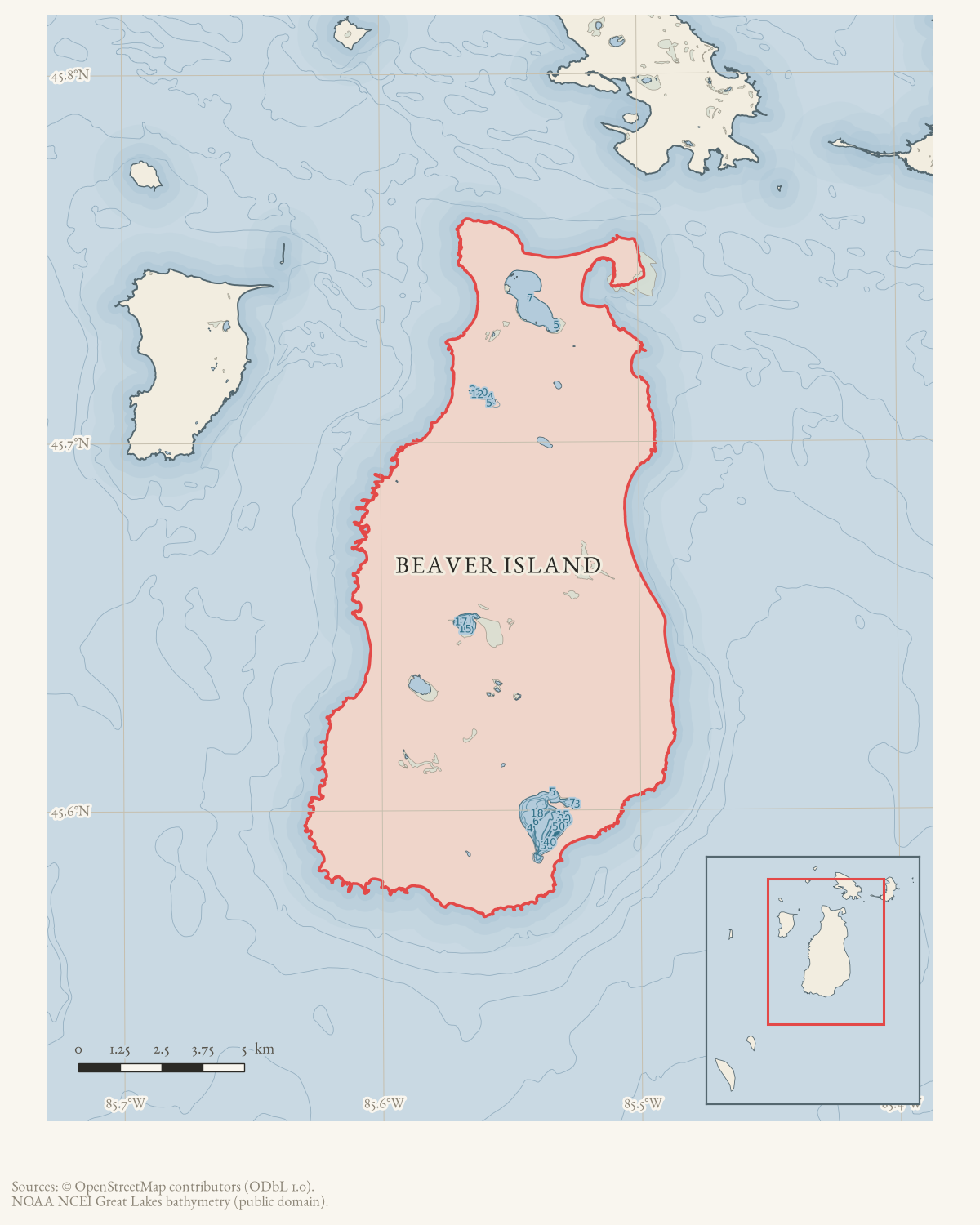
- 45.7244° N, 85.6720° WGoogle Maps: Michigan Conservation DepartmentDownload KML
- Eras
- Modern era
- Concepts
- conservationenvironmentgovernance
- Within
- Beaver Island
Summary
The Conservation Department is the state wildlife agency documented in the Beaver Beacon directing hunting, land purchase, and fisheries work on Beaver Island from the late 1950s through the early 1960s. Held reports credit it with purchasing High Island for $55,000 in 1958, posting a resident conservation officer whose office passed from Karl Kuebler to Vernon Fitzpatrick in 1959, introducing wild turkeys to the island in 1961, running a two-year island predator study through biologist John Ozaga, and eradicating and restocking Fox Lake with brook trout between 1961 and 1962. This is the department’s documented local record, not its institutional history.
History
The department’s earliest held local action is a land purchase: the March 1958 Beacon reports that the Conservation Department bought High Island for $55,000, leaving only the acre around the old Indian mission and school in private hands.1 The department also staffed the island with a resident conservation officer. Karl Kuebler retired from that post in December 1958 after 16 years on Beaver Island and 35 years total in Conservation Department work; the Game Club gave him an oyster dinner that February, and the Beacon reported his replacement would be named in March.23 By April 1959 the department had appointed Vernon Fitzpatrick, then 30, a graduate of the Michigan College of Mining and Technology who had spent two years in the department’s forestry division.4 Fitzpatrick held the post through the early 1960s, filing the Beacon’s monthly weather reports for the federal Weather Bureau, announcing hunting seasons, and carrying out the department’s field work described below.5
Wildlife introduction was a recurring department project. In January 1961 the Beacon reported that the department’s Game Division planned to bring about twenty wild turkeys from the Allegan State Forest, in flocks near Bonner’s Bluff and the Green’s Lake area.6 The turkeys arrived on August 31, 1961: two adult females and six young birds trapped at the Swan Creek Wildlife Experiment Station, though the adults died before the flight to the island, probably of asphyxiation. The six young birds were released at Angeline Bluff before a large crowd, and the department told the Beacon it hoped to bring the flock to thirty birds.7 By November the six survivors had been seen near town, appearing healthy and grown, and the department was reported still planning further releases.8
The department also studied the island’s predator population. John Ozaga, a Michigan State student working as a Game Division student conservation aide, began the study in the summer of 1960.9 By September 1961 he had logged two years of data: coyote and fox kill records back to 1947 (137 coyotes killed by deer hunters, coyote hunters, and trapping combined over 24 years) and a 214-mile winter survey of predation on deer, rabbits, and grouse, from which he concluded the coyote and fox population was no longer a serious threat to island game.10 That same report announced Fitzpatrick’s “bucks only” deer season for 1961, adopted because the department judged the herd somewhat reduced in number, to allow it to rebuild before any-deer hunting resumed.11 The season closed with 22 deer taken by 230 hunters, five illegal kills of which two were salvaged for needy families, and a notably large eight-point buck dressing out at 144 pounds.12
Fisheries work centered on Fox Lake. After Conservation Department netting samples found the lake dominated by undersized, malformed perch that had displaced its bass, the Civic Association voted on February 9, 1961 to eradicate the fish population; a Fisheries Division letter proposed trying trout instead of the original bass-restocking plan, and the Association agreed. On May 1, 1961, department biologist Mr. Fukano and Fish Division’s Jerry Meyers poisoned the lake.13 A July test still found the lake toxic;14 a November retest, after fourteen trial brook trout died, again found poison remaining, which Fitzpatrick attributed to the lake’s stagnant water working more slowly than a lake in active recreational use.8 The following month, on December 6, 1961, fish culturist Bud Knight of Oden Hatcheries and Fitzpatrick planted 2,000 brook trout, about 450 pounds, in Fox Lake.15 The department’s other 1961 wildlife work included releasing 28 disease-free ruffed grouse on Hog Island in late July, while a state game biologist, Mr. Schlatterer, ran a grouse census on Beaver Island itself.14
Both threads continued into 1962. Ozaga’s coyote tagging carried on into that year: of nine coyotes taken by hunters that fall, none carried a tag from the nine he had marked the previous summer, and Fitzpatrick reported Game Division plans to resume turkey trapping at Allegan State Forest for a further Beaver Island delivery.16 The department opened a record-keeping program for Fox Lake’s trout fishery that March, placing a bulletin board and angler report forms at the lake to track catch and set future stocking rates, and asked anglers that April to avoid minnows as bait, since an earlier minnow overpopulation had helped justify the lake’s 1961 poisoning.1718 The four turkeys released in 1961 survived their first winter; a private citizen’s parallel effort to supplement the flock with hatchery-purchased birds was turned down over concerns about the stock’s “wildness,” and Game Division Supervisor Ray Schofield told the Beacon the department preferred Michigan-reared stock.18
Evidence and limits
This record follows the newspaper’s wording and local scope. It does not claim the department’s formal legal name, founding or successor dates, jurisdiction, or identity with the separately modeled Conservation Commission that appears in the held game-order records. The 1961 reports also do not establish a complete staff roster or a permanent institutional relationship with Beaver Island. Personnel below the conservation officer, including Ozaga, Bud Knight, and the Fisheries Division’s Fukano and Meyers, are identified only by the roles and names the Beacon printed, without personnel files or full career records.
Significance
Between 1958 and 1962 the department was the state actor behind the archipelago’s largest documented land purchase (High Island), its wildlife introductions (wild turkey, ruffed grouse), its predator research, and a complete fisheries conversion of Fox Lake from a native bass-and-perch lake to a stocked trout fishery — work carried out through a resident conservation officer and coordinated repeatedly with island bodies such as the Civic Association and the Game Club. See Wildlife and game management for the island’s wildlife record across a longer span.
Open questions
- What formal state agency name and records correspond to the 1961 “Conservation Department”?
- How does it relate institutionally to the separately modeled Conservation Commission?
- Can state wildlife files confirm the turkey, predator, deer, toxicity, and trout accounts?
See also
- Beaver Island
- High Island
- Fox Lake
- Hog Island
- Angeline Bluff
- Vernon Fitzpatrick
- John Ozaga
- Bud Knight
- First wild-turkey release on Beaver Island, 1961
- John Ozaga predator study on Beaver Island, 1961
- Beaver Island bucks-only deer season announced for 1961
- Brook-trout stocking at Fox Lake, 1961
- Beaver Island Game Club
- Beaver Island Civic Association
- Wildlife and game management
Footnotes
-
Beaver Beacon, March 1958, “HIGH ISLAND.” ↩
-
Beaver Beacon, January 1959, “RETIRED FROM CONSERVATION DEP’T.” ↩
-
Beaver Beacon, February 1959, “TESTIMONIAL DINNER.” ↩
-
Beaver Beacon, April 1959, “NEW..NEW..NEW..Conservation Officer.” ↩
-
Beaver Beacon, September 1961, “Weather.” ↩
-
Beaver Beacon, January 1961, “Conservation News.” ↩
-
Beaver Beacon, September 1961, “Wild Turkeys Arrive.” ↩
-
Beaver Beacon, August 1960, predator-study notice. ↩
-
Beaver Beacon, September 1961, “Conservation Department News.” ↩
-
Beaver Beacon, September 1961, “Conservation Department News.” ↩
-
Beaver Beacon, December 1961, “Conservation Department News.” ↩
-
Beaver Beacon, May 1961, “Fox Lake.” ↩
-
Beaver Beacon, December 1961, “Good News.” ↩
-
Beaver Beacon, January 1962, coyote-hunt and turkey-planning notes. ↩
-
Beaver Beacon, March 1962, “Conservation Department News” and “Turkey Talk.” ↩
-
Beaver Beacon, April 1962, “More Turkey Talk” and “Fox Lake.” ↩ ↩2
The dated record
Sources
- Calls the agency the Conservation Department, attributes the wild-turkey delivery and release plan to it, and reports John Ozaga as its biologist and Vernon Fitzpatrick as its conservation officer.data1 · beaver-island-archive · beaver_beacon · 1961-09_Beaver-Beacon
- The held seven-page issue scan is paired with the OCR source and confirms the published notice or report; it does not expand the source-specific identity, event, or outcome claims.data1 · beaver-island-archive · scans · beaver_beacon · issues · 1961-09_Beaver-Beacon
- Reports Conservation Department testing of Fox Lake toxicity and plans to bring more wild turkeys after the six released birds appeared healthy.data1 · beaver-island-archive · beaver_beacon · 1961-11_Beaver-Beacon
- The held five-page issue scan is paired with the OCR source and confirms the published notice or report; it does not expand the source-specific identity, event, or outcome claims.data1 · beaver-island-archive · scans · beaver_beacon · issues · 1961-11_Beaver-Beacon
- Reports Vernon Fitzpatrick's deer-season figures and the joint planting of 2,000 brook trout by Bud Knight and Fitzpatrick at Fox Lake.data1 · beaver-island-archive · beaver_beacon · 1961-12_Beaver-Beacon
- The held six-page issue scan is paired with the OCR source and confirms the published notice or report; it does not expand the source-specific identity, event, or outcome claims.data1 · beaver-island-archive · scans · beaver_beacon · issues · 1961-12_Beaver-Beacon
- Reports the Game Division plan to bring approximately twenty wild turkeys from Allegan State Forest, with proposed flocks near Bonner's Bluff and in the Green's Lake area. It does not establish delivery, release, or survival.data1 · beaver-island-archive · beaver_beacon · 1961-01_Beaver-Beacon
- The held five-page issue scan is paired with the OCR source and confirms the published notice or report; it does not expand the source-specific identity, event, or outcome claims.data1 · beaver-island-archive · scans · beaver_beacon · issues · 1961-01_Beaver-Beacon
- Reports that the Conservation Department purchased High Island for $55,000, with one acre around the former Indian mission and school remaining outside state ownership. The holding institution's portal restricts automated access; the archive holds a copy of this issue and can provide it on request.data1 · beaver-island-archive · beaver_beacon · 1958-03_Beaver-Beacon
- Project cross-reference to the High Island place locator, retrieved 2026-08-06.The point at approximately -85.6720321, 45.7244435 is the existing representative locator for High Island, the property whose 1958 purchase by the Conservation Department is reported above. It represents an agency property/management association, not a department headquarters, the excluded mission parcel, or a legal island boundary. No public copy of this file is known; the archive holds one and can provide it on request.kb · articles · places · high-island
- Reports Karl Kuebler's retirement as local conservation officer after 16 years on the Island and 35 years total in Conservation Department work, and that he planned to remain on the Island. The holding institution's portal restricts automated access; the archive holds a copy of this issue and can provide it on request.data1 · beaver-island-archive · beaver_beacon · 1959-01_Beaver-Beacon
- Reports a Game Club oyster dinner honoring Karl Kuebler's retirement and says his replacement was expected to be named in March. The holding institution's portal restricts automated access; the archive holds a copy of this issue and can provide it on request.data1 · beaver-island-archive · beaver_beacon · 1959-02_Beaver-Beacon
- Introduces Vernon Fitzpatrick, age 30, as the new Conservation Officer, a graduate of the Michigan College of Mining and Technology who had worked two years in the Conservation Department's forestry division. The holding institution's portal restricts automated access; the archive holds a copy of this issue and can provide it on request.data1 · beaver-island-archive · beaver_beacon · 1959-04_Beaver-Beacon
- Identifies John Ozaga as a Michigan State student working as a Game Division student conservation aide studying predators on the Island, and reports a Conservation Department tour for visiting Sea Scouts.data1 · beaver-island-archive · beaver_beacon · 1960-08_Beaver-Beacon
- Reports the Conservation Department's recommendation to eradicate Fox Lake's existing perch population, a February 9, 1961 Civic Association vote to proceed, the May 1 poisoning of the lake by department biologist Mr. Fukano and Fish Division's Jerry Meyers, and the plan for a fall trout planting.data1 · beaver-island-archive · beaver_beacon · 1961-05_Beaver-Beacon
- Reports Vernon Fitzpatrick's account of 28 disease-free ruffed grouse released on Hog Island during the week of July 30, a continuing Fox Lake toxicity test, and a state game biologist's (Mr. Schlatterer) grouse census on the Island.data1 · beaver-island-archive · beaver_beacon · 1961-08_Beaver-Beacon
- Reports that Conservation Biologist John Ozaga had tagged nine coyotes that summer, none of the nine taken that fall carrying a tag, and that Vernon Fitzpatrick reported Game Division plans to resume turkey trapping at Allegan State Forest for another Beaver Island delivery.data1 · beaver-island-archive · beaver_beacon · 1962-01_Beaver-Beacon
- Reports the Fox Lake trout season opening the last Saturday in April 1962, a new department record-keeping program using a lakeside bulletin board and angler report forms to plan future stocking, and a private citizen's (Bruce Meixsell) unsuccessful effort to supplement the department's turkey program with hatchery-purchased birds, denied over concerns about hatchery-stock "wildness."data1 · beaver-island-archive · beaver_beacon · 1962-03_Beaver-Beacon
- Reports Game Division Supervisor Ray Schofield's preference for Michigan-reared turkey stock, the Game Club's search for approved hatcheries to supplement the flock, that the four turkeys released in 1961 survived their first winter, that Game Division's own trapping program failed that winter, and Fitzpatrick's request that Fox Lake anglers avoid minnows because the lake had previously become overpopulated with them, leading to its 1961 poisoning.data1 · beaver-island-archive · beaver_beacon · 1962-04_Beaver-Beacon
Added 1 August 2026 · revised 4 August 2026. Recent changes
Cite this article
Beaver Island Archive, “Michigan Conservation Department”, https://beaverislandarchive.org/organizations/michigan-conservation-department-wildlife-1961/, accessed [date], citing Beaver Beacon, September 1961, “Wild Turkeys Arrive” and “Conservation Department News.” (and 18 further sources listed on the page).
Last revised 2026-08-04. Fill in [date] with the date you read it — this page is static and cannot know that.
BibTeX for “Michigan Conservation Department”RIS for “Michigan Conservation Department”