- Active
- fl. 1960–1961
- Eras
- Modern era
- Concepts
- conservationenvironment
- Within
- Beaver Island
Summary
John Ozaga is identified from 1960 through 1962 as a Michigan Conservation Department biologist who studied coyotes, foxes, deer, and grouse on Beaver Island, beginning as a Michigan State University student conservation aide in 1960 and continuing as a named department biologist through at least the winter of 1961. His tracking and tagging work, and the mortality and population counts he produced, are the most detailed wildlife field data the held Beaver Beacon record preserves for the island’s coyote-management era of the late 1950s and early 1960s.1234
History
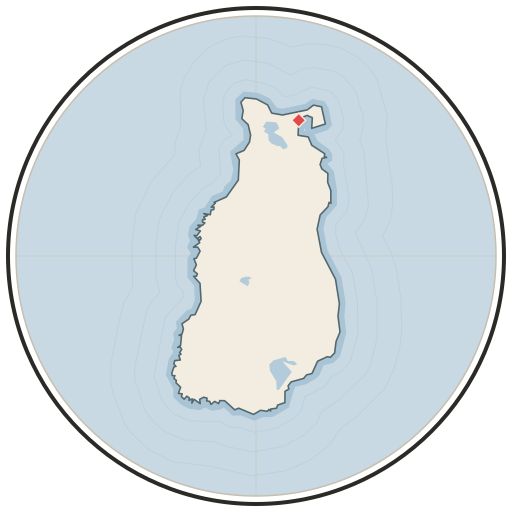
In August 1960 the Beacon introduced “Mr. John Ozaga, a student at Michigan State,” studying predators on the island as a Game Division student conservation aide.1 That month he tagged a coyote that, by April 1961, had been shot 350 miles north in Levering, Michigan — evidence, the paper noted, that coyotes traveled widely from the island.2
By March 1961 he was described as “Conservation Department Biologist” rather than student aide, and had tracked coyotes an estimated 350 miles across the island that winter. His count found eleven dead deer carcasses, two of them killed by coyotes, and he estimated that roughly thirty additional deer had been left in the woods by hunters because of a lack of tracking snow that season — a number he set against a Conservation Department three-year mainland average of four dead deer per square mile under a bucks-only season.3
The Conservation Department’s September 1961 report, covering his 214 miles of hiking from January through March that year, gave the fullest picture: records kept since 1947 showed 21 coyotes killed by deer hunters, 38 by coyote hunters, and 78 trapped, for a cumulative total of 137 over the preceding 24 years. Of animals found dead during his 1961 hikes, one deer had been killed by a coyote (against eight lost to the deer season itself), two snowshoe rabbits were confirmed coyote kills with nine more of uncertain cause, and of nine dead grouse found, one had been taken by a predatory bird, one by a fox, one by a coyote, and six of uncertain cause. Ozaga concluded from the study that the island’s coyote and fox population was now low and no longer a serious concern to hunters, and separately reported that the grouse population was exceptionally high that year (233 birds counted in 29 broods, against just three broods the year before) ahead of the October 1 grouse season. The same September report carried Vernon Fitzpatrick’s announcement of a bucks-only deer season for 1961, adopted to let the herd rebuild.4
In January 1962 the paper reported that Ozaga had tagged nine coyotes that past summer, none of which were among nine coyotes taken that fall in a December hunt, except for one hunter’s joke of placing a bear tag on a coyote Ozaga was called out to check.5 A March 2011 “50 Years Ago” retrospective column in the Beacon revisited the March 1961 report, crediting Ozaga with the 350-mile coyote tracking figure but stating “nine dead deer carcasses” where the original 1961 item reported eleven, a discrepancy this article flags rather than resolves.6
Significance
Ozaga’s counts are the most granular wildlife-mortality data the held Beacon record preserves for Beaver Island’s mid-century coyote-management debate, which recurs across the corpus in game-club bounty programs, organized hunts, and repeated Conservation Department notices through the 1960s and 1970s. His 1961 conclusion, that the island’s predator population had fallen to a level no longer worth alarm, sits alongside the cumulative 1947–1961 kill total of 137 coyotes as evidence for how the department justified continued, if reduced, hunting and trapping pressure rather than elimination.
Evidence and limits
This is an episode-qualified record spanning three field seasons (1960–1962), drawn entirely from the Beacon’s own summaries of Ozaga’s reports rather than his original field notes or any Conservation Department file. No source held here gives Ozaga’s age, hometown, academic outcome at Michigan State, full career, or later wildlife-management assignments. The 2011 retrospective column’s “nine” versus the original 1961 report’s “eleven” dead deer carcasses is noted above as an unresolved inconsistency between two Beacon issues 50 years apart, not a claim this article adjudicates.
Open questions
- What was John Ozaga’s full career and formal Conservation Department assignment after 1961–1962?
- Where are his field notes and the underlying wildlife records, if they survive?
- Does the “nine” versus “eleven” dead-deer-carcass discrepancy between the 1961 report and the 2011 retrospective trace to a transcription error, or does the 2011 column draw on a different source?
See also
Footnotes
The dated record
Sources
- Identifies John Ozaga as a Conservation Department biologist and attributes the 1961 predator study, 214 miles of hiking, mortality observations, and grouse-brood count to him.data1 · beaver-island-archive · beaver_beacon · 1961-09_Beaver-Beacon
- The held seven-page issue scan is paired with the OCR source and confirms the published notice or report; it does not expand the source-specific identity, event, or outcome claims.data1 · beaver-island-archive · scans · beaver_beacon · issues · 1961-09_Beaver-Beacon
- Identifies John Ozaga as a Michigan State student and Game Division student conservation aide studying predators on Beaver Island; it does not provide a full personnel biography.data1 · beaver-island-archive · beaver_beacon · 1960-08_Beaver-Beacon
- The held four-page issue scan is paired with the OCR source and confirms the published notice or report; it does not expand the source-specific identity, event, or outcome claims.data1 · beaver-island-archive · scans · beaver_beacon · issues · 1960-08_Beaver-Beacon
- Reports that John Ozaga had tagged nine coyotes during the previous summer and that none of nine coyotes taken in the fall had one of his tags; it does not establish a complete tagging register or identify the hunters beyond the article’s account.data1 · beaver-island-archive · beaver_beacon · 1962-01_Beaver-Beacon
- The held five-page issue scan is paired with the OCR source and confirms the published notice or report; it does not expand the source-specific identity, event, or outcome claims.data1 · beaver-island-archive · scans · beaver_beacon · issues · 1962-01_Beaver-Beacon
- Reports that a coyote tagged on Beaver Island in August 1960 by "John Ozaga, Conservation Department agent," was shot in Levering, Michigan in April 1961, evidence the paper offers of coyote travel across the ice.data1 · beaver-island-archive · beaver_beacon · 1961-04_Beaver-Beacon
- The held six-page issue scan is paired with the OCR source and confirms the published notice or report; it does not expand the source-specific identity, event, or outcome claims.data1 · beaver-island-archive · scans · beaver_beacon · issues · 1961-04_Beaver-Beacon
- Identifies John Ozaga as Conservation Department Biologist studying coyotes on the island that winter, reporting an estimated 350 miles tracked, eleven dead deer carcasses found (two coyote-killed), and an estimate of about thirty deer left in the woods by hunters due to lack of tracking snow.data1 · beaver-island-archive · beaver_beacon · 1961-03_Beaver-Beacon
- The held six-page issue scan is paired with the OCR source and confirms the published notice or report; it does not expand the source-specific identity, event, or outcome claims.data1 · beaver-island-archive · scans · beaver_beacon · issues · 1961-03_Beaver-Beacon
- Beaver Beacon, March 2011, "50 Years Ago" retrospective column.A fifty-years-ago retrospective summarizes the March 1961 item, crediting Ozaga with tracking coyotes 350 miles and finding "nine dead deer carcasses" — a figure that does not match the original March 1961 report's "eleven dead deer carcasses," a discrepancy this article flags rather than resolves. No public copy of this file is known; the archive holds one and can provide it on request.data1 · beaver-island-archive · beaver_beacon · 2011-03_Beaver-Beacon
- The held forty-four-page issue scan is paired with the OCR source and confirms the published notice or report; it does not expand the source-specific identity, event, or outcome claims.data1 · beaver-island-archive · scans · beaver_beacon · issues · 2011-03_Beaver-Beacon
Added 1 August 2026 · revised 5 August 2026. Recent changes
Cite this article
Beaver Island Archive, “John Ozaga”, https://beaverislandarchive.org/people/john-ozaga/, accessed [date], citing Beaver Beacon, September 1961, “Conservation Department News.” (and 11 further sources listed on the page).
Last revised 2026-08-05. Fill in [date] with the date you read it — this page is static and cannot know that.