- Date
- 1855-07-31
- Eras
- Strang eraIndigenous era
- Concepts
- governancetreaty-rightsanishinaabe-odawa
- Within
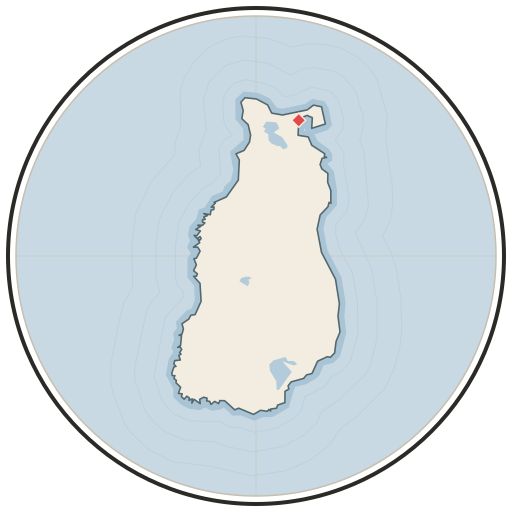
- Beaver Island archipelago
Summary
The Treaty of Detroit was concluded on 31 July 1855 at Detroit between commissioners George W. Manypenny and Henry C. Gilbert, on the part of the United States, and the Ottawa and Chippewa Indians of Michigan — described in the treaty’s own preamble as “parties to the treaty of March 28, 1836.” It was ratified on 15 April 1856, proclaimed on 10 September 1856, and published at 11 Statutes 621. Its six articles withdraw specific tracts of Michigan public land from sale for named bands, including the Beaver Island Band, set out cash and in-kind payments, release the United States from liability under earlier treaties (with one named exception), and dissolve the “tribal organization” of the signatory Ottawa and Chippewa in most respects. Where the 1836 Treaty of Washington reserved “the Beaver islands of Lake Michigan” as a single unnamed tract for a five-year term, the 1855 treaty names the Beaver Island Band’s holdings with more precision, but assigns them to High Island and Garden Island rather than to Beaver Island itself.
Land withdrawn and reserved
Article First withdraws from sale “all the unsold public lands within the State of Michigan” described in eight numbered tracts, one for each named band or group of bands. The third of these reads, in full: “For the Beaver Island Band—High Island, and Garden Island, in Lake Michigan, being fractional townships 38 and 39 north, range 11 west—40 north, range 10 west, and in part 39 north, range 9 and 10 west.” A separate, fourth tract — for the Cross Village, Middle Village, L’Arbre Croche, and Bear Creek bands — is also opened to “such Bay du Noc and Beaver Island Indians as may prefer to live with them,” meaning the treaty did not require every person associated with the Beaver Island Band to settle on the High Island/Garden Island tract; some could instead take land among the mainland bands. Article First does not mention Beaver Island itself in any of the eight tracts.
The article also sets out how individual allotments within these tracts were to be assigned: 80 acres to each head of family, 40 acres to each single person over 21, and 80 or 40 acres to orphaned children depending on family size, selected and listed by the Indian agent by 1 July 1856, with restricted certificates converting to patents after ten years.
Payments
Article Second sets the United States’ total payment to the signatory Ottawa and Chippewa at $538,400: $80,000 for education over ten annual installments; $75,000 over five years for agricultural implements, carpenters’ tools, household goods, building materials, cattle, and labor connected with removal and settlement; $42,400 for ten years of support for four blacksmith shops; $306,000 distributed largely per capita over ten years and after; and $35,000 over ten years paid specifically to the Grand River Ottawas in place of earlier permanent annuities. The treaty does not break these sums out by band, so no figure specific to the Beaver Island Band’s payment is stated in the text.
Release of prior claims
Article Third has the Ottawa and Chippewa “release and discharge the United States from all liability on account of former treaty stipulations,” including the 1836 Treaty of Washington, in exchange for the grants and payments set out above — with one named exception: “the right of fishing and encampment secured to the Chippewas of Sault Ste. Marie by the treaty of June 16, 1820.” The 1855 treaty text names that exception for the Sault Ste. Marie Chippewas alone; it does not restate a fishing or encampment right for the Beaver Island Band, and this article does not infer one where the text is silent.
Beaver Island provisions
Article First’s schedule is the treaty’s operative allocation for this archipelago: “For the Beaver Island Band—High Island, and Garden Island.” The wording is evidence for the treaty’s allocation of those islands; it is not by itself a complete history of occupancy, title, or present-day jurisdiction. The Anishinaabe presence in the archipelago article places the provision alongside the much thinner local and settler record.
Article Fifth says that the “tribal organization” of the signatory Ottawa and Chippewa, “except so far as may be necessary for the purpose of carrying into effect the provisions of this agreement, is hereby dissolved,” and provides that any future negotiations would proceed without a general convention of the signatory Indians. That is quoted treaty language, not a timeless description of Anishinaabe political life or of current tribal sovereignty. The present knowledge base retains this distinction because later federal recognition and contemporary tribal governments are separate subjects requiring their own authoritative sources. Article Sixth makes the agreement “obligatory and binding on the contracting parties” only once ratified by the President and Senate — the ratification recorded above.
Open questions
- The corpus needs a page-image or National Archives transcription checked against this treaty-text capture.
- The legal history connecting the 1836 Beaver-island reservation, the 1855 island schedule, and later federal recognition is not yet modeled as a chain of legal proceedings.
- The treaty’s full schedule and all provisions should be indexed as structured evidence rather than represented only in this summary.
See also
Read the document
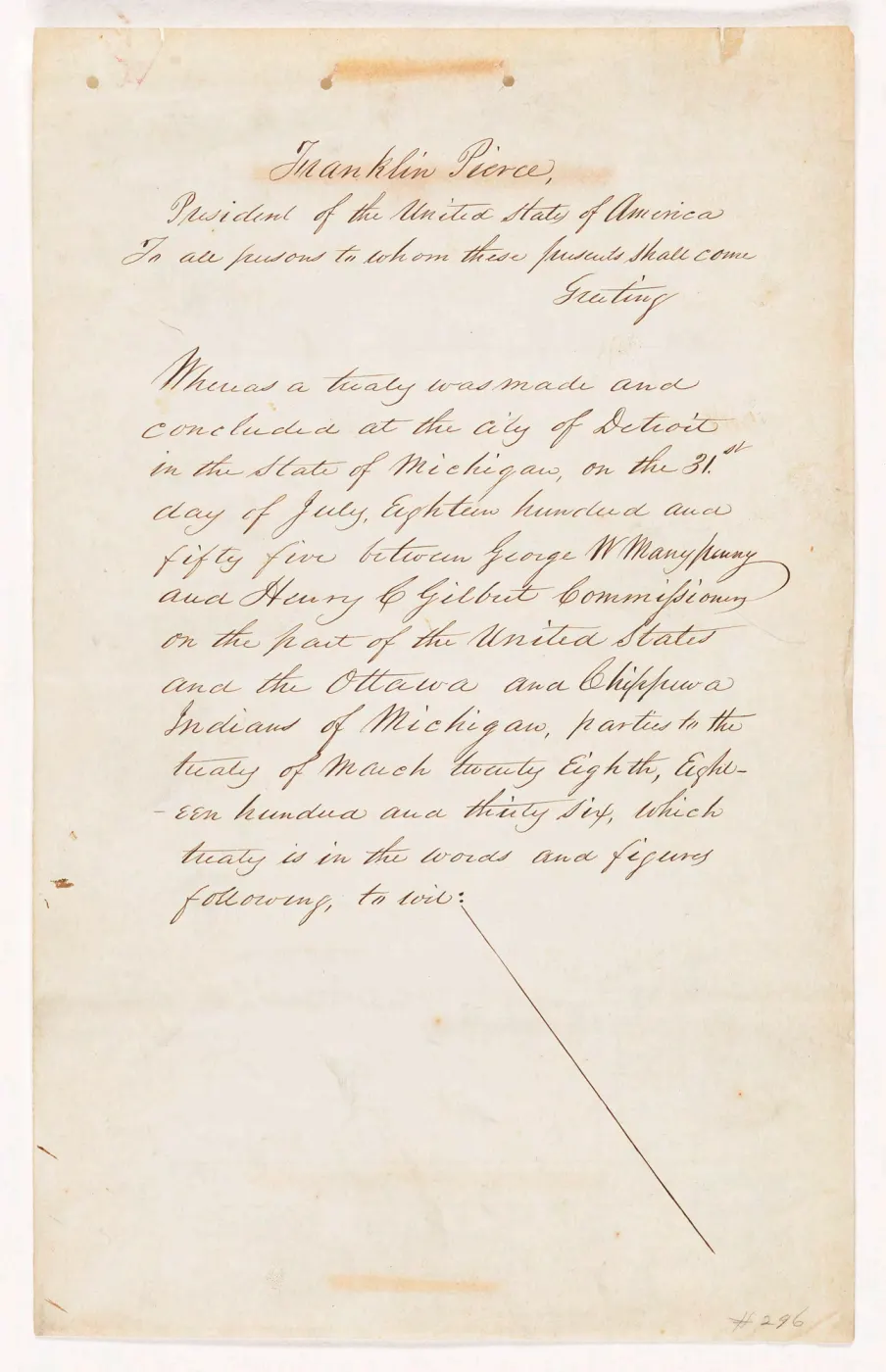
40 pages, rendered from the held scan.


Sources
- Retrieved treaty text held in the corpus. The local capture records the signature, ratification, proclamation, Statutes citation, and Articles First, Second, Third, Fifth, and Sixth used here.web · treaty_1855_detroit
- The proclamation leaf (image 1) opens: "Whereas a treaty was made and concluded at the city of Detroit in the State of Michigan, on the 31st day of July, eighteen hundred and fifty five between George W. Manypenny and Henry C. Gilbert Commissioners on the part of the United States and the Ottawa and Chippewa Indians of Michigan, parties to the treaty of March twenty eighth, eighteen hundred and thirty six" -- opened and read; matches this article's citation verbatim. Franklin Pierce's proclamation signature; docket number '#296' visible bottom right, matching Ratified Indian Treaty 296. Public domain, U.S. Government record.images · commons · extract · ratified_indian_treaty_296_ottawa_and_chippewa_sault_ste_marie_bands_grand_river_bands_grand_traverse_bands_little_traverse_bands_and_mackinac_bands_detroit_michigan_jul_dpla_44bd037b155c16dcd8a1fddcdfb2af0c
Added 31 July 2026. Recent changes
Cite this article
Beaver Island Archive, “Treaty of Detroit with the Ottawa and Chippewa, 1855”, https://beaverislandarchive.org/documents/treaty-detroit-1855/, accessed [date], citing Treaty with the Ottawa and Chippewa, 31 July 1855, 11 Stat. 621. (and 1 further source listed on the page).
Last revised 2026-07-31. Fill in [date] with the date you read it — this page is static and cannot know that.
BibTeX for “Treaty of Detroit with the Ottawa and Chippewa, 1855”RIS for “Treaty of Detroit with the Ottawa and Chippewa, 1855”