- Date
- 1836-03-28
- Eras
- Early American eraIndigenous era
- Concepts
- governancetreaty-rightsanishinaabe-odawa
- Within
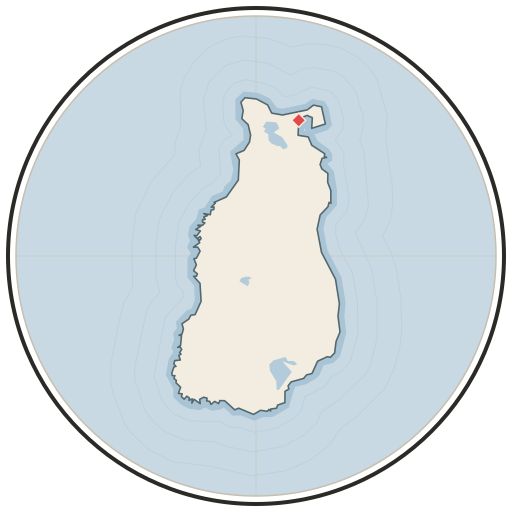
- Beaver Island archipelago
Summary
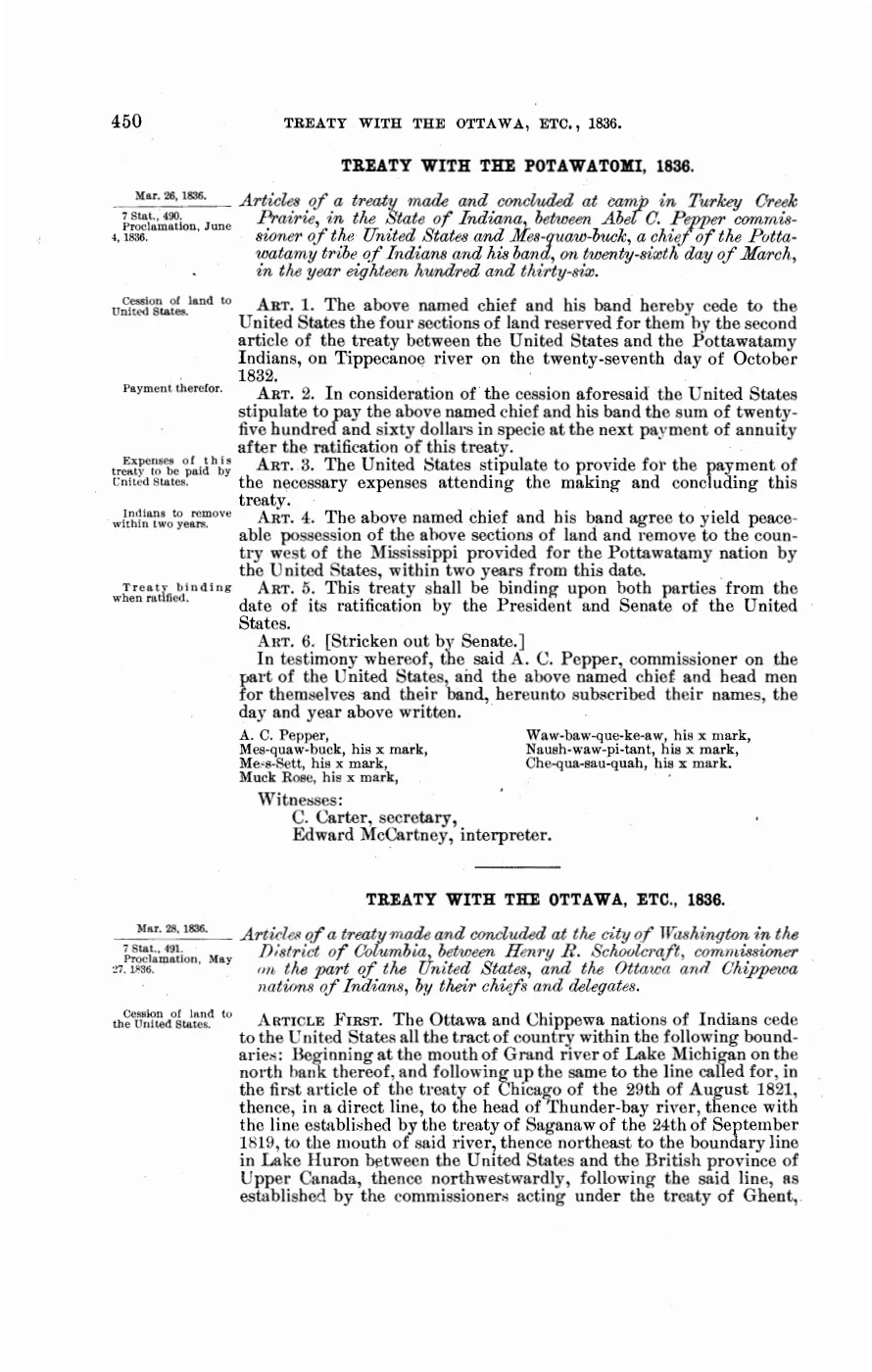
The Treaty of Washington, signed on 28 March 1836 and proclaimed on 27 May, is the earliest federal treaty that names the Beaver islands directly, predating the 1855 Treaty of Detroit. It is a federal agreement between the United States and the Ottawa and Chippewa nations, negotiated by commissioner Henry R. Schoolcraft and published at 7 Statutes 491. The text quoted below is read from the standard public-domain compilation of federal Indian treaties held here — Charles J. Kappler’s Indian Affairs: Laws and Treaties, volume II, pages 450–456 — not from a secondary transcription; page numbers cited here are the printed folio, read off the scan itself.
The cession
Article First is the operative cession. It describes a single boundary running from the mouth of the Grand River, up through the line of the 1821 Treaty of Chicago, east to the head of the Thunder Bay River, north along the 1819 Treaty of Saginaw line, northeast to the international boundary in Lake Huron, through the Straits and the St. Marys River, west along the south shore of Lake Superior to the Chocolate River, south to the Green Bay shoreline, and back east across Lake Michigan to the point of beginning. The Ottawa and Chippewa nations, it says,
“cede to the United States all the tract of country within the following boundaries … comprehending all the lands and islands, within these limits, not hereinafter reserved” (Kappler II, pp. 450–451).
The Beaver archipelago falls within that boundary and so is ceded outright, subject to the reservation Article Third then carves out of it.
The Beaver Island reservation
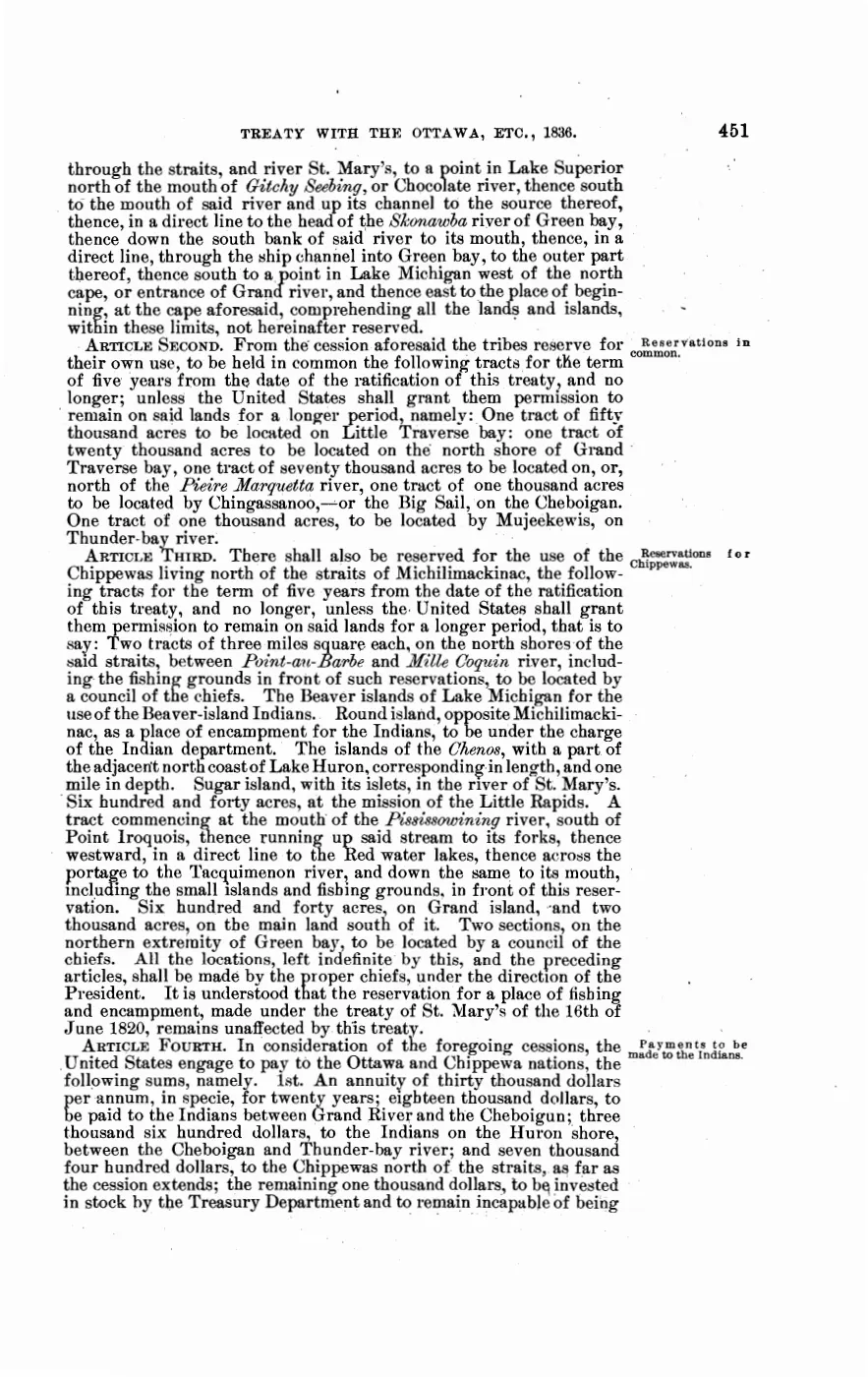
Article Third reserves specific tracts “for the use of the Chippewas living north of the straits of Michilimackinac” for a term of five years from ratification, “and no longer, unless the United States shall grant them permission to remain on said lands for a longer period.” Among the listed tracts:
“Two tracts of three miles square each, on the north shores of the said straits, between Point-au-Barbe and Mille Coquin river, including the fishing grounds in front of such reservations, to be located by a council of the chiefs. The Beaver islands of Lake Michigan for the use of the Beaver-island Indians. Round island, opposite Michilimackinac, as a place of encampment for the Indians …” (Kappler II, p. 451).
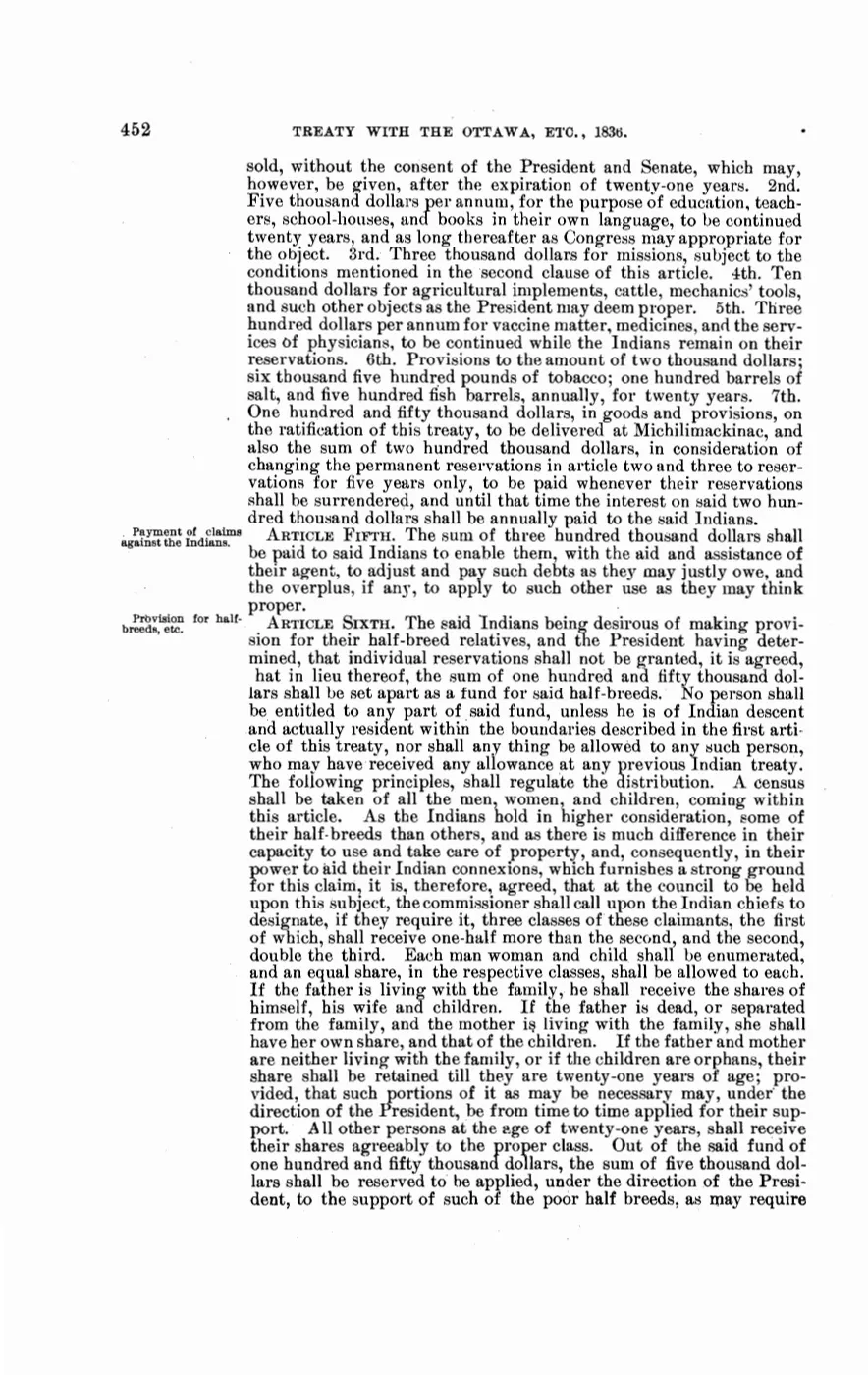
This is the sentence on which the Anishinaabe presence in the archipelago article’s whole documentary record ultimately rests. Two things in the surrounding text are easy to lose if the sentence is quoted alone. First, the reservation is time-limited on its face — five years, extendable only at federal discretion — a limitation Article Fourth reinforces by paying an additional $200,000 “in consideration of changing the permanent reservations in article two and three to reservations for five years only” (Kappler II, p. 452). Second, the “fishing grounds” language in this article is attached explicitly to the Point-au-Barbe/Mille Coquin tracts and to a Sault Ste. Marie-area tract further down the same list — the treaty text does not repeat that phrase for the Beaver islands specifically, and this article does not claim it does.
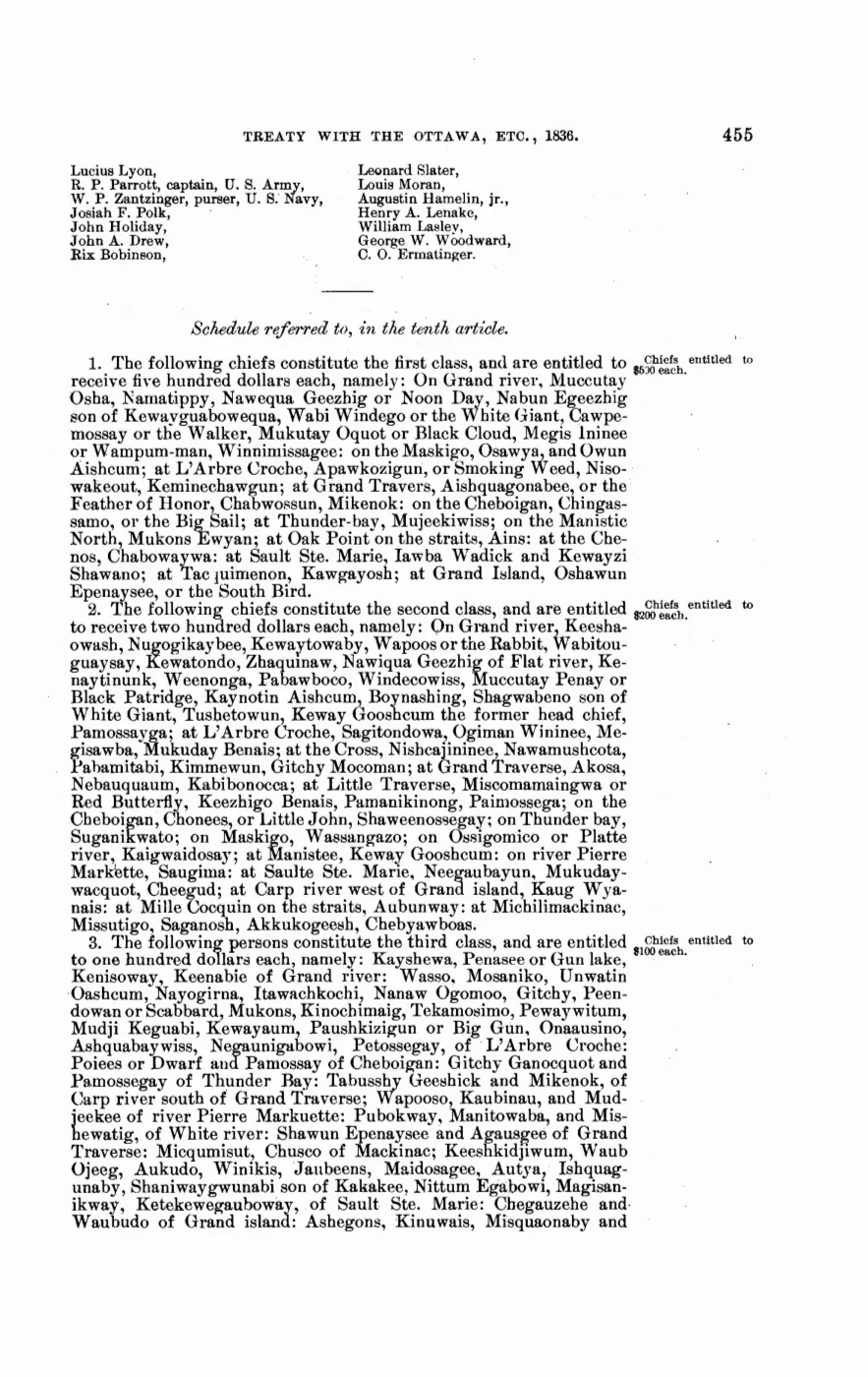
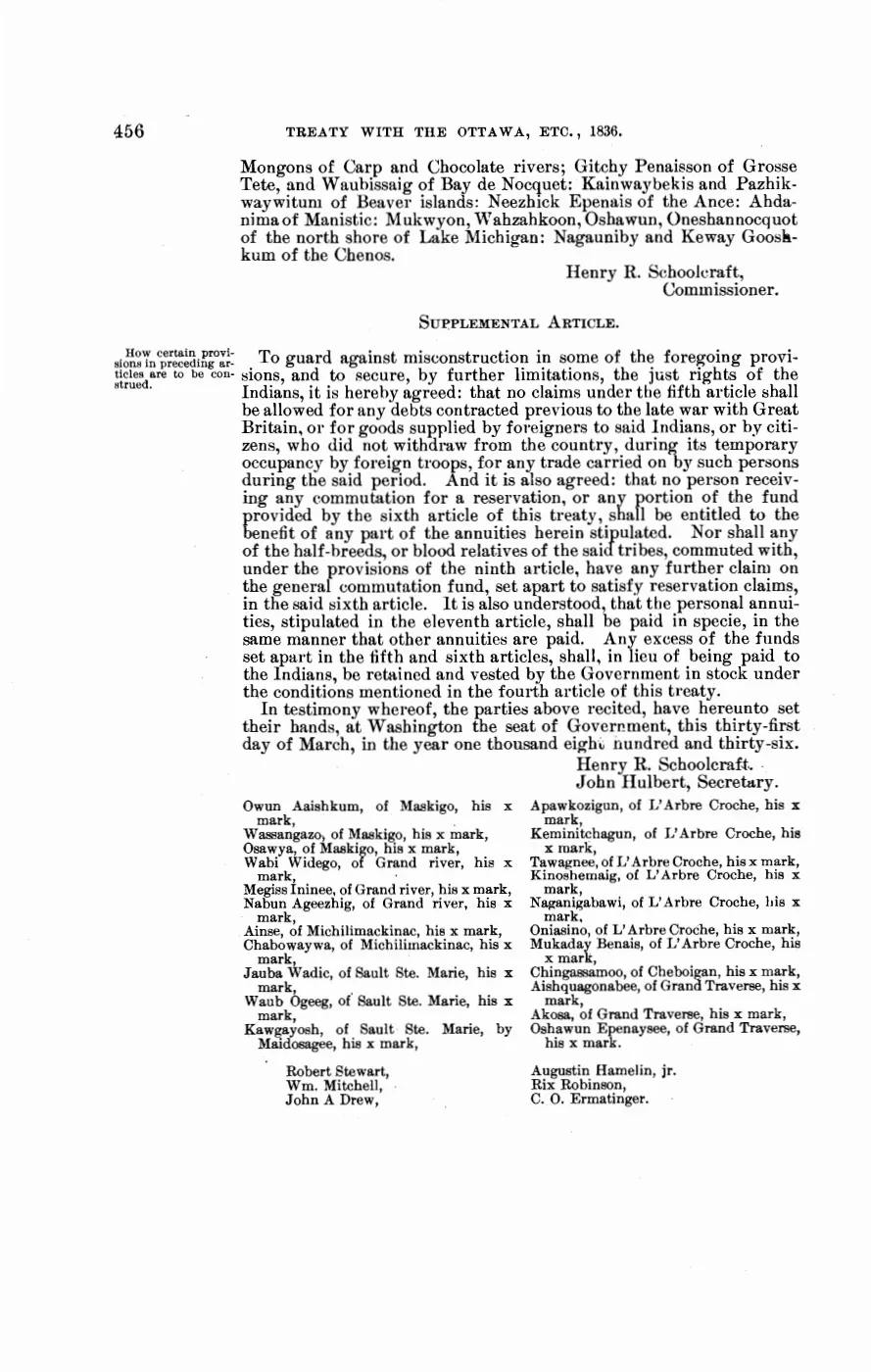
Later in Article Third, the schedule referenced in Article Tenth names Kainwaybekis and Pazhikwaywitum among the third class of individual payees, “entitled to one hundred dollars each”: “… Kainwaybekis and Pazhikwaywitum of Beaver islands …” (Kappler II, p. 456). The names are preserved in the treaty’s spelling; the schedule places them “of Beaver islands” and entitles them to a payment — it does not identify them as signatories, establish that they were present at Washington, or establish a fuller identity.
Hunting and occupancy on the ceded lands
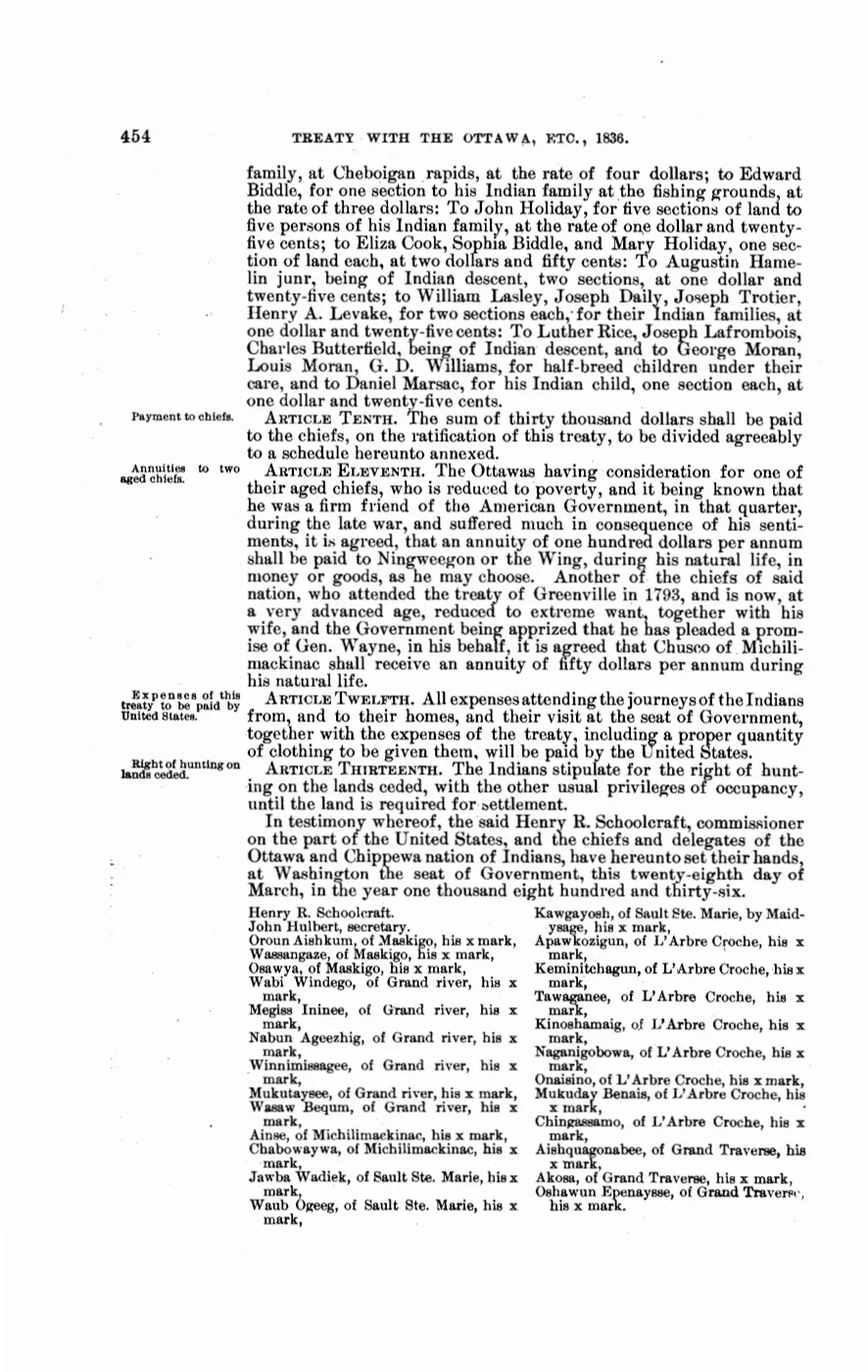
The treaty’s only rights clause covering the ceded territory generally — as distinct from the enumerated reservations — is Article Thirteenth:
“The Indians stipulate for the right of hunting on the lands ceded, with the other usual privileges of occupancy, until the land is required for settlement” (Kappler II, p. 454).
This is described here as a hunting-and-occupancy clause, not a treaty article captioned for fishing, because that is what the 1836 text says, not because later usufructuary-rights litigation is being summarized here. Any claim about the treaty’s effect on fishing rights specifically should be checked against the specialized legal literature and case law construing this and related treaties, not inferred from this article alone.
Which copy is canonical
Two copies of this treaty are held here. The Kappler scan cited above — a U.S. Government publication in the public domain — is the canonical text and the one this article quotes. A second capture, transcribed from Oklahoma State University’s Tribal Treaties Database, is kept only as a secondary witness: its webpage carries a fair-use notice rather than a public-domain license, so that particular capture is not republished here, even though the two copies agree on every clause quoted here.
Open questions
- Kainwaybekis and Pazhikwaywitum are not yet connected to verified family, biographical, or Indigenous-authored sources beyond the treaty schedule.
- The relationship between this five-year reservation, Article Thirteenth’s hunting clause, and later treaty provisions, including the 1855 Detroit treaty and modern usufructuary-rights case law, needs a dedicated legal and historical study this article does not attempt.
- The five-year term is a feature of this instrument’s text and should not be collapsed into a claim that Anishinaabe presence on the islands ended in 1841: the Anishinaabe presence in the archipelago article documents continuous presence and the limitations of the settler record.
See also
Read the document
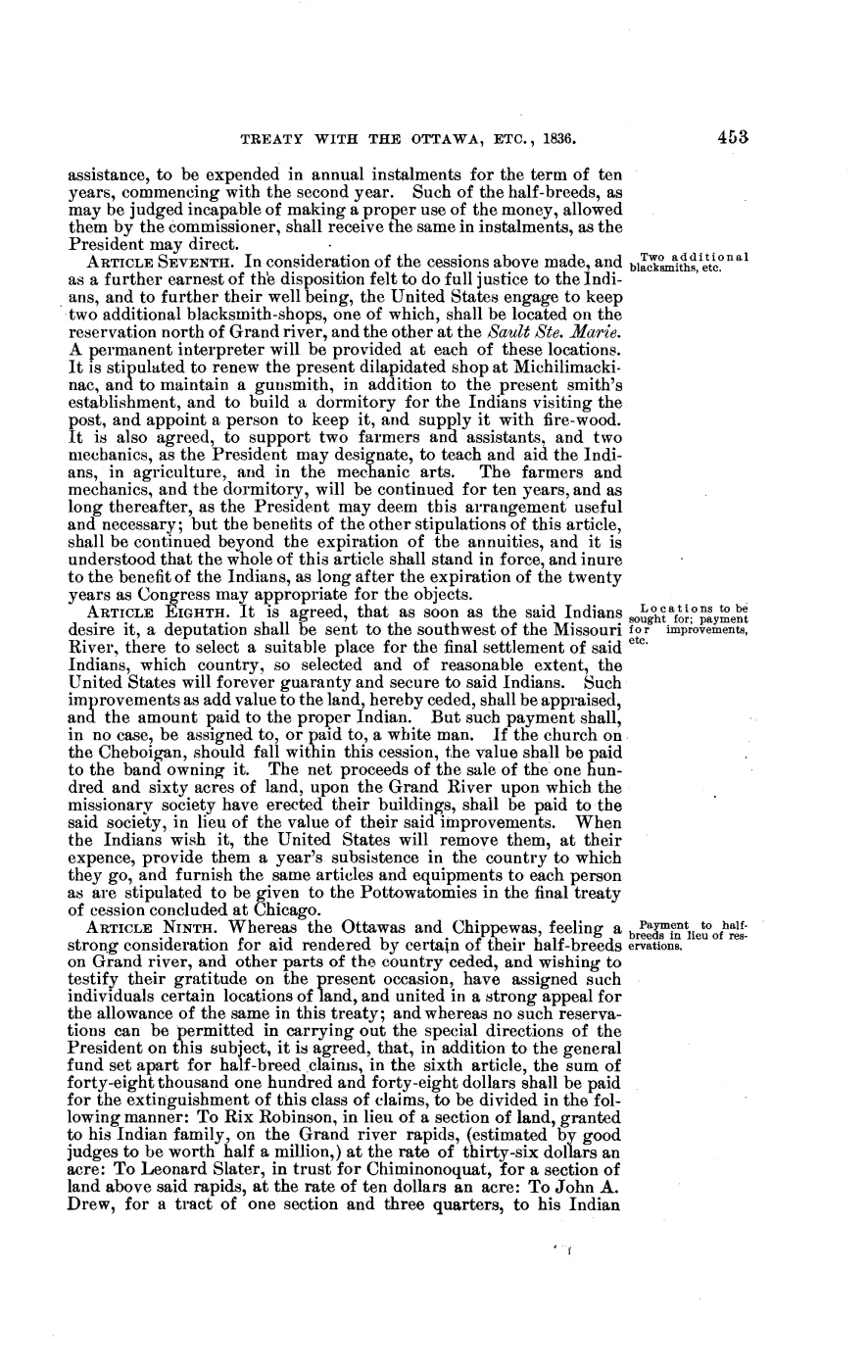
7 pages, rendered from the held scan. The printed folios run 450–456; the scan's own images run 1–7.
Sources
- The federal original: the standard public-domain compilation, digitized by Oklahoma State University Library from the Government Printing Office edition and stated by OSU to be a U.S. Government publication in the public domain. This is the canonical copy of the treaty text held here; page citations in this article are to the printed folio (450–456), read off the page numbers printed on the scan itself.documents · treaty_1836_washington_kappler · sources · kappler-vol2-treaty-with-the-ottawa-etc-1836-pp450-456
- Page-labelled PyMuPDF extraction derived from the held Kappler scan, one page per printed folio 450–456. Consult the PDF for the scan itself; quotations in this article were checked against this text.documents · treaty_1836_washington_kappler · kappler-vol2-treaty-with-the-ottawa-etc-1836-pp450-456
- Secondary witness, not republished here. A transcription scraped from Oklahoma State University's Tribal Treaties Database; the webpage itself carries a fair-use notice rather than a public-domain license, so this capture is held for comparison only. It independently transcribes the same treaty and agrees with the held Kappler scan below on every clause quoted in this article.web · treaty_1836_washington
Added 31 July 2026 · revised 2 August 2026. Recent changes
Cite this article
Beaver Island Archive, “Treaty of Washington with the Ottawa, etc., 1836”, https://beaverislandarchive.org/documents/treaty-washington-1836/, accessed [date], citing Charles J. Kappler, comp., Indian Affairs: Laws and Treaties, vol. II (Treaties), Washington: Government Printing Office, 1904, pp. 450–456, “Treaty with the Ottawa, etc., 1836.” (and 2 further sources listed on the page).
Last revised 2026-08-02. Fill in [date] with the date you read it — this page is static and cannot know that.
BibTeX for “Treaty of Washington with the Ottawa, etc., 1836”RIS for “Treaty of Washington with the Ottawa, etc., 1836”