- Founded
- 1959-03
- Dissolved
- 1966-11
- Coordinates
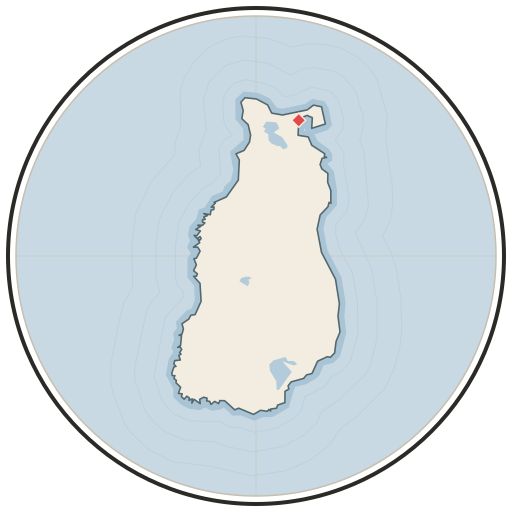
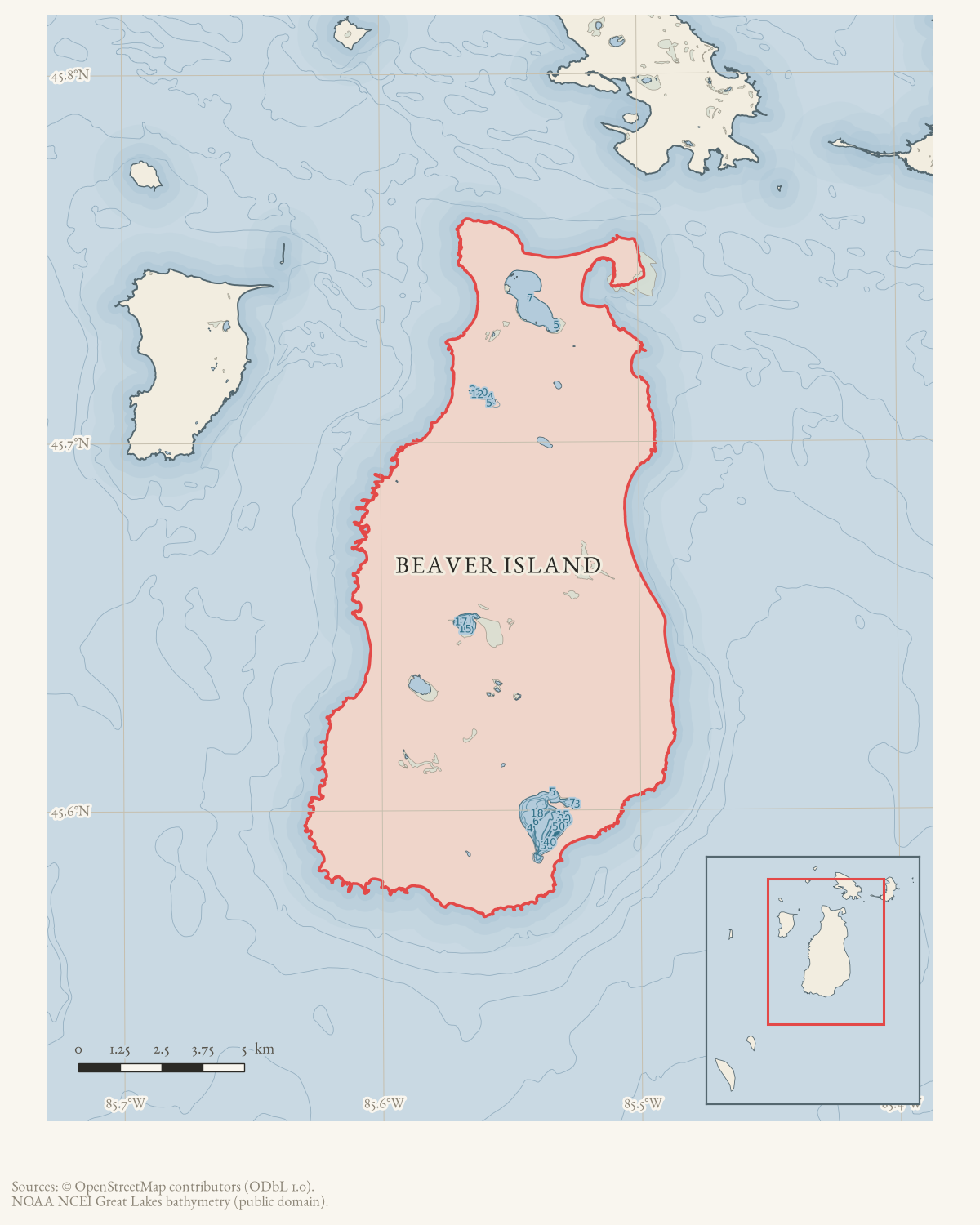
- 45.6833° N, 85.5001° WGoogle Maps: Central Michigan UniversityDownload KML
- Eras
- Modern era
- Concepts
- educationcommunityconservation
- Within
- Beaver Island
Summary
Central Michigan University’s Beaver Island program began with a building on Sand Bay announced in March 1959 and opened that August, before the Beaver Beacon had settled on a name for it. By January 1960 the State Board of Education had accepted the building as college property and named it the Conference House; the Beacon soon called it the “C.M.U. Center” instead, and the two names appear side by side through the mid-1960s. Held newspaper notices trace the program almost without a gap from 1959 to 1966: annual summer classes, a 1964 laboratory building, and a Sand Bay facility that mainland institutions and island organizations used for their own meetings — a civic improvement workshop, a statewide clergy economic conference, a legislative hearing, an outdoor writers’ convention — years before the university started calling the place its “Biological Station” in February 1967. This article covers the program under its earlier names, 1959-1966; see Central Michigan University Biological Station for the named institution that followed, and Evidence and limits, below, for how the two articles divide the record and what remains unresolved between them.
History
The earliest held notice, in the March 1959 Beacon, reports Henry Allen, consulting engineer to the State Board of Education, announcing that Central Michigan University planned “a building about the middle of Sand Bay, to house 40 students,” for special summer courses. By June the building was “mushrooming” — the Beacon described it as “an extention branch of the Biological Dept. of Central Michigan University,” with capacity for about 40 students and a reported cost of $30,000, expected to be finished in early August.
It opened, still unnamed in print, for a weekend session on 21–24 August 1959. The Beacon lists the attendees: State Board of Education members Stephen and Mrs. Nisbett, Superintendent of Public Instruction Lynn Bartlett and family, and Chris Magnusson; the presidents of Western Michigan, Eastern Michigan, Northern Michigan, and Central Michigan universities with their families; several controllers and vice-presidents for business affairs; and State Board supervising engineer Henry C. Allen, who by then had a Beaver Island address of his own.
By January 1960 the Beacon’s “Welcome” notice reported the building “officially accepted by the State Board of Education” and named the Conference House: dormitory housing for 40, and a published schedule of short courses for that summer in conservation, biology, outdoor education, art, and music, self-financed at $45 per semester hour of credit. The Conference House carries the building’s own record; this article follows the program.
Summer 1960 bore that out. The May Beacon reported the extension school “booked to capacity” for its summer classes; the first class arrived that June; and by September the paper judged, in a single line, that “Central Michigan University classes raised our summer population by a fair margin.” In July, an ornithology class based at what the Beacon called the “C.M.U. Lodge” identified more than 100 bird species during island field work — the same skill the program would keep offering, in one form or another, for decades after.
The program surfaces twice more in 1961, in both cases as a partner rather than the subject. On 3-4 February the Beaver Island Civic Association convened the Beaver Island Improvement Workshop, inviting island and mainland business people alongside the Conservation Department, the Charlevoix County Road Commission, the Beaver Island Boat Company, and Central Michigan University to discuss the island’s growth; the Beacon reported 33 attendees and called the two-day meeting a success. That September, about 80 clergy, business, and labor representatives met at what the Beacon now called “Central Michigan University’s center on Beaver Island” for the first Clergy Economic Foundation Conference held in Michigan, a four-day meeting co-sponsored by the Clergy Economic Foundation and directed by Howard Sommer. It is the earliest held source to call the building a “center” rather than the January 1960 “Conference House,” and the same October issue records a further $16.60 collected there for repairs to Dr. Feodor Protar’s home.
CMU’s Beaver Island presence read as personal, not only institutional, by 1962. The September Beacon reported that “President Elliott and Executive Vice President Grey of Central Michigan University” — named only by surname — had purchased lots at Wicklow Beach, and that Gerald R. Poor of the university had turned over a further $16.14 collection to the Beaver Island Historical Society’s Protar fund. In July 1963 the state legislature’s Interim Committee on State Parks and Public Lands held a public hearing “at the C.M.U. Center” as part of a two-day island visit; Central Michigan University’s delegation was Dr. Woody Smith, George Wheeler, Pete Merdick, Hal Bell, and Colin Smith. “C.M.U. Center” and “Conference House” appear side by side in the Beacon through the decade; no source read distinguishes which name applied to which building, or whether both named the same one.
By May 1964 the university had begun construction of a 24-by-48-foot laboratory building for that summer’s use — the first held record of construction beyond the original Conference House. A month later Central Michigan University hosted the Michigan Outdoor Writers Association’s three-day convention, 11-14 June, housing about 60 members at university facilities with overflow at Beaver Lodge and island motels; the Beaver Island Game Club served as host, and Howard Sommess — Sommer in the 1961 spelling — again represented the university. An August thank-you letter from writer Leonard R. Barnes called it the association’s best meeting in its twenty-year history.
No source read names Central Michigan University in 1965, but two items that summer describe its program without spelling out the name. In July, researchers at “C.M.U.’s summer facility” live-trapped, tagged, and released 300 chipmunks in a single afternoon. In August, the Beacon reported about 40 graduate students completing eight weeks of field work, marked by a farewell picnic at the township campground — and, in the same report, four of the group beaching a 16-foot boat overnight on Hog Island in high winds. The Coast Guard searched by air and sea while the university’s own boat, the Chippawa, joined the search and found the four in good condition: the Hog Island rescue.
The record resumes under the “C.M.U.” banner in 1966. An open house on 17 July served the island community coffee, doughnuts, and lemonade during a tour of the center, and the eight-week summer session closed on 14 August, again enrolling biology teachers from across the country working toward degrees. That November, “Dr. and Mrs. Matthew Hahn, of Central Michigan University” contracted builder Walt Wojan for a new summer home on the island’s east side, foundation already in. Three months later, in February 1967, the Beacon reported a $44,940 grant for a “Summer Institute of Biology for Secondary School Teachers” directed by “Dr. Matthew H. Hohn, professor in the C.M.U. Department of Biology” — the first source read to name the facility the “Beaver Island Biological Station.” Neither notice reconciles the “Hahn” and “Hohn” spellings; the shared given name, middle initial, and university affiliation, five months apart, make it probable they are the same person, but no source read states this directly. The February 1967 notice marks the end of this article’s scope; see Central Michigan University Biological Station for the named Biological Station that follows.
Evidence and limits
No source read for this article gives a university charter, a formal building-ownership record, a complete enrollment figure, or a course catalogue for these years. The Beacon’s coverage is nonetheless close to continuous from March 1959 through November 1966, with no gap longer than a year and 1965 covered only by two items that never spell out the university’s name. What the record does not establish is whether the 1959 Conference House, the “C.M.U. Center” named from 1961, and the 1964 laboratory building are one expanding campus, a single building called by different names in different years, or more than one structure — no source read draws that connection. Nor does any source read confirm that Dr. Matthew Hahn (November 1966) and Dr. Matthew H. Hohn, the institute and station director named in February 1967, are the same person; that identification, made above, is this article’s inference from the surrounding evidence, not a stated fact. The two organization articles are kept separate because the earlier sources describe a building and program without the “Biological Station” name, while the 1967 source introduces both that name and a named director; readers wanting the continuous institutional history should read both, in order.
Significance
These are the earliest held records of Central Michigan University’s presence on Beaver Island, a presence that continued under the Biological Station name into the 2000s. Beyond its own summer classes, the record shows the Sand Bay center hosted the island’s civic improvement planning, a statewide clergy economic conference, a state legislative hearing, and an outdoor writers’ convention within its first eight years — a university facility that mainland institutions and island organizations used as shared infrastructure well before it carried the Biological Station name. The 1959 description of the building as “an extension branch of the Biological Dept.” shows the program was biology-department territory from its first summer, years before “Biological Station” appears in print.
Open questions
- Whether the January 1960 Conference House, the “C.M.U. Center” named from 1961, and the 1964 laboratory building are the same structure, an expanding campus, or separate buildings is not established by any source read.
- Whether Dr. Matthew Hahn (November 1966) and Dr. Matthew H. Hohn, the director named in February 1967, are the same person — probable on the surrounding evidence, but not stated by any source read.
- Who administered the program day to day between 1960 and 1967. Howard Sommer/Sommess is named as a conference or convention organizer in 1961 and 1964, and Dr. Woody Smith heads the 1963 legislative delegation, but no source read names a station or program director before Dr. Hohn in 1967.
- What “President Elliott” and “Executive Vice President Grey” (1962) were called in full, and whether their Wicklow Beach purchase connects to the university’s institutional presence or was simply personal.
See also
- Central Michigan University Biological Station
- Central Michigan University Conference House
- First Central Michigan University summer class arrives, 1960
- Central Michigan University ornithology class identifies more than 100 bird species, 1960
- Beaver Island Improvement Workshop meets and reports projects, 1961
- Clergy Economic Foundation conference meets at the CMU center on Beaver Island, 1961
- Michigan Outdoor Writers Association Beaver Island convention announcement, 1964
- Coast Guard and CMU boat recover four stranded Hog Island researchers, 1965
- Beaver Island Historical Society
- Feodor Protar
The dated record
Sources
- Sand Bay point used as a bay-level representative location for the historical Beaver Island CMU program because the held reports place its 1959 Conference House there; it is not a university office or a surveyed building point.osm · water
- Reports Henry Allen, Consulting Engineer for the State Board of Education, announcing that Central Michigan University planned a building "about the middle of Sand Bay, to house 40 students" taking special summer courses. This is the earliest held notice of the program. The holding institution's portal restricts automated access; the archive holds a copy of this issue and can provide it on request.data1 · beaver-island-archive · beaver_beacon · 1959-03_Beaver-Beacon
- The held issue scan is paired with the OCR source and confirms the published notice.data1 · beaver-island-archive · scans · beaver_beacon · issues · 1959-03_Beaver-Beacon
- Describes the building under construction as "an extention branch of the Biological Dept. of Central Michigan University," facilities for about 40 students, expected completion in early August, at a reported cost of $30,000. The holding institution's portal restricts automated access; the archive holds a copy of this issue and can provide it on request.data1 · beaver-island-archive · beaver_beacon · 1959-06_Beaver-Beacon
- The held issue scan confirms the published notice.data1 · beaver-island-archive · scans · beaver_beacon · issues · 1959-06_Beaver-Beacon
- Reports the "new, yet unnamed facility" on Sand Bay opened for a weekend session August 21-24, 1959, attended by State Board of Education members and the presidents of Western Michigan, Eastern Michigan, Northern Michigan, and Central Michigan universities. The holding institution's portal restricts automated access; the archive holds a copy of this issue and can provide it on request.data1 · beaver-island-archive · beaver_beacon · 1959-09_Beaver-Beacon
- The held issue scan confirms the published notice.data1 · beaver-island-archive · scans · beaver_beacon · issues · 1959-09_Beaver-Beacon
- Names Central Michigan University in the announcement that its new Beaver Island college building had been accepted by the State Board of Education and would operate summer 1960 courses. It does not supply a university charter, program catalogue, or formal building ownership record.data1 · beaver-island-archive · beaver_beacon · 1960-01_Beaver-Beacon
- The held four-page issue scan is paired with the OCR source and confirms the published notice or report; it does not expand the source-specific identity, event, or outcome claims.data1 · beaver-island-archive · scans · beaver_beacon · issues · 1960-01_Beaver-Beacon
- Reports the University's Beaver Island extension school booked to capacity for summer classes. It does not supply enrollment, courses, or a program catalogue.data1 · beaver-island-archive · beaver_beacon · 1960-05_Beaver-Beacon
- The held three-page issue scan is paired with the OCR source and confirms the published notice or report; it does not expand the source-specific identity, event, or outcome claims.data1 · beaver-island-archive · scans · beaver_beacon · issues · 1960-05_Beaver-Beacon
- Reports that bird watchers in the "Ornithology class at C.M.U. Lodge identified over 100 species of birds during their field work." Does not supply a species list or instructor of record.data1 · beaver-island-archive · beaver_beacon · 1960-07_Beaver-Beacon
- The held issue scan confirms the published notice.data1 · beaver-island-archive · scans · beaver_beacon · issues · 1960-07_Beaver-Beacon
- States that "Central Michigan University classes raised our summer population by a fair margin." A one-line seasonal impression, not a count.data1 · beaver-island-archive · beaver_beacon · 1960-09_Beaver-Beacon
- The held issue scan confirms the published notice.data1 · beaver-island-archive · scans · beaver_beacon · issues · 1960-09_Beaver-Beacon
- Reports the Civic Association's 3-4 February workshop with 33 attendees, including representatives of the Conservation Department, "Central Michigan College," the Charlevoix County Road Commission, and the Beaver Island Boat Company, to discuss the island's growth and "the plans of the college." A later item in the same issue thanks Central Michigan University by name alongside the Conservation Department, Road Commission, and Boat Company for its help. Does not name any university officer present.data1 · beaver-island-archive · beaver_beacon · 1961-02_Beaver-Beacon
- Reports about 80 representatives at the first Michigan Clergy Economic Foundation Conference, 10-14 September 1961, at "Central Michigan University's center on Beaver Island" - the earliest source read that calls the building a "center" rather than the "Conference House." Co-sponsored by the Clergy Economic Foundation and Central Michigan University; Howard Sommer is named as conference director. The same issue records a $16.60 collection by George Wheeler at "Central Michigan University Center," earmarked for repairs to Dr. Feodor Protar's home.data1 · beaver-island-archive · beaver_beacon · 1961-10_Beaver-Beacon
- Reports "President Elliott and Executive Vice President Grey of Central Michigan University have purchased lots in Wicklow Beach." A separate item reports Gerald R. Poor of Central Michigan University turning over a $16.14 collection to the Beaver Island Historical Society's Protar Fund. Neither item gives full given names, dates the purchase precisely, or connects the officers to the island program's administration.data1 · beaver-island-archive · beaver_beacon · 1962-09_Beaver-Beacon
- Reports the Michigan House of Representatives' Interim Committee on State Parks and Public Lands holding a public hearing "at the C.M.U. Center" on 8 July 1963, followed by an island tour on the 9th. Names Central Michigan University's representatives as Dr. Woody Smith, George Wheeler, Pete Merdick, Hal Bell, and Colin Smith. Does not describe the hearing's content beyond the identified "number one problem" of island roads.data1 · beaver-island-archive · beaver_beacon · 1963-07_Beaver-Beacon
- Announces a three-day Michigan Outdoor Writers Association convention beginning 11 June 1964, to be held at Central Michigan University, with the Beaver Island Game Club as host. Names Gregg Smith and Charles Welsh as co-chairmen working with Howard Sommess of Central Michigan University.data1 · beaver-island-archive · beaver_beacon · 1964-03_Beaver-Beacon
- Reports about 60 Michigan Outdoor Writers Association members being "housed at Central Michigan University facilities," with overflow at Beaver Lodge and island motels, 11-14 June 1964. Names Charles Welch and Gregg Smith as co-chairmen and Howard Sommers of Central Michigan University as a collaborator.data1 · beaver-island-archive · beaver_beacon · 1964-06_Beaver-Beacon
- Prints a letter judging the June Outdoor Writers meeting the organization's best in its 20-year history and crediting Beaver Islanders and Central Michigan University.data1 · beaver-island-archive · beaver_beacon · 1964-08_Beaver-Beacon
- Reports that "research workers at C.M.U.'s summer facility" live-trapped, tagged, and released 300 chipmunks in a single afternoon. Does not name the researchers or the study. This and the August 1965 item below are the only sources read that place the program on the island in 1965; neither spells out "Central Michigan University."data1 · beaver-island-archive · beaver_beacon · 1965-07_Beaver-Beacon
- Reports about 40 graduate students completing eight weeks of field work and study, with a farewell picnic at the township campground. The same item reports four of the group beaching a 16-foot boat on Hog Island overnight in high winds; Coast Guard search parties and C.M.U.'s own boat, the Chippawa, searched by air and sea, and the Chippawa crew found the four in good condition. See [[event/beaver-island-cmu-hog-island-rescue-1965|the Hog Island rescue event]] for the fuller record.data1 · beaver-island-archive · beaver_beacon · 1965-08_Beaver-Beacon
- Reports an open house for the island community on 17 July 1966 and the close of an eight-week summer session on 14 August, attended by biology teachers from across the United States working toward degrees. This is the earliest issue read to head its C.M.U. notices with that exact banner.data1 · beaver-island-archive · beaver_beacon · 1966-08_Beaver-Beacon
- Reports "Dr. and Mrs. Matthew Hahn, of Central Michigan University," contracting builder Walt Wojan for a new summer home on the island's east side, foundation in place. Does not state Hahn's role at the university. Compare the February 1967 grant notice below, which names "Dr. Matthew H. Hohn" as director of the newly named Beaver Island Biological Station; the two spellings are not reconciled by any source read. The holding institution's portal restricts automated access; the archive holds a copy of this issue and can provide it on request.data1 · beaver-island-archive · beaver_beacon · 1966-11_Beaver-Beacon
- Reports a $44,940 grant for a "Summer Institute of Biology for Secondary School Teachers" at the "Beaver Island Biological Station," directed by "Dr. Matthew H. Hohn, professor in the C.M.U. Department of Biology." This is the earliest source read to use the name "Biological Station" for the program; it marks the boundary of this article's scope. See [[organization/central-michigan-university-biological-station]] for the subsequent record.data1 · beaver-island-archive · beaver_beacon · 1967-02_Beaver-Beacon
Added 1 August 2026 · revised 4 August 2026. Recent changes
Cite this article
Beaver Island Archive, “Central Michigan University”, https://beaverislandarchive.org/organizations/central-michigan-university-1960/, accessed [date], citing OpenStreetMap, Sand Bay feature, downloaded 2026-08-06. (and 26 further sources listed on the page).
Last revised 2026-08-04. Fill in [date] with the date you read it — this page is static and cannot know that.
BibTeX for “Central Michigan University”RIS for “Central Michigan University”