- Dates
- 1900-12-14 – 1900-12-15
- Kind
- Disaster
- Where
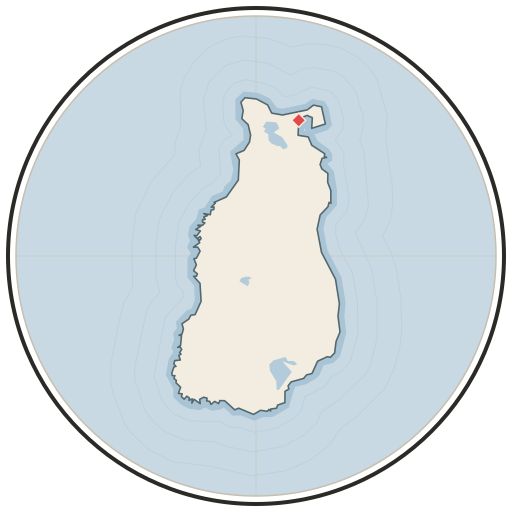
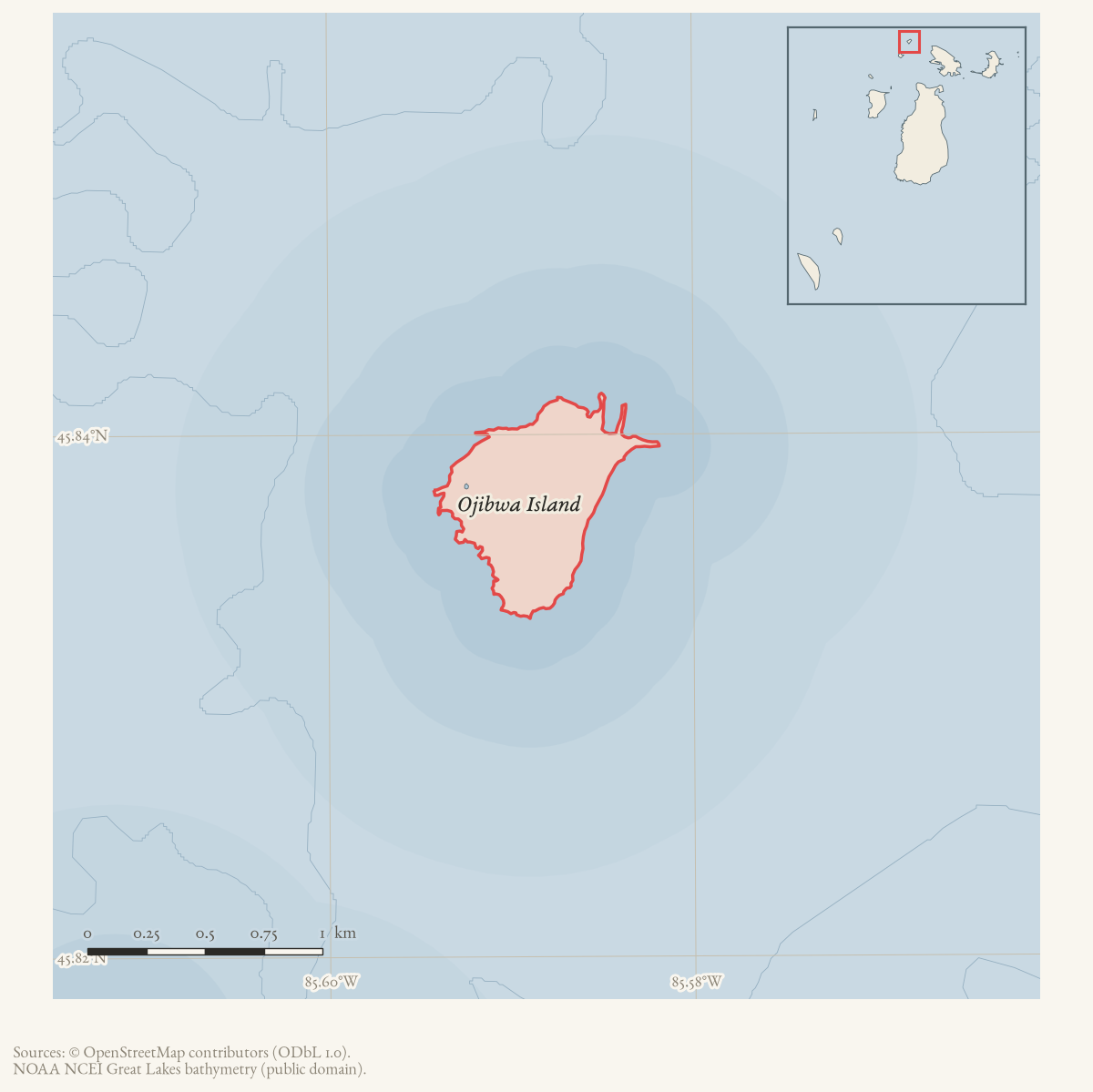
- Ojibwa Island
- Participants
- Owen J. McCauley (survivor) · William H. Shields (survivor) · Mary Shields (victim) · Lucy Davis (victim) · Lucien F. Morden (victim)
- Lives lost
- 3
- Eras
- Modern era
- Concepts
- maritimeshippinglighthousesheritagecommunity
- Within
- Beaver Island archipelago
Summary
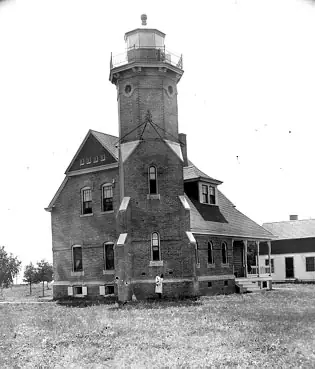
On December 14, 1900, the day the Squaw Island light closed for the winter, its five-person crew launched a 22-foot sailboat for the nine-mile passage south to Beaver Island. A squall capsized the boat within minutes of a favorable start. Three of the five — Lucy Davis, Mary Shields, and Lucien Morden — died of exposure during an overnight drift in Lake Michigan; keeper William H. Shields and first assistant Owen J. McCauley survived roughly twenty hours in the water and on the capsized hull before a passing steamer sighted them the next morning. The sole surviving account, McCauley’s, was first published in the Charlevoix Courier in December 1948 and was reprinted in the Beaver Beacon at least four times over the following decades, making it one of the island’s most repeated disaster narratives.1
History
The light was closed the morning of December 14, and at 12:30 p.m. the crew put to sea: keeper Shields, his wife, her niece Lucy Davis of Richmond, Indiana, first assistant McCauley, second assistant Morden of Montague, and Shields’s shepherd dog, Fids. The day was cold with dense haze limiting visibility; a moderate northeast wind gave the boat a beam reach, and the party estimated reaching St. James harbor within two hours. The wind died, returned briefly from the east, and died again. As the boat lay becalmed, McCauley noticed a squall approaching from the north and warned Shields, at the helm, and Morden, handling the fore sheet. With the boat holding no headway, the gust caught the sails before they could be slacked and rolled the boat over.1
McCauley avoided going into the water at first but went to the others’ aid once they were in the lake. He and Morden pulled Mrs. Shields onto the upturned hull and tied her to the centerboard, and tied Mrs. Davis with the fore sheet; when that held poorly, McCauley cut a sail halyard in the water to improvise better lashings. Gear was thrown or pried loose from the wreck to add buoyancy. A fish tug rounding Beaver Island’s northeast point passed too far off to see them, and the party hoped instead to drift into the tugs’ evening return path; they did not. The dog, Fids, tired and drowned first. As night fell the survivors saw the returning tugs’ lights, too distant to hail. Mrs. Davis, despairing, wept and then appeared to sleep; she died about 6:30 p.m. Mrs. Shields, asking repeatedly after her niece and told she was sleeping, grew delirious and died about 8 p.m. McCauley later said only that “it is beyond my ability to describe the horrible agonies suffered by the women before they died.” Morden, his hands already numb, told the others he would be next; McCauley tried to encourage him with the hope of drifting toward High Island, “where the Indians would help us,” but Morden lost his grip on the jib sheet and slid into the water, pulling away from McCauley’s grasp before he sank.1
At dawn on December 15 the two survivors were still far from land. Passing fish tugs came no closer than about three miles. Realizing they would also miss Trout Island, the men’s only remaining hope was to drift into the main steamer channel; a southeast wind rising at sunrise brought further snow squalls. Mrs. Shields’s body remained in the water beside her husband, who retied himself and McCauley loosely enough to allow movement against the cold. Around mid-morning McCauley spotted smoke to the east; after another squall passed, a steamship came into view, and he managed to stand and wave it down. The ship was the Manhattan, of the Gilchrist Steamship Company, bound for Manitowoc, Wisconsin, with a cargo of coal; her crew lowered a boat and brought the two men and the women’s bodies aboard. At Manitowoc the next morning the men were taken to Holy Family Hospital. McCauley, in better condition, was discharged and reached Beaver Island on December 26. Shields, his hands and feet badly frozen, remained hospitalized six months and lost one leg at the knee.1
The event also has a documented home-front side, recorded in a 1972 letter from McCauley’s daughter, Clementine McCauley. McCauley had married Mary McDonough in June 1899; she stayed behind on Beaver Island, pregnant with Clementine, on her doctor’s advice. On the morning of December 15 she learned from John McCann, captain of one of the island’s fishing tugs, that the Squaw Island light had not been lit the previous night — alarming, because a keeper’s light was expected to burn as long as the crew remained on station, even past a scheduled departure. She pressed Owen “Big Owen” Gallagher, McCauley’s uncle and then captain and sole member of the Beaver Island Life-Saving Station, to investigate; he took a tug to the island and found the light dark. McCauley had wired news of his survival from Manitowoc, but no cable reached Beaver Island, and the mail boat Hackley could not cross the lake from Charlevoix until December 24, when the telegram finally arrived. Until then the family did not know whether McCauley was alive. Her brother, Patrick McDonough, left immediately for Manitowoc and brought McCauley home on crutches; both his feet were frozen, and he was largely incapacitated for the rest of the winter, though he recovered fully. McCauley lived to 89 and died on September 14, 1958, at the Marine Hospital in Detroit; he is buried in St. Joseph, Michigan, alongside his wife, who predeceased him.2
Following his recovery, Shields was appointed keeper of the newly constructed lighthouse depot at Charlevoix, where he served until retiring in April 1924; he died in September 1925. McCauley, a Beaver Island native who had entered the lighthouse service in 1898, was promoted to principal keeper of the Squaw Island light after the tragedy and held that post until the light was discontinued in 1928, when he transferred to the St. Joseph light. He retired in 1936 and, as of the 1948 telling, still spent summers back on Beaver Island.1
The story stayed in circulation on the island through the Beaver Beacon, which reprinted the original Courier account in its January 1965 tenth- anniversary issue3 and again in December 1971 as “48 Years Ago Tragedy Struck Squaw Island Light Crew.”4 The December 1971 reprint prompted Clementine McCauley’s letter, which the Beacon printed the following month as “Squaw Island Story, Part II.”2 The Beacon reprinted the account a fourth time in January 1978, as a tribute after Clementine McCauley’s own sudden death in St. Joseph on January 14 of that year, noting she had been born on Beaver Island in 1901, graduated its high school, and gone on to a career teaching in the Detroit school system, retiring as an elementary school principal in Ecorse.5 The August 1991 Beacon reprinted the January 1978 account again as “SQUAW ISLAND TRAGEDY,” without adding an independent contemporary source.6 The Beacon’s editors credited her with contributing handwritten recollections of her early life and her parents’ lives to the paper over the years.5
Significance
The tragedy is the best-documented disaster in the working history of the Squaw Island light, and its survivors’ later careers tie it directly into the succession of keepers at both Squaw Island and the Charlevoix lighthouse depot. The home-front account also documents, incidentally, how the Beaver Island Life-Saving Station and the mail-boat connection to the mainland functioned — or did not — in December 1900: a lone keeper investigating on his own initiative, and a ten-day gap before news of a survivor reached his family. The story’s repeated republication in the Beaver Beacon across four decades, each time tied to an anniversary, a death in the family, or later historical circulation, marks it as one of the pieces of island oral history most consciously kept alive in print.
Evidence and limits
Every published account of the accident itself traces to a single source:
McCauley’s 1948 telling to the Charlevoix Courier, which the Beaver
Beacon reprinted essentially verbatim in 1965, 1971, 1978, and 1991. These are
not independent investigations, and no contemporary 1900 newspaper account
has been located in the held corpus. Clementine McCauley’s 1972 letter is a
second, independent account, but it describes the family’s experience on
Beaver Island rather than the accident itself, and it was written 71 years
after the event by someone who was an infant at the time, drawing on family
memory rather than direct observation. The reports also record that
Shields’s dog, Fids, died before the three people did; the article’s
lives_lost: 3 follows the source’s human count and does not treat the dog
as a person record.
The held sources do not give the sailboat’s name or registry, the Manhattan’s official number or master, a complete list of her rescue crew, exact drift coordinates, or civil records (birth, death, or burial) resolving every person named in the 1900 and 1972 accounts to a documented biography. No lighthouse-service personnel record has been located to independently confirm Shields’s and McCauley’s service dates, though both are consistent across all four reprints.
Open questions
- Can lighthouse-service, Coast Guard, hospital, cemetery, or death records independently document the three deaths, Shields’s hospitalization and later appointment, or McCauley’s promotion?
- What was the name and registry of the 22-foot sailboat?
- Which records identify the Manhattan’s official number, master, and rescue crew beyond her ownership by the Gilchrist Steamship Company?
- Does a contemporary (1900–1901) newspaper account of the accident survive, independent of McCauley’s 1948 retelling?
- Can civil or parish records connect the episode-qualified McCauley, McDonough, Gallagher, Shields, Davis, and Morden records used here to later documented families on Beaver Island?
See also
Footnotes
-
Charlevoix Courier, “48 Years Ago Tragedy Struck Squaw Island Light Crew; Lone Survivor Tells Story,” December 1948, held Courier OCR compilation,
data/newspapers/charlevoix/ocr/markdown/charlevoixcourie1231unse.md. ↩ ↩2 ↩3 ↩4 ↩5 -
Beaver Beacon, January 1972, “Squaw Island Story, Part II” (Clementine McCauley’s letter). ↩ ↩2
-
Beaver Beacon, January 1965 (Tenth Anniversary Issue), “48 Years Ago Tragedy Struck Squaw Island Light Crew; Lone Survivor Tells Story.” ↩
-
Beaver Beacon, December 1971, “48 Years Ago Tragedy Struck Squaw Island Light Crew.” ↩
-
Beaver Beacon, January 1978, “The Squaw Island Tragedy,” and the accompanying obituary of Clementine McCauley. ↩ ↩2
-
Beaver Beacon, August 1991, “SQUAW ISLAND TRAGEDY” (reprint of the January 1978 account). ↩
Sources
- Charlevoix Courier, “48 Years Ago Tragedy Struck Squaw Island Light Crew; Lone Survivor Tells Story,” held Courier OCR compilation.The held Courier compilation preserves the detailed account of the December 14–15, 1900 capsizing, three deaths, two survivors, and Manhattan rescue; the exact original issue date is not promoted from the compilation title. No public copy of this file is known; the archive holds one and can provide it on request.
- Charlevoix Courier, raw OCR for the held “48 Years Ago Tragedy” account.Raw OCR independently preserves the account and the ship/company spelling variant Gilechrist. No public copy of this file is known; the archive holds one and can provide it on request.
- Reprints the Courier account, naming the keepers, the 22-foot sailboat, the three deaths, the two survivors, and the Manhattan rescue.data1 · beaver-island-archive · beaver_beacon · 1965-01_Beaver-Beacon
- The held six-page issue scan is paired with the OCR source and confirms the published notice or report; it does not expand the source-specific identity, event, or outcome claims.data1 · beaver-island-archive · scans · beaver_beacon · issues · 1965-01_Beaver-Beacon
- Held raw Beacon OCR preserves the reprint independently.data1 · beaver-island-archive · beaver_beacon · 1965-01_Beaver-Beacon
- The held six-page issue scan is paired with the OCR source and confirms the published notice or report; it does not expand the source-specific identity, event, or outcome claims.data1 · beaver-island-archive · scans · beaver_beacon · issues · 1965-01_Beaver-Beacon
- Later reprint confirms the date sequence, names, drift, deaths, Manhattan rescue, Shields’s later amputation, and McCauley’s lighthouse career.data1 · beaver-island-archive · beaver_beacon · 1971-12_Beaver-Beacon
- The held eight-page issue scan is paired with the OCR source and confirms the published notice or report; it does not expand the source-specific identity, event, or outcome claims.data1 · beaver-island-archive · scans · beaver_beacon · issues · 1971-12_Beaver-Beacon
- Clementine McCauley’s letter adds Mary McDonough, Owen Gallagher’s station response, Patrick McDonough’s trip, the Hackley mail-route delay, and the family’s later account.data1 · beaver-island-archive · beaver_beacon · 1972-01_Beaver-Beacon
- The held nine-page issue scan is paired with the OCR source and confirms the published notice or report; it does not expand the source-specific identity, event, or outcome claims.data1 · beaver-island-archive · scans · beaver_beacon · issues · 1972-01_Beaver-Beacon
- Reprints the account as a tribute to Clementine McCauley, identifying the December 14–15, 1900 capsizing, three deaths, two survivors, and rescue by the Manhattan. It is a later newspaper reprint and does not replace the original contemporary records or resolve all variant retellings. The holding institution's portal restricts automated access; the archive holds a copy of this issue and can provide it on request.data1 · beaver-island-archive · beaver_beacon · 1978-01_Beaver-Beacon
- The held nine-page January issue PDF is paired with the canonical OCR source and confirms the reprinted tragedy account.data1 · beaver-island-archive · scans · beaver_beacon · issues · 1978-01_Beaver-Beacon
- Reprints the January 1978 Beacon account of the December 1900 capsizing, three human deaths, two survivors, and rescue by the Manhattan; it is a later retelling and does not establish an independent contemporary account. The holding institution's portal restricts automated access; the archive holds a copy of this issue and can provide it on request.data1 · beaver-island-archive · beaver_beacon · 1991-08_Beaver-Beacon
- The held twenty-two-page issue scan confirms the later reprint.data1 · beaver-island-archive · scans · beaver_beacon · issues · 1991-08_Beaver-Beacon
Added 1 August 2026 · revised 5 August 2026. Recent changes
Cite this article
Beaver Island Archive, “Squaw Island Light-Crew Tragedy, 1900”, https://beaverislandarchive.org/events/squaw-island-light-crew-tragedy-1900/, accessed [date], citing Charlevoix Courier, “48 Years Ago Tragedy Struck Squaw Island Light Crew; Lone Survivor Tells Story,” held Courier OCR compilation. (and 12 further sources listed on the page).
Last revised 2026-08-05. Fill in [date] with the date you read it — this page is static and cannot know that.
BibTeX for “Squaw Island Light-Crew Tragedy, 1900”RIS for “Squaw Island Light-Crew Tragedy, 1900”