- Dates
- 2015 – 2016
- Eras
- Modern era
- Concepts
- environmentconservationforestswetlandsgeologysoils
- Within
- Garden Island · High Island
Summary
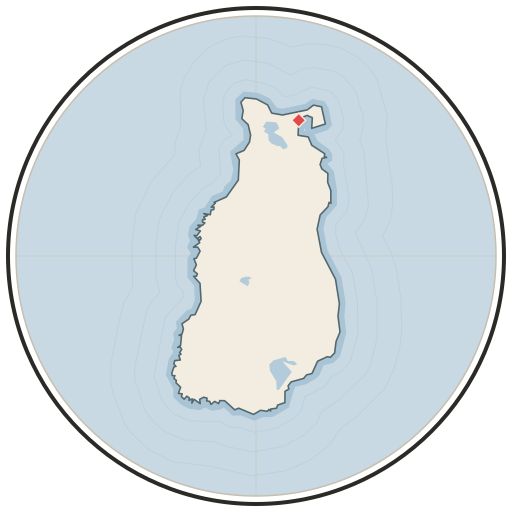
The 2015 MNFI addendum is a key bridge between the archipelago’s habitat maps and its species records. It surveyed Garden and High Islands with the Little Traverse Bay Bands of Odawa Indians and combined natural-community surveys, rare plants and invertebrates, snails, bats, and invasive plants.
It documented 17 natural-community occurrences: ten previously known occurrences updated and seven new occurrences. Five new occurrences were on Garden Island and three on High Island. The highest stewardship priority was the pair of Great Lakes marshes on Garden Island.
Forests, soils, and tree structure
The report’s site descriptions add measurements that are not present in the land-cover rasters:
- Garden Island Boreal Forest: shallow alkaline loams and loamy organics over limestone cobble, pH 7.5–8.0; northern white-cedar-dominated canopy; cored trees estimated at roughly 135–165 years old; windthrow and coarse woody debris are prominent.
- High Island Boreal Forest: alkaline sands, gravelly sands, and clayey sands at pH 7.5–7.8 over a shallow acidic organic layer; northern white-cedar-dominated canopy with white spruce, paper birch, red maple, red pine, red oak, and white pine; dense yew may affect regeneration.
- High Island Dry-mesic Northern Forest: shallow acidic horizons over acidic sands, pH 4.5–5.0; hemlock, white pine, and red oak dominate; charcoal and cut stumps record fire and logging history.
- High Island Nezewabegon Forest: acidic loamy sands, pH 5.0–5.5; large sugar maple, yellow birch, hemlock, red oak, and cedar; a partial red-oak core counted 230 growth rings, with some trees estimated at 250–300 years. The report explicitly connects the absence of deer with an opportunity to study forest composition without high browse pressure.
- Garden Island Red Oak Garden: contrasting soil polygons—shallow alkaline loams over cobble in the south and deeper acidic sands over cobble in the north—with sugar maple, red oak, yellow birch, white ash, and paper birch.
These records make the raster layers more useful: NLCD and canopy values can describe island-wide structure, while this report supplies field-measured soil, tree-age, DBH, canopy, and disturbance context at named occurrences.
Animals and invertebrates
- Lake Huron locust: six or more individuals were observed at Garden’s Northcutt Bay in 2015; High Island had more than 800 across sand/gravel beach, low foredune, and Great Lakes barrens habitat. The High Island occurrence was expanded and ranked excellent-to-good viability.
- Hine’s emerald dragonfly: not reconfirmed on Garden in 2015, but extensive suitable calcareous wetland habitat remained around Jensen Harbor and Northcutt Bay; it was not observed and suitable habitat was not found on High in the survey areas. These are bounded survey results, not absence claims.
- Snails: 15 species were documented on High, including an updated Great Lakes physa record. Garden yielded 24 species, including a new special- concern Tapered vertigo occurrence and potentially important Iroquois vallonia collections.
- Other fauna: incidental observations included Merlin, Bald Eagle, northern water snake, eastern garter snake, eastern newt, monarchs, and multiple dragonfly taxa.
Bats
Two acoustic stations were placed on each island from June 10 through July 8, 2015. Eight of Michigan’s nine known bat species were detected at all four stations. The raw pass counts are preserved in the crosswalk, including Eastern red, hoary, silver-haired, little brown, big brown, northern long-eared, Indiana, and tricolored bats.
The report treats the Indiana, northern long-eared, and tricolored detections as especially significant but cautions that automated acoustic classification can confuse similar calls, especially among Myotis. Acoustic detections show presence at the station; they do not establish breeding, roosting, population size, or habitat use.
Connectivity and limits
This source connects four layers of the knowledge base:
- field-measured soil, hydrology, canopy, tree age, and disturbance;
- named natural-community occurrences and stewardship priorities;
- species-level records for rare plants, insects, snails, bats, reptiles, and birds; and
- the broader NLCD/tree-canopy and SSURGO context for all seven islands.
The 2015 work covers Garden and High only. It does not fill the species-level gaps for North Fox, South Fox, Whiskey, or the smaller refuge islands. Its non-detections are survey- and method-bounded, and its acoustic records require taxonomic caution.
Sources
See the sources: block above and the generated JSON crosswalk.
Sources
- The report describes 2015 natural-community, rare-species, snail, bat, and invasive-plant surveys conducted with the Little Traverse Bay Bands of Odawa Indians. It is a targeted baseline and not a complete inventory.research · wildlife · sources · mnfi_garden_high_combined_2016
- Retrieved 2026-08-02; the held 117-page PDF has SHA-256 852e6e9219a5c05ce031a06d448ecf652bd11f740b35297e85b85b4ed4604626.research · wildlife · sources · mnfi_garden_high_combined_2016
- Generated crosswalk and provenance sidecar.The generated index preserves report-page and extracted-text anchors, raw bat-pass counts, forest/soil/tree measurements, species observations, and evidence limits. No public copy of this file is known; the archive holds one and can provide it on request.research · wildlife · indices · mnfi_garden_high_2015_biodiversity_index
Added 3 August 2026. Recent changes
Cite this article
Beaver Island Archive, “MNFI Garden and High Island biodiversity, habitat, and acoustic surveys, 2015”, https://beaverislandarchive.org/documents/mnfi-garden-high-2015-biodiversity-survey/, accessed [date], citing Higman, Phyllis J.; Cohen, Joshua G.; Slaughter, Bradford S.; Lee, Yu Man; Badra, Peter J.; Klatt, Brian J.; and Schools, Edward H., Natural Community, Rare Species and Invasive Plant Surveys of Garden and High Island: An Addendum to 2011 Surveys, MNFI Report No. 2016-04 (2016). (and 2 further sources listed on the page).
Last revised 2026-08-03. Fill in [date] with the date you read it — this page is static and cannot know that.
BibTeX for “MNFI Garden and High Island biodiversity, habitat, and acoustic surveys, 2015”RIS for “MNFI Garden and High Island biodiversity, habitat, and acoustic surveys, 2015”