- Coordinates
- 45.5950° N, 85.5151° WGoogle Maps: NomadDownload KML
- Eras
- Modern era
- Concepts
- societylumberingtourismcommunity
- Within
- Beaver Island
- Media
- Beaver Island History Map, 1978 revision
Summary
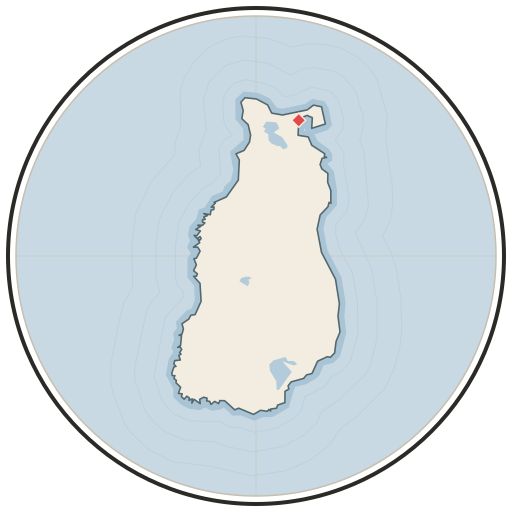
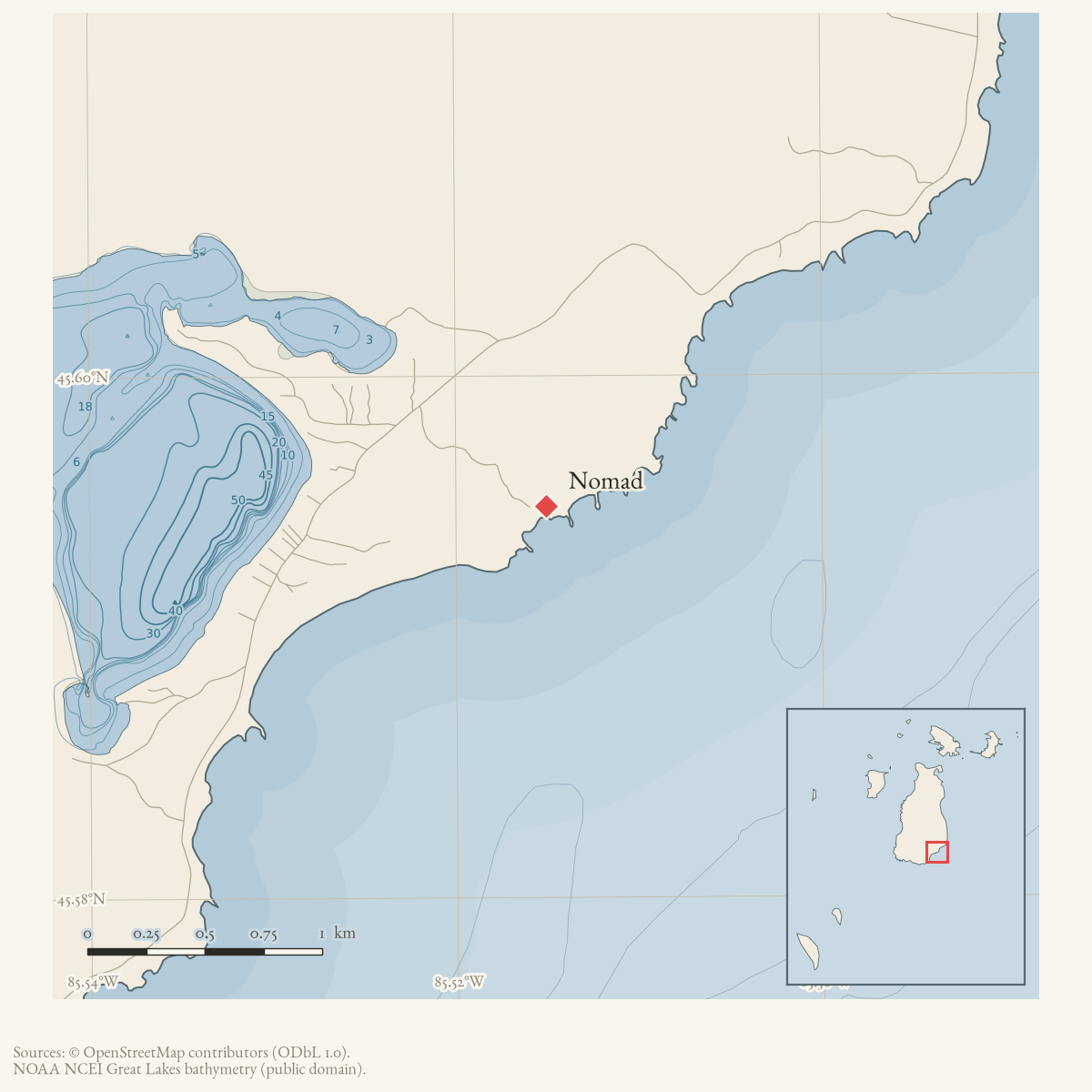
Nomad is a named former settlement on the south end of Beaver Island, built around a sawmill that Garrett “Gat” Cole established after his mainland mill burned. According to his son Jesse Cole’s own account, Garrett moved the family to the island in 1902 and named the new mill settlement “City of Nomad.”1 By the 1910s it had grown into a small community with a hotel, a dock, a store, and at least one post-office operation. The postal chronology is disputed: a 1964 report gives 1913–14, a contemporary school report calls its office “new” in 1917, and a later family recollection places Julia Cole’s service around 1919–27.234 GNIS records it today as a “Populated Place” sourced from a National Oceanic and Atmospheric Administration nautical chart rather than a topographic map, meaning the name persisted on navigation charts after the settlement itself had declined.5 The site is now remembered chiefly through Beaver Beacon reminiscences and as a landscape reference point — “Nomad’s Corner,” “Nomad Lane” — rather than as an inhabited place.6
History
Garrett Cole’s own account, relayed by a descendant in a 1978 letter to the Beacon, gives the founding directly: “At 4 years, my father, Garrett Cole, in 1902 had a thriving lumber and shingle Mill and one night the whole Mill burned up… He in desperation moved to Beaver Island with family and bought another shingle and lumber Mill on the south end of Beaver Island calling that City of Nomad.”1 A 1962 obituary for his daughter Mattie Cole Pratt corroborates the founding in briefer terms: she “came to Beaver Island as a young girl with her parents, Julia and Garrett Cole, who started the town of Nomad at the South end of the Island.”7 With no school on site, an older Cole sister and a neighbor, Rose Green, taught the younger children.1
By April 1917 the settlement was substantial enough to serve as a meeting point for prospective land buyers: a Citizen’s Realty Company agent met one new arrival at Nomad and described a hotel and dock the company had built just south of Cables Creek.8 An independent local-history account of Pfeiffer’s Orchard, a mile east of the East Side Drive, likewise recalls a wagon trip to “pick up apples from Pfieffer’s at the dock at Nomad,” corroborating the dock’s use as a landing point for the surrounding farms.9 By September 1964, a retrospective by Helen Hoffman Collar — writing of her own first Island summer in 1915 — recalled “quite a cluster of cottages around Nomad, where the Coles operated a sawmill and a small store,” adding plainly: “Nomad was a town and had its own Post Office.”10 A contemporary May 1917 school report says the community had “a new post office” called Nomad.3 A March 1981 letter names the postmistress and gives approximate operating years: “Julia Cole was the lovely lady who used to have the Post Office in ‘Nomad’ on the south end of Beaver Island from 1919 to 1927, approximately.”4 A 1964 postal-history report supplies a different, much earlier interval: March 10, 1913 to June 15, 1914.2 The same report gives June 5, 1917 to October 31, 1933 for High Island. Those High Island dates closely resemble the Historical Map’s “P.O. 1917–1933” at Nomad, suggesting that the map transposed them. The 1917 contemporary notice nevertheless indicates an office or reopening after the reported 1914 discontinuance. Postal appointment and discontinuance records are still needed to reconcile the sequence.
The map also says Garrett Cole bought Sweitzer’s shingle mill in 1912, held a “Cole’s Jubilee,” named the store and post office for his boat Nomad, and operated the mill until 1926. Jesse Cole’s family account instead places the family’s move and mill purchase in 1902. A contemporary August 1917 item does document Garrett Cole using a launch named Nomad, but it does not prove which thing received the name first. The Jubilee, 1912 purchase, and 1926 endpoint remain unverified.
The Cole rescue flight
Nomad is also the setting for an often-retold local story: an early emergency airplane flight to Beaver Island, made to treat a head injury Jesse Cole suffered in his father’s sawmill. Jesse Cole’s own 1963 letter to the Beacon gives the fullest first-person account and dates it “about 1920”: “the airplane came from Charlevoix to land on Lake Genesrath to bring Dr. Armstrong, from Charlevoix, for me as I was injured in the lumber woods… I was unconscious (amnesia) for 4 months.”11 Later retellings in the Beacon repeat the story with variant dates and added detail: a 2007 retrospective sets it in “the winter of 1923” and adds that Jesse’s sister in Chicago arranged a plane from Selfridge Field, that a first aircraft developed engine trouble, and that a second plane, the Osprey II, landed first on frozen Lake Charlevoix to collect the doctor and then on frozen Lake Geneserath;12 a 1988 Fourth of July parade float carried a sign reading “First Plane to Beaver Island January 1921”;13 and a 2003 retrospective dates it only to “the early 1920s.”14 These accounts do not agree on a year — 1920, 1921, and 1923 all appear in sources held here — and this article reports the range rather than picking one; Jesse Cole’s own 1963 letter is the earliest and most direct source, but “about 1920” is itself a recollection made more than four decades after the event.
Later use of the site
By 1960, cottages at Nomad were changing hands as summer property: James and Constance DeClaire purchased the Wanty property there,15 and the Gail Berchard cottage at Nomad burned completely on 28 November 1960.16 In October 1962, a new cottage was planned “on the Nomad corner.”17 Otter and hunting-party reports through the 1960s continued to use Nomad as a landscape reference point rather than a populated place — a lost hunter in December 1962 had told his party he would come out “at Nomad” later that day, and Iron Ore Creek is described as the starting point for the same route.18 By March 1998, the St. James and Peaine Township boards formally named a road “Nomad Lane.”6
Names
GNIS records no variant name for Nomad and no former or superseded name is attested in any source held here — unlike several other places in this archipelago, this is not a spelling-classification question. The naming complication here is instead one of status, not spelling: Nomad functioned as a named, populated place with a post office during at least parts of the 1910s; the exact sequence is unresolved.234 It survives today only as an unincorporated locality name, carried forward onto navigation charts (GNIS’s own source for the feature is a 1990-91 NOAA nautical chart, not a topographic survey) and onto a formally named township road.56
Open questions
- Did the 1913–14 Nomad post office reopen in 1917, and when did Julia Cole serve? Obtain the federal appointment and discontinuance records.
- Which Coles operated the sawmill and store at different periods, and can business directories, land records, or U.S. Post Office Department annual reports fix these dates independently of family recollection?
- Did the Citizen’s Realty Company hotel and dock survive beyond the 1910s?
- Can the 1920/1921/1923 dates given for the Cole rescue flight be reconciled against Dr. Armstrong’s own records, a Selfridge Field flight log, or the Journal of Beaver Island History, Volume 5, which has not been located?
See also
Footnotes
-
Beaver Beacon, February 1978, letter from a Cole family member. ↩ ↩2 ↩3
-
Charlevoix Courier, June 25, 1964, “P.O. on High Island?” ↩ ↩2 ↩3
-
Charlevoix County Herald, May 18, 1917, school commissioner’s notes. ↩ ↩2 ↩3
-
Beaver Beacon, March 1981, letter from a Cole family member. ↩ ↩2 ↩3
-
USGS GNIS, Domestic Names (Michigan), feature 1618186,
data/federal/gnis/gnis_names.geojson. ↩ ↩2 -
Beaver Beacon, February 1962, obituary of Mrs. Mattie (Cole) Pratt. ↩
-
Beaver Beacon, September 1963, “A Letter of Interest.” ↩
-
Beaver Island Net, “Pfeiffer’s Orchard,”
data/websites/www.beaverisland.net/markdown/Places/Pfeiffers_Orchard/pfeiffers_orchard.md. ↩ -
Beaver Beacon, September 1964, “Know Your Neighbor,” Helen Hoffman Collar. ↩
-
Beaver Beacon, October 1963, “Letter of Interest,” Jesse Cole. ↩
-
Beaver Beacon, February 2007, “Beaver Tales” retrospective. ↩
-
Beaver Beacon, July 1988, Fourth of July parade description. ↩
-
Beaver Beacon, October 2003, “Beaver Tales” retrospective. ↩
-
Beaver Beacon, August 1960, property notice. ↩
-
Beaver Beacon, December 1960, property report. ↩
-
Beaver Beacon, October 1962, property report. ↩
-
Beaver Beacon, December 1962, “Lost.” ↩
Maps for this place
These Atlas plates provide regional context. They do not establish a precise boundary, current ownership, access right, operating status, or field condition.
- EnvironmentSoils, wetlands, hydrography, and terrain
- GeologyGeneralized geology and landforms
- HydrologyMapped water and wetland context
- AccessMapped routes, facilities, and protected areas
- Land surveyPLSS geometry and historic GLO patent-location context
Sources
- GNIS feature 1618186; feature class 'Populated Place'; map 'Beaver Island South'; date_created 1 July 1991, sourced to a National Oceanic and Atmospheric Administration nautical chart (Phase IA compilation, 1990-91) rather than a USGS topographic map — the name survived onto navigation charts. No variant-name row exists for this feature.federal · gnis · gnis_names
- No row for feature 1618186 exists in the national variant-names table; GNIS records no alternative spelling or superseded name for Nomad.federal · gnis · gnis_variant_names
- First-person account: "I was one of 9 children of Garrett and Angel Julia Cole... At 4 years, my father, Garrett Cole, in 1902 had a thriving lumber and shingle Mill and one night the whole Mill burned up... He in desperation moved to Beaver Island with family and bought another shingle and lumber Mill on the south end of Beaver Island calling that City of Nomad." Also: no school existed there, so an older sister and a neighbor, Rose Green, taught the Cole children. The holding institution's portal restricts automated access; the archive holds a copy of this issue and can provide it on request.data1 · beaver-island-archive · beaver_beacon · 1978-02_Beaver-Beacon
- States that Mattie Cole "came to Beaver Island as a young girl with her parents, Julia and Garrett Cole, who started the town of Nomad at the South end of the Island," and names surviving siblings including "one brother, Jess Cole."data1 · beaver-island-archive · beaver_beacon · 1962-02_Beaver-Beacon
- States "Julia Cole was the lovely lady who used to have the Post Office in 'Nomad' on the south end of Beaver Island from 1919 to 1927, approximately." This is the only source held here giving specific years for the post office's operation, and it is qualified by its own author as approximate. The holding institution's portal restricts automated access; the archive holds a copy of this issue and can provide it on request.data1 · beaver-island-archive · beaver_beacon · 1981-03_Beaver-Beacon
- First-person account by Jesse Cole, son of Garrett and Julia Cole: "About 1920, the airplane came from Charlevoix to land on Lake Genesrath to bring Dr. Armstrong, from Charlevoix, for me as I was injured in the lumber woods, while working for my father, Gat Cole of Nomad, Beaver Island. I was unconscious (amnesia) for 4 months." This is the primary first-person date for the injury and flight, given as "about 1920."data1 · beaver-island-archive · beaver_beacon · 1963-10_Beaver-Beacon
- Beaver Beacon, February 2008, "Beaver Tales" (letters from Jesse Cole).Summarizes a letter from Jesse Cole describing his life after moving to Beaver as a child, settling at Nomad, being taught by his sisters and then at the "Little Red Schoolhouse," leaving the island as a young man, and eventually working in theater and banking before retiring to Florida. Cross-references his "near-fatal accident at Nomad," said to be told in Volume 5 of the Journal of Beaver Island History (not held here). No public copy of this file is known; the archive holds one and can provide it on request.data1 · beaver-island-archive · beaver_beacon · 2008-02_Beaver-Beacon
- Beaver Beacon, February 2007, "Beaver Tales" retrospective.Retells the same injury-and-rescue story with more circumstantial detail and a different year: "In the winter of 1923, Jesse Cole, living at Nomad, suffered a head injury at his father's sawmill," his sister in Chicago arranged a plane from Selfridge Field, a first plane developed engine trouble, and a second plane, the Osprey II, landed first on frozen Lake Charlevoix to collect the doctor and then on frozen Lake Geneserath. This account gives "1923" against Jesse Cole's own 1963 letter, which gives "about 1920" — the two are not reconciled here. No public copy of this file is known; the archive holds one and can provide it on request.data1 · beaver-island-archive · beaver_beacon · 2007-02_Beaver-Beacon
- Describes a parade float sign reading "First Plane to Beaver Island January 1921," commemorating the same Cole rescue flight with a third distinct date. A community commemorative claim, not a primary account. The holding institution's portal restricts automated access; the archive holds a copy of this issue and can provide it on request.data1 · beaver-island-archive · beaver_beacon · 1988-07_Beaver-Beacon
- Beaver Beacon, October 2003, "Beaver Tales" retrospective.Paraphrases a further Jesse Cole letter recounting the same injury and rescue, dating it only to "the early 1920s." No public copy of this file is known; the archive holds one and can provide it on request.data1 · beaver-island-archive · beaver_beacon · 2003-10_Beaver-Beacon
- Independent corroboration of a dock at Nomad, describing a trip to "pick up apples from Pfieffer's at the dock at Nomad."
- Local retrospective by Helen Hoffman Collar describes Nomad as a town with its own post office, a cluster of cottages, and the Coles' sawmill and small store.data1 · beaver-island-archive · beaver_beacon · 1964-09_Beaver-Beacon
- The held eight-page issue scan is paired with the OCR source and confirms the published notice or report; it does not expand the source-specific identity, event, or outcome claims.data1 · beaver-island-archive · scans · beaver_beacon · issues · 1964-09_Beaver-Beacon
- First-person account says a Citizen's Realty Company representative met the writer at Nomad in April 1917 and describes a hotel and dock just south of Cables Creek.data1 · beaver-island-archive · beaver_beacon · 1963-09_Beaver-Beacon
- The held six-page issue scan is paired with the OCR source and confirms the published notice or report; it does not expand the source-specific identity, event, or outcome claims.data1 · beaver-island-archive · scans · beaver_beacon · issues · 1963-09_Beaver-Beacon
- Reports a planned cottage on the Nomad corner.data1 · beaver-island-archive · beaver_beacon · 1962-10_Beaver-Beacon
- The held five-page issue scan is paired with the OCR source and confirms the published notice or report; it does not expand the source-specific identity, event, or outcome claims.data1 · beaver-island-archive · scans · beaver_beacon · issues · 1962-10_Beaver-Beacon
- Reports the destruction by fire of the Gail Berchard cottage at Nomad on November 28, 1960.data1 · beaver-island-archive · beaver_beacon · 1960-12_Beaver-Beacon
- The held five-page issue scan is paired with the OCR source and confirms the published notice or report; it does not expand the source-specific identity, event, or outcome claims.data1 · beaver-island-archive · scans · beaver_beacon · issues · 1960-12_Beaver-Beacon
- Reports James and Constance DeClaire purchasing the Wanty property at Nomad; it does not provide a deed, parcel, price, or exact transaction date.data1 · beaver-island-archive · beaver_beacon · 1960-08_Beaver-Beacon
- The held four-page issue scan is paired with the OCR source and confirms the published notice or report; it does not expand the source-specific identity, event, or outcome claims.data1 · beaver-island-archive · scans · beaver_beacon · issues · 1960-08_Beaver-Beacon
- Records a road-naming motion: "MOTION by Nelson, second by Martin to approve the new road names of Keeran Lane, and Nomad Lane, passed" — evidence the place name was formalized onto a township road by 1998. The holding institution's portal restricts automated access; the archive holds a copy of this issue and can provide it on request.data1 · beaver-island-archive · beaver_beacon · 1998-03_Beaver-Beacon
- Charlevoix County Herald, May 18, 1917, school commissioner’s notes.Contemporary report says the new Peaine No. 2 branch school had twelve children and that the community also had “a new post office” called Nomad. It documents an office in 1917 but not an opening day, postmaster, or duration. No public copy of this file is known; the archive holds one and can provide it on request.
- Charlevoix Courier, June 25, 1964, “P.O. on High Island?”Postal-history report gives Nomad’s post office as March 10, 1913–June 15, 1914 and High Island’s as June 5, 1917–October 31, 1933. It conflicts with the contemporary 1917 “new post office” notice and with a later Cole-family recollection. No public copy of this file is known; the archive holds one and can provide it on request.
- Charlevoix Courier, August 1, 1917, Nomad correspondence.Contemporary report says Garrett Cole traveled to Elk Rapids and Traverse City in the launch Nomad. It documents the boat and name in 1917 but not whether the settlement, store, or post office was named for it. No public copy of this file is known; the archive holds one and can provide it on request.
- Described in this archive: Beaver Island History Map, 1978 revision.Says Garrett Cole bought Sweitzer’s mill in 1912, named the store and post office after his boat, operated the mill to 1926, and had a post office from 1917 to 1933. The post-office dates closely reproduce the 1964 report’s High Island dates and conflict with its Nomad dates.
Added 28 July 2026 · revised 7 August 2026. Recent changes
Cite this article
Beaver Island Archive, “Nomad”, https://beaverislandarchive.org/places/nomad/, accessed [date], citing U.S. Geological Survey, Geographic Names Information System, Domestic Names (Michigan), retrieved 2026-07-28. (and 25 further sources listed on the page).
Last revised 2026-08-07. Fill in [date] with the date you read it — this page is static and cannot know that.