- Date
- 1853
- Eras
- Strang era
- Concepts
- anishinaabe-odawatoponymyhistoriography
Summary
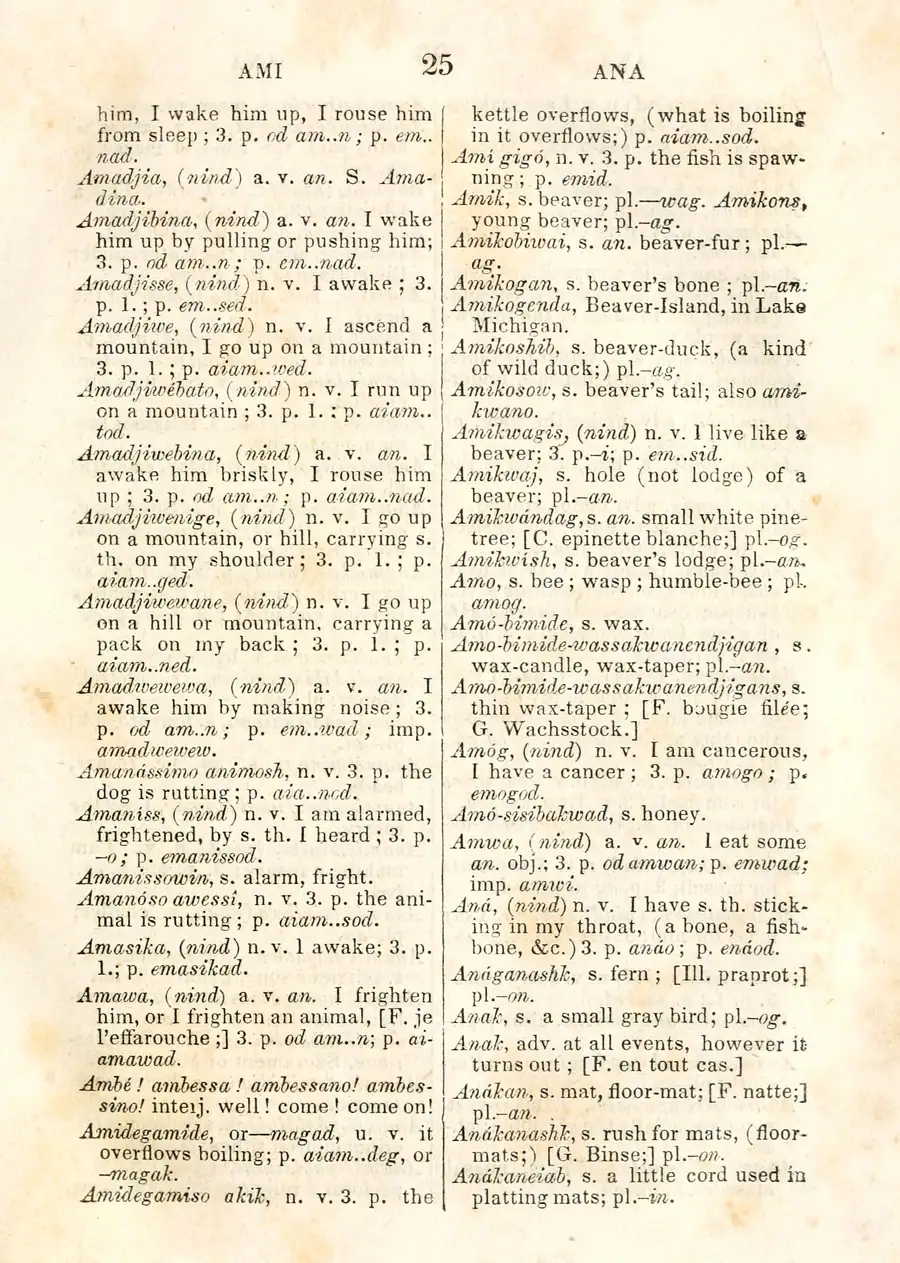
Frederic Baraga’s 1853 Dictionary of the Otchipwe Language, Explained in English provides the earliest printed attestation held here for the form Amikogenda: its p. 25 entry pairs the form with “Beaver Island, in Lake Michigan.”
The entry is an important historical name attestation. It preserves a mission-era dictionary’s spelling and English arrangement, rather than deciding the preferred present spelling, pronunciation, grammar, community usage, or the full history of the island’s names.
Evidence and limits
The checked page establishes what this edition prints. It does not independently identify every speaker or community from which Baraga learned the form, assign a precise historical place boundary, or substitute for Anishinaabe community and language-authority sources. Its terminology is retained in the title and quotation for bibliographic accuracy, not adopted as current terminology.
See also
Sources
- Printed page image checked. Under “Beaver Island, in Lake Michigan,” the dictionary gives “Amikogenda.” This is a 1853 mission-era dictionary attestation and English gloss arrangement; it is not a modern orthographic authority, pronunciation guide, comprehensive place-name history, direct evidence of a present community’s terminology, or proof of uninterrupted language use.
Added 2 August 2026 · revised 4 August 2026. Recent changes
Cite this article
Beaver Island Archive, “Baraga, Dictionary of the Otchipwe Language, 1853”, https://beaverislandarchive.org/documents/baraga-dictionary-otchibwe-language-1853/, accessed [date], citing Frederic Baraga, *A Dictionary of the Otchipwe Language, Explained in English* (Cincinnati, 1853), p. 25..
Last revised 2026-08-04. Fill in [date] with the date you read it — this page is static and cannot know that.
BibTeX for “Baraga, Dictionary of the Otchipwe Language, 1853”RIS for “Baraga, Dictionary of the Otchipwe Language, 1853”