- Born
- 1853-07-13
- Died
- circa 1861
- Work
- Fishing and hunting guide
- Member of
- Church of Jesus Christ of Latter Day Saints, Strangite
- Eras
- Strang era
- Concepts
- governancemormonismreligionhistoriography
- Within
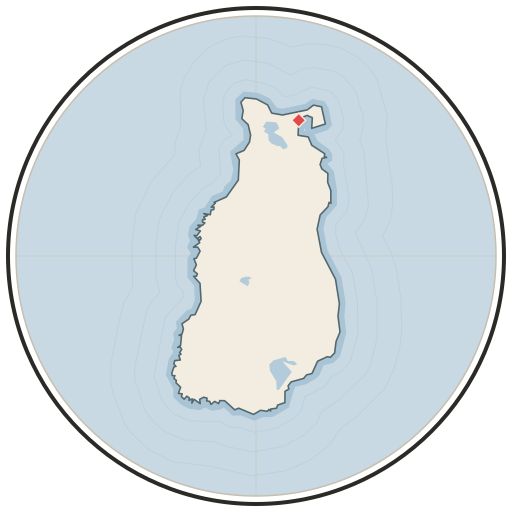
- Beaver Island
Summary
Alexander Wentworth was, with Thomas Bedford, one of the two men who shot James Jesse Strang on the dock at Saint James, Beaver Island, on 16 June 1856. He fired a revolver, striking Strang twice. He had earlier been a Mormon in good enough standing to be wounded fighting on the Mormon side at the 1853 battle of Pine River, and by 1856 had married into the Johnson-McCulloch family that led the break with Strang. He surrendered aboard the U.S. steamer Michigan, was released without trial, and — unlike Bedford — is traced for some years afterward: he returned to Beaver Island at least twice as a visitor, working as a fishing and hunting guide, and told Elizabeth Whitney Williams directly that he never regretted the shooting. Nothing about his birth, death, or life after his last recorded visit is established from sources held here, so this later period is recorded as contested.
History
From Mormon posse to assassin
Wentworth’s documented history on Beaver Island begins on the Mormon side of a conflict, not against it. In July 1853 he was among Sheriff Joshua Miller’s unarmed party sent to summon jurors at the fishermen’s settlement of Pine River, which was ambushed there; the contemporary Northern Islander account lists him among the wounded: “Alexander Wentworth and Lewis Briggs have each a shot hole through the flesh of the left arm.”1 See Battle of Pine River.
By 1856, according to Quaife, Wentworth was “a young man and something of a dandy” who had married a daughter of Frank Johnson, Dr. H. D. McCulloch’s business partner, tying him by marriage to the leading figures of the faction that had turned against Strang; Quaife’s source for the marriage is his own interview with Zenas Wright, 25 May 1920.2 A contemporary newspaper wire report, printed four days after the shooting, corroborates the general shape of this alignment without naming the marriage: “Both Bedford and Wentworth had been Mormons, but had seceded and had joined with the McCulloch faction in the late schism.”3
Elizabeth Whitney Williams gives a fuller account of the marriage from the other direction. Wentworth’s wife was the daughter of a wealthy Buffalo merchant, Mr. Johnson, whom “the King and ‘Douglas’” (the alias under which Strang’s plural wife Elvira Field, disguised as a man, then traveled) visited and persuaded to sell up and settle on the island; the family built the “Johnson House” on Font Lake, a two-story dwelling with its own ballroom. Their daughter was “a very handsome … highly educated” musician. Strang’s continuing social visits to the couple after her marriage “became disagreeable to the young wife,” a friction Williams thought “may have been one of the reasons for Wentworth’s shooting the king.”45
Quaife, by contrast, frames Wentworth (with Bedford) as lacking, on his own, “the enterprise and courage unaided to compass the King’s murder,” and credits Dr. Hezekiah D. McCulloch’s estrangement from Strang with supplying the “brain and resolution to bring the thing to pass”; he names a fourth conspirator besides Bedford, Wentworth and McCulloch, an itinerant “Doctor” Atkyn who had opened a daguerreotype gallery at Saint James in 1855.2 The two explanations for Wentworth’s own motive, a personal grievance over his marriage and recruitment into McCulloch’s wider quarrel with Strang, are not mutually exclusive, and neither source held here reconciles them explicitly.
The shooting
Quaife’s account, drawn from the church historian Warren Post’s manuscript “Apostolic Testimony,” has McCulloch bringing home several pistols before the shooting and giving them to “his clique that they might become expert marksmen,” so that when the Michigan returned to the harbor “after several days practice in shooting at targets,” Wentworth and the others were prepared.6 On the evening of 16 June 1856, Wentworth and Bedford shot Strang from behind as he walked toward the Michigan, emerging from in front of “Johnson and McCulloch’s” store, the firm of Wentworth’s father-in-law and Strang’s estranged physician, in full view of several men there and of officers and crew on the steamer, none of whom intervened.7 Strang’s own paper named them four days later: “Wentworth had a revolver, and Bedford a horse pistol, with which he struck him over the head and face, while lying on the ground.”8 Quaife’s fuller narrative has Wentworth fire first, striking Strang in the head, then fire again, hitting him in the face below the right eye, before Bedford beat him with the pistol butt.9 See Assassination of James Strang for the full account and the ways the surviving sources disagree on its details.
Wentworth and Bedford “made no attempt to escape, but surrendered themselves” aboard the Michigan, and both had families who left the island with them for Mackinac on the same steamer, per the same report.3 Her commander refused to give them up to the Emmet County sheriff and carried them to Mackinac, where they were released within days and never tried.10 Quaife records that Sheriff Granger there “kept them in prison for the space of ‘about five minutes,’ after which they were set at liberty and treated as heroes by the townsmen.”11 Williams gives a compatible account: they were jailed about a week, then released quietly at night with the instruction “ask no questions,” and she adds an explanation for why no charge followed: “public sentiment was so great at the time against the Mormons it would have been impossible to find a jury to convict them.”12 About ten days after the shooting, Wentworth returned to Saint James aboard the Michigan with McCulloch and Bedford and took part in an attempt to “arrest” Mormons in sight.13
After 1856
Unlike Bedford, who disappears from the sources held here after mid-1856, Wentworth is traced for some further years through Elizabeth Whitney Williams’s memoir. She recalls that “soon after I was married,” Wentworth — “a fine looking and intelligent man, very quiet in his manner,” known locally as “Alec” — boarded with her household on the island for several weeks as a visitor, guiding other guests to the best fishing streams and duck- and pigeon-hunting grounds. She “often talked with Wentworth about the shooting of Strang, asking him if he had any regrets about what he had done.” His answer, quoted directly: “I have never yet regretted what I did. The Mormon life was bad, and there was no good in it as I can see and I would not live it over again for anything.”14 Williams records that this was his second such visit, favoring the “Johnson House” at Font Lake — his wife’s old home — and that “after that he never came again and we never heard from him any more.”14 No later trace of him is established from sources held here.
Significance
Wentworth’s trajectory — from a wounded member of the Mormon sheriff’s posse at Pine River in 1853 to one of Strang’s two assassins in 1856 — is a compact illustration of how far the Kingdom’s internal politics had turned in three years. His own later, unequivocal statement to Williams that he did not regret the killing is one of very few direct first-person statements by either assassin held here.
Open questions
- Which motive predominates — personal grievance over his marriage and Strang’s visits (Williams), or recruitment into Dr. McCulloch’s broader quarrel with Strang (Quaife) — is not resolved from sources held here.
- His wife’s name is not given in any source held here, only that she was a daughter of Frank Johnson, a Buffalo merchant, and grew up in the “Johnson House” the family built on Font Lake after selling their Buffalo property. A June 1856 newspaper report states he had “a family” who left the island with him; no source held here names her or says whether children were involved.
- Birth, death, and life after his last visit to the island. Williams states plainly that after his second post-1856 visit “we never heard from him any more”; no further trace has been located.
- Whether any charge was ever filed against him for the assassination. No Emmet or Mackinac county record has been located here.
See also
Sources
Footnotes
-
“Murderous Assault – Attack on Sheriff Miller – Six Men Wounded!” Northern Islander extra, 14 July 1853, reprinted in A Few Historical Facts Concerning the Murderous Assault at Pine River (1920), p. 2. ↩
-
Quaife, The Kingdom of Saint James (1930), p. 167 and n., citing an interview with Zenas Wright, 25 May 1920. ↩ ↩2
-
“Assassination at Beaver Island,” Daily National Intelligencer, 24 June 1856, p. 3. ↩ ↩2
-
Ibid., pp. 192-193. ↩
-
Ibid., p. 193. ↩
-
Ibid., pp. 170-171, quoting Warren Post’s manuscript “Apostolic Testimony,” p. 21. ↩
-
Ibid., p. 171. ↩
-
“Murderous Assault,” Daily Northern Islander, 20 June 1856. ↩
-
Ibid., p. 168. ↩
-
Ibid., pp. 171-172. ↩
-
Ibid., pp. 171-172. ↩
-
Elizabeth Whitney Williams, A Child of the Sea; and Life among the Mormons (1905), pp. 177-178. ↩
-
Ibid., p. 173. ↩
In the sources
Helen Collar (1911–1995) spent four decades transcribing Beaver Island census returns, parish registers, deeds and death records onto index cards, and recording what islanders told her. Clarke Historical Library publishes that work. It is a researcher's working file — what a record says, what she suspected, and what an informant remembered, often in the same paragraph — so what follows is what the archive holds, not what this archive claims.
Helen Collar's biographical papers hold an entry headed “Alexander Wentworth”. Whether it concerns the same person is unverified — names repeat heavily in this community.
The names agree; nothing else in the entry corroborates it.
These are Collar's twentieth-century working notes. They preserve the language of her informants and of her period, including racial descriptions of Anishinaabe residents, and they are quoted verbatim because altering a transcription silently would be worse. See the register of dated records for what the parish registers record, and the editorial standards for what this archive will and will not turn a transcription into.
Sources
- Names him as one of the two assassins: "Mr. Strang recognized in the persons of the assassins Thomas Bedford and Alexander Wentworth. Wentworth had a revolver, and Bedford a horse pistol..."
- Lists him among the wounded on the Mormon side at the 1853 battle of Pine River, three years before he helped kill Strang -- "Alexander Wentworth and Lewis Briggs have each a shot hole through the flesh of the left arm."
- States he "was a young man and something of a dandy," who "married a daughter of Frank Johnson, partner of Dr. H. D. McCulloch," making him "closely connected with the firm which provided the forefront of opposition" to Strang (source given as an interview with Zenas Wright, 25 May 1920); names a fourth conspirator, "Doctor" Atkyn, alongside Bedford, Wentworth and McCulloch; records that McCulloch gave his "clique" pistols for target practice before the shooting, per Warren Post's manuscript; describes the shooting itself ("Wentworth shot him in the head... Wentworth fired again, shooting him in the face below the right eye"), occurring in front of Johnson and McCulloch's store; states the two were held at Mackinac "about five minutes" before release and were "treated as heroes by the townsmen"; and indexes him as present "in Pine River battle."
- States his motive as personal grievance against Strang and, separately, that "the king's visits became disagreeable to the young wife" after Wentworth married a "highly educated" island girl "may have been one of the reasons for Wentworth's shooting the king." Names the wife's family home the "Johnson House" at Font Lake, wealthy Buffalo merchants recruited to the island by Strang and "Douglas" (Elvira Field, disguised as a man). States that public sentiment against the Mormons was so strong that no jury could have convicted the assassins. Records that he later boarded with the Williams household for two seasons as a visiting fishing and hunting guide, and quotes him directly on the shooting: "I have never yet regretted what I did. The Mormon life was bad, and there was no good in it as I can see and I would not live it over again for anything."
- "Assassination at Beaver Island," *Daily National Intelligencer* (Washington City), 24 June 1856, p. 3, reprinting the *Detroit Advertiser* of 20 June.Reports that Wentworth and Bedford "made no attempt to escape, but surrendered themselves," and that both "had been Mormons, but had seceded and had joined with the McCulloch faction in the late schism," and that both had families who left the island with them for Mackinac aboard the same steamer. No public copy of this file is known; the archive holds one and can provide it on request.federal · chronicling_america · sn83026172_1856-06-24_ed1_p3
Added 28 July 2026 · revised 2 August 2026. Recent changes
Cite this article
Beaver Island Archive, “Alexander Wentworth”, https://beaverislandarchive.org/people/alexander-wentworth/, accessed [date], citing "Murderous Assault," *Daily Northern Islander* (Saint James, Lake Michigan), Friday 20 June 1856. (and 4 further sources listed on the page).
Last revised 2026-08-02. Fill in [date] with the date you read it — this page is static and cannot know that.
BibTeX for “Alexander Wentworth”RIS for “Alexander Wentworth”